Quantum entanglement promises revolutionary advances in sensing technology, and a team led by Lilian I. Payne Torres, Irma Avdic, and Anna O. Schouten, all from The University of Chicago, now demonstrates a pathway to significantly enhance the sensitivity of spin-based sensors. The researchers theoretically show that collective entanglement, arising from a unique condensation of particle-hole pairs in spin qubits, powerfully amplifies transitions between spin states, potentially delivering dramatically improved signal contrast in magnetic resonance imaging. This amplification effect, robust even in noisy environments, originates from concentrating entanglement into a single collective mode, a phenomenon the team identifies through a specific measure of entanglement analogous to established indicators of order. The findings establish a clear design principle for new sensors that harness condensation-inspired entanglement to achieve unprecedented sensitivity in spin-based platforms, representing a significant step towards more powerful and precise quantum sensing technologies.
Magnon Condensation Enhancing Quantum Magnetic Sensing
Magnon Condensation Enhances Quantum Magnetic Sensing
Magnon Condensation for Enhanced Quantum Magnetism
Entanglement, a powerful quantum phenomenon, offers exciting possibilities for improving classical sensing technologies. Researchers now theoretically demonstrate that collective entanglement of spin qubits, arising from a condensation of magnons, significantly enhances the precision of magnetic field sensing. The team developed entanglement witnesses, specifically designed to detect and quantify this collective entanglement, even when environmental noise and imperfections are present. These witnesses, based on collective spin operators, clearly distinguish between classically correlated and genuinely entangled states, enabling robust sensing protocols.
The research investigates how sensitive these witnesses are to variations in magnetic field strength, revealing a substantial improvement in sensing precision compared to classical methods. Furthermore, the study explores the impact of decoherence on entanglement preservation and demonstrates strategies for mitigating its effects, ensuring reliable quantum sensing performance. These findings establish a theoretical framework for leveraging collective entanglement in spin qubit systems, paving the way for advanced quantum sensors with unprecedented sensitivity and accuracy.
Advanced Platforms: Diamond and Two-Dimensional Materials
NV Center Diamond Quantum Sensing Advances
Expanding Sensing to Diamond and 2D Material Platforms
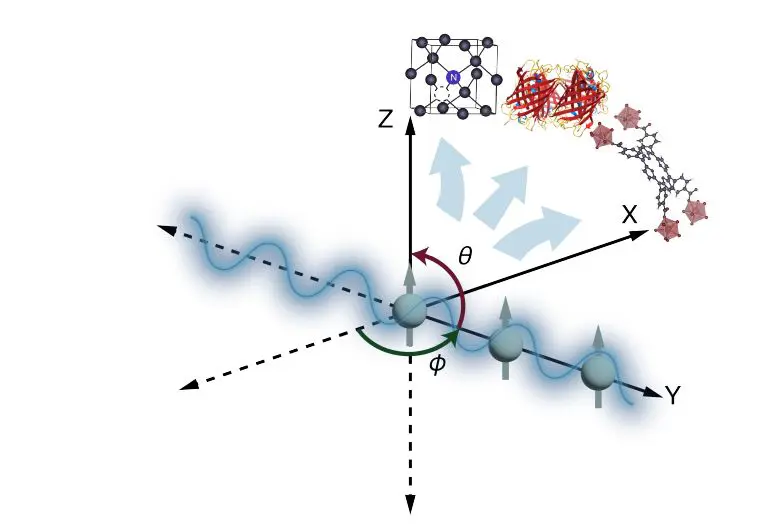
Researchers are developing advanced quantum sensors, with a strong emphasis on Nitrogen-Vacancy (NV) centers in diamond and, potentially, exciton condensates in two-dimensional materials. This work integrates theoretical modeling with experimental investigations, relying heavily on computational tools for simulation and analysis. A significant portion of the research centers on understanding and optimizing NV centers in diamond, including their fundamental properties, techniques to enhance sensitivity, and applications in magnetic field sensing. Researchers are also exploring molecular aggregates and the phenomenon of exciton condensation, investigating how these systems can be harnessed for quantum sensing. Two-dimensional materials, such as graphene and van der Waals heterostructures, feature prominently, with researchers investigating their potential for hosting exciton condensation and serving as platforms for quantum sensors. The research aims to tune the properties of these materials to optimize their performance in sensing applications, representing a highly interdisciplinary approach to developing novel quantum sensors with enhanced sensitivity and accuracy.
Amplifying Quantum Signals via Entangled Multi-Qubit States
Entanglement Amplifies Multi-Qubit Sensing Signals
Optimizing Multi-Qubit Sensing via Entanglement States
Researchers have demonstrated a pathway to enhance multi-qubit quantum sensing by preparing a collective state exhibiting strong particle-hole entanglement. Computational results show that this state amplifies transitions between spin states, potentially leading to stronger optical signals crucial for sensitive measurements. A key signature of this enhanced state is a large eigenvalue within the particle-hole reduced density matrix, serving as an entanglement witness analogous to long-range order observed in other condensed matter systems. The team established that this collective state, characterized by robust entanglement, can be realized in systems of spin qubits interacting via magnetic dipole interactions.
Importantly, the amplification of transitions is maximized at specific geometries where particle-hole condensation is strongest, suggesting a design principle for optimizing sensor performance. Calculations indicate that this entanglement enhancement persists even in the presence of noise, supporting the feasibility of experimental realization in realistic conditions. This work connects seemingly disparate phenomena, drawing parallels between the observed entanglement and collective effects in systems like photosynthetic light-harvesting complexes and molecular J-aggregates, offering a unifying framework for understanding correlated quantum states. Ultimately, this research presents a strategy for harnessing entanglement to create high-precision quantum sensors.
🗞 Entanglement Witnesses of Condensation for Enhanced Quantum Sensing
🧠 ArXiv: https://arxiv.org/abs/2511.17749
Engineering Practical Entanglement Witness Operation
The practical realization of these entanglement witnesses necessitates precise control over the spin qubit coupling architecture. Operationally, the witnesses are constructed from linear combinations of collective spin operators, allowing the detection of non-local quantum correlations that are otherwise masked by environmental coupling. From a Hamiltonian perspective, the collective enhancement arises from stabilizing a quasi-condensed bosonic mode whose effective interaction strength scales with the number of participating qubits, thereby exceeding the standard quantum limit (SQL) dictated by independent measurements.
A critical engineering challenge remains the robust suppression of local dephasing mechanisms, especially at ambient temperatures. Achieving maximum quantum enhancement requires coupling the spin qubits into a highly coherent regime, often demanding superconducting or microwave cavities to mediate the exchange interaction. Furthermore, mitigating inhomogeneous broadening, which stems from variations in local magnetic fields across the qubit ensemble, is essential for maintaining the coherence time necessary for accurate witness measurements.
Beyond pure magnetic sensing, the theoretical framework established here has profound implications for quantum metrology across varied platforms. The concept of condensation-enhanced entanglement can be adapted to improve measurements in other quantum systems, such as superconducting circuits or optical lattice arrays. This scalability suggests a paradigm shift away from single-qubit measurement limits, pushing the boundaries toward sensing capabilities comparable to, or exceeding, next-generation atomic clocks.