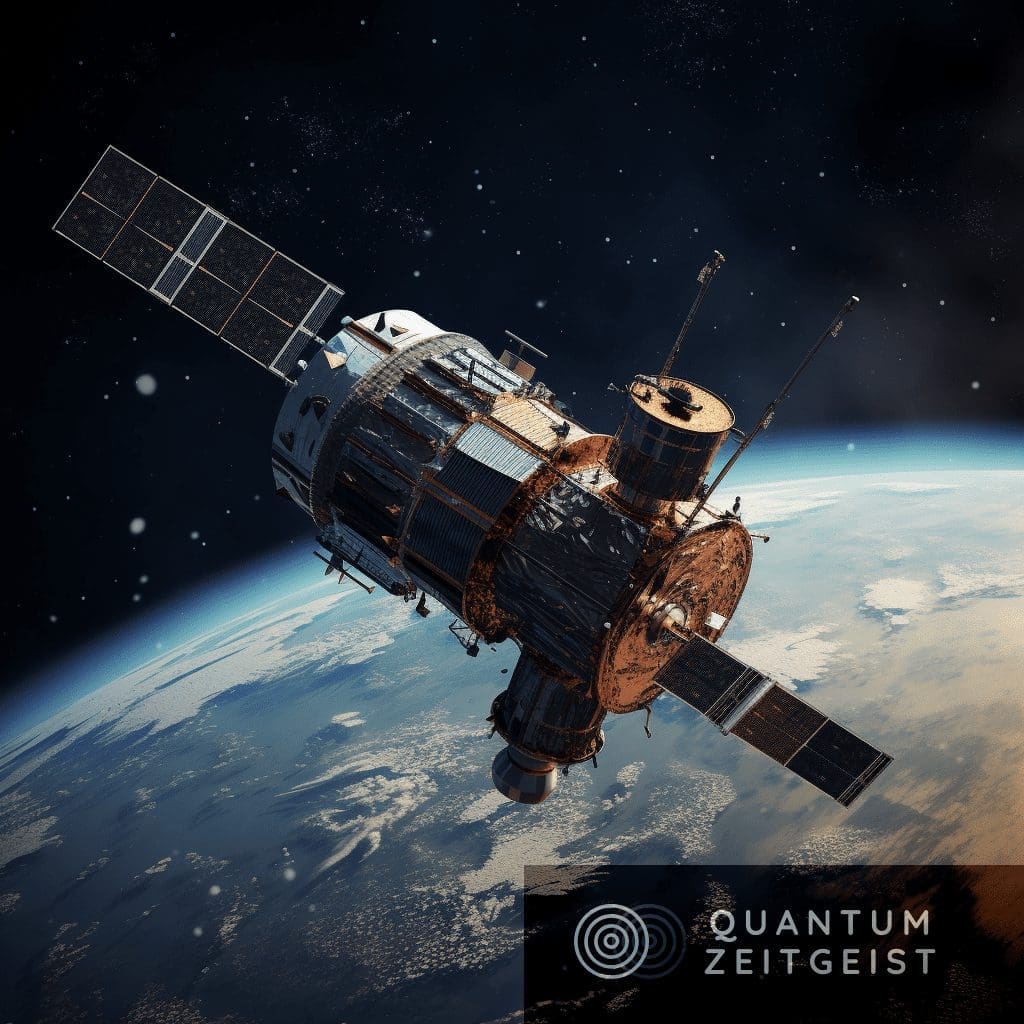
Quantum entanglement, a phenomenon where two particles remain connected regardless of distance, is key to future space applications. Scientists used the European Space Agency’s research platforms to test its robustness. They subjected quantum hardware to various conditions, including a car trip through Vienna’s hilly outskirts and a drop from a tower at the Technical University of Dresden. The hardware also experienced extreme accelerations in a centrifuge in Ranshofen, Austria. These tests aimed to study gravitational effects on quantum systems and explore the relationship between relativity and quantum physics.
Quantum Entanglement: A Key to Future Space Applications
Quantum entanglement, a phenomenon that occurs at subatomic scales, is a critical component in developing quantum technology. This process involves two particles, such as a pair of photons, remaining connected even when separated by vast distances. Once entangled, these particles can be used in various applications, including quantum computers, quantum teleportation, and secure data exchange.
Testing Quantum Hardware in Various Environments
For quantum technology to be practical, the hardware must be able to withstand a variety of environments, ranging from everyday situations like being in your pocket to more extreme conditions like being in a spacecraft in orbit. To test the durability of quantum entanglement, scientists turned to the European Space Agency’s research platforms.
Quantum Hardware: From Bumpy Roads to Weightlessness
In an effort to push the boundaries of quantum technology, scientists subjected their hardware to a series of rigorous tests. The aim was to study the subtle gravitational effects on a quantum system and explore the connections between relativity and quantum physics. This research could potentially help us understand the fluctuations responsible for the large-scale structure of the Universe.
In one test, a quantum setup was taken on a car trip through Vienna, Austria, and its hilly outskirts. The journey included sharp turns and bumpy roads, with the hardware experiencing acceleration in all directions. This test demonstrated the robustness of the electronics and apparatus involved in quantum technology.
Quantum Hardware: From Tower Drops to Centrifuge Spins
In another test, the quantum hardware was dropped from a tower at the Technical University of Dresden, Germany, and spun in a centrifuge in Ranshofen, Austria. During these tests, the hardware experienced accelerations as little as 30 mg and as much as 30 g – 1000 times less and 30 times more gravity than you experience while reading this sentence. These tests further demonstrated the robustness of quantum hardware, showing its potential for use in a variety of environments and applications.
Quantum Technology: A Robust Future
These tests show that quantum technology, and specifically quantum entanglement, is robust and versatile. It can withstand a variety of environments and conditions, making it a promising technology for future applications in space and beyond. As we continue to explore the connections between relativity and quantum physics, we may gain a deeper understanding of the Universe’s large-scale structure.
Summary
Quantum entanglement, a phenomenon where two particles remain connected regardless of distance, is being tested for its robustness in various environments, including during a car trip and a drop from a tower, to understand its potential in quantum computing and secure data exchange. These tests aim to study the effects of gravity on a quantum system, which could further our understanding of the large-scale structure of the Universe.
- Quantum entanglement, a phenomenon where two particles remain connected regardless of distance, is key to future space applications, including quantum computers and secure data exchange.
- Scientists are testing the robustness of quantum hardware to ensure it can withstand various environments, from everyday use to space travel.
- The European Space Agency‘s research platforms were used to test the hardware’s resilience to gravitational effects and explore the relationship between relativity and quantum physics.
- Initial tests involved a car trip through Vienna, Austria, where the hardware was subjected to sharp turns and bumpy roads, demonstrating the robustness of the electronics.
- Further tests were conducted at the Technical University of Dresden, Germany, and in Ranshofen, Austria, where the hardware was dropped from a tower and spun in a centrifuge, experiencing extreme variations in gravity. These tests are crucial in understanding the large-scale structure of the Universe.