

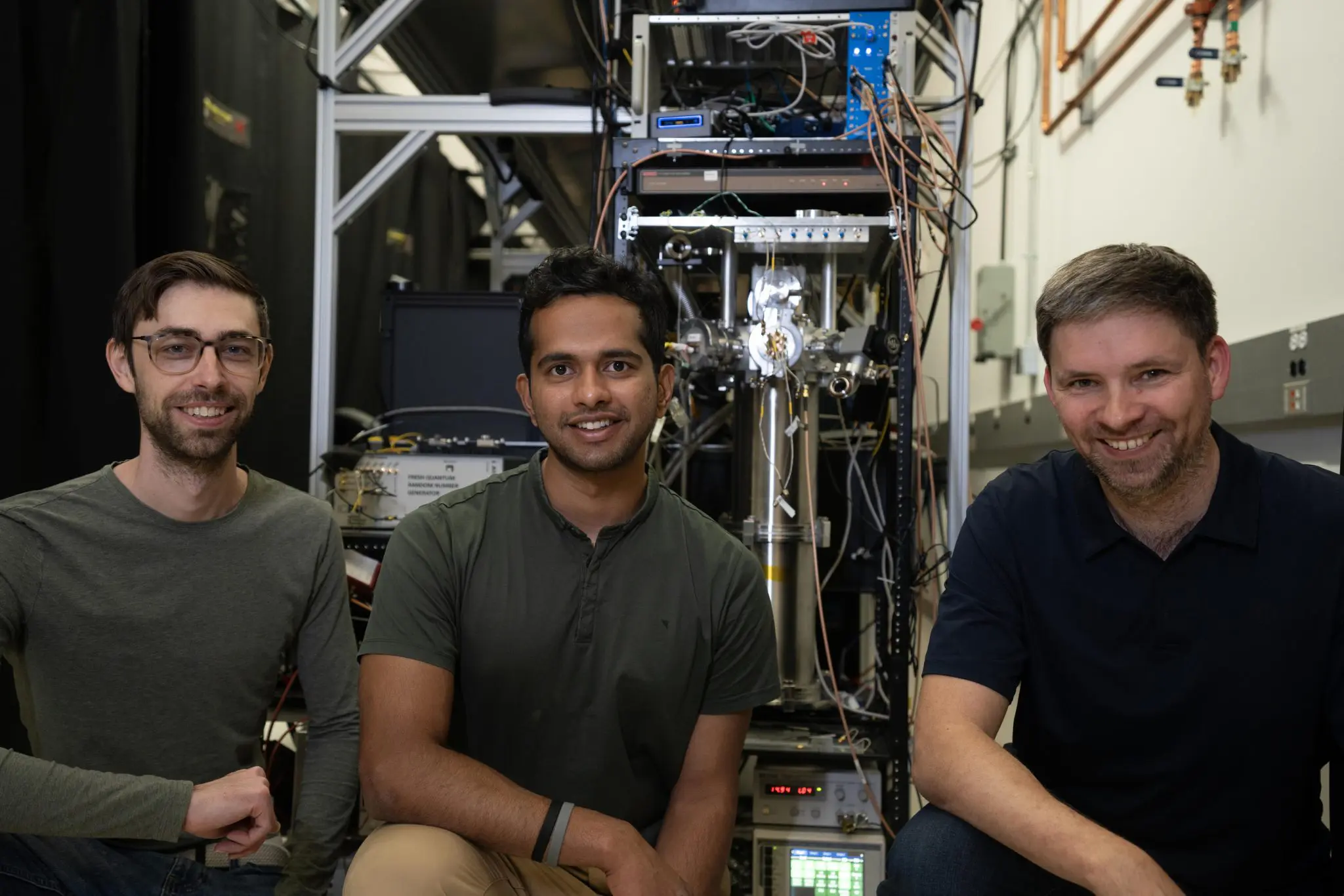
The National Institute of Standards and Technology (NIST), in collaboration with the University of Colorado Boulder, has established the Colorado University Randomness Beacon (CURBy), the first publicly accessible random number generator underpinned by quantum entanglement. This novel service leverages the inherent randomness of quantum mechanics to produce verifiable and demonstrably unbiased numbers, broadcast freely as a public resource. Unlike conventional random number generators reliant on computational algorithms, CURBy’s foundation in quantum nonlocality – a phenomenon Einstein famously termed ‘spooky action at a distance’ – offers a fundamentally secure and transparent source of randomness applicable to diverse fields, from secure lotteries to impartial jury selection. The project represents a significant milestone, delivering a ‘provable quantum advantage’ in the realm of data generation and establishing a new standard for trust and transparency in random number services.
NIST and its collaborators transformed a fundamental principle of quantum physics – inherent randomness – into a publicly accessible service, the Colorado University Randomness Beacon (CURBy). This beacon generates random numbers using a NIST-developed protocol and broadcasts them daily for unrestricted use, addressing the need for verifiable and unbiased randomness in various applications.
At the core of CURBy is a NIST-run Bell test, a quantum experiment that leverages the phenomenon of entangled photons. These entangled pairs exhibit correlated properties even when physically separated, and measuring one particle yields a truly random outcome. This randomness isn’t simply statistical; it’s fundamentally guaranteed by the laws of quantum mechanics, unlike the pseudo-randomness generated by conventional computer algorithms.
The process begins with generating entangled photon pairs
The process begins with generating entangled photon pairs within a nonlinear crystal. These photons travel via optical fiber to separate laboratories, where their polarization is measured. This measurement process is repeated 250,000 times per second, generating a continuous stream of random data. Millions of these quantum “coin flips” are then processed by a computer program at the University of Colorado Boulder.
Converting these quantum correlations into usable random numbers required significant engineering. Initial Bell test demonstrations were time-consuming and yielded limited data. The team spent years automating and robustifying the experiment, achieving a 99.7% success rate in its first 40 days of operation, producing random numbers 7,434 times out of 7,454 attempts.
CURBy incorporates the Twine protocol to ensure data traceability and security throughout the random number generation process. Developed by NIST researchers, Twine utilizes quantum-compatible blockchain technologies, enabling collaborative randomness generation and certification based on the Bell test results.
Central to Twine’s functionality is the assignment of a unique hash to each dataset produced by the beacon. These hashes, a core component of blockchain technology, function as digital fingerprints, allowing for identification and scrutiny of each data block. This system allows any user to verify the data underpinning each random number generated, enhancing transparency and trust.
The Twine protocol isn’t limited to a single beacon; it’s designed for scalability. The protocol can accommodate the integration of additional random number beacons, creating a network of interconnected randomness where multiple entities contribute, but no single entity maintains control. This expansion creates a distributed and resilient system for generating verifiable randomness.
By intertwining these hash chains, Twine establishes a
By intertwining these hash chains, Twine establishes a timestamped, traceable data structure. This interconnectedness also provides a robust security mechanism, enabling participants to immediately detect any attempts at data manipulation. The system’s design prioritizes data integrity and allows for rapid identification of compromised data sets.
Jasper Palfree, a research assistant on the project, describes Twine as a means of “weaving together” multiple beacons into a “tapestry of trust.” This collaborative approach strengthens the overall security and reliability of the random number generation process, fostering confidence in the generated outputs.
The open-source nature of the project and the availability of all code and data encourage public scrutiny and further development. CURBy is designed for broad applicability, including uses such as selecting jury candidates, conducting random audits, and assigning resources through public lotteries, providing a reliable and verifiable source of randomness for a variety of critical applications.
External Link: Click Here For More


