On April 15, 2025, a study titled ‘Transforming Resonance Fluorescence into Maximally Entangled Photon Pairs Using Minimal Resources’ demonstrated an efficient method for creating entangled photons with minimal resources, verified through a Bell inequality test.
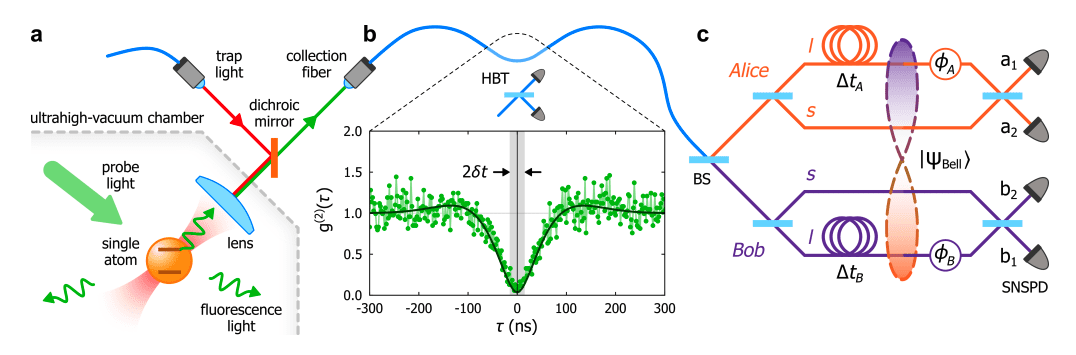
The research demonstrates that resonance fluorescence from a weakly coupled two-level emitter can be transformed into a stream of maximally entangled photon pairs in the time-bin basis using beam splitters, delay lines, and post-selection. The entanglement was confirmed via a CHSH-type Bell inequality test, achieving an S-parameter of 2.80 ± 0.19, which represents a clear violation of the classical bound by over 4σ. This result advances the development of efficient sources for bandwidth-limited time-bin entangled photons, critical for quantum technologies in communication and sensing.
Generating High-Fidelity Bell States with Franson Interferometers: Advancing Quantum Computing
In a significant advancement in quantum computing research, scientists have successfully generated high-fidelity Bell states using Franson interferometers. This achievement represents a crucial step toward more reliable and scalable quantum systems.
The experiment involved creating entangled photon pairs through an interferometer with two arms of differing lengths. By leveraging interference effects based on the photons’ arrival times at detectors, the researchers were able to entangle them. The photon streams were then categorized into four distinct states: |ss, |sl, |ls, and |ll. This innovative approach allowed for the characterization of entanglement without the need to measure every possible basis, effectively addressing experimental limitations.
The fidelity of the generated Bell state was measured at 0.87 ± 0.02, indicating a high degree of similarity to the ideal state. This level of fidelity is essential for quantum computing tasks that require robust entanglement. To ensure the reliability of their results, the researchers employed statistical methods, including the addition of Poissonian noise and multiple reconstructions of the density matrix.
The implications of this research extend to both quantum computing and communication. High-fidelity entangled states are fundamental for quantum error correction, fault-tolerant operations, and applications such as quantum key distribution and teleportation. The use of Franson interferometers offers a novel approach compared to traditional methods, potentially enhancing efficiency in integrating with existing quantum systems.
While the study acknowledges some limitations in directly measuring all expectation values, it provides a robust framework for state characterisation through indirect methods. This research not only contributes to the field of quantum optics but also opens avenues for practical applications in scalable quantum technologies.
In conclusion, this experiment demonstrates a reliable method for generating high-fidelity Bell states, underscoring the potential of Franson interferometers as tools in advancing quantum computing and communication technologies. The innovative techniques and rigorous statistical analysis highlight the importance of this contribution to the field.
👉 More information
🗞 Transforming Resonance Fluorescence into Maximally Entangled Photon Pairs Using Minimal Resources
🧠 DOI: https://doi.org/10.48550/arXiv.2504.11294