

Generating entanglement is crucial for quantum technologies, yet repeated measurements usually disrupt this delicate process. Surajit Bera, Igor V. Gornyi, Sumilan Banerjee, and Yuval Gefen investigate a surprising phenomenon, demonstrating that entanglement can actually be generated through a carefully designed series of local measurements, even without any underlying unitary dynamics. The team constructs a model involving interconnected chains of particles and shows that volume-law entanglement, a robust and scalable form of quantum connection, emerges purely from these non-commuting measurements. Remarkably, this strong entanglement arises from measuring only single-particle properties, and the researchers further demonstrate control over the process by introducing constraints through measurements of more complex properties, opening new avenues for controlled entanglement generation and the exploration of non-unitary quantum dynamics.
Continuous Measurement Drives Entanglement Transitions
This collection of research papers explores measurement-induced phase transitions (MIPTs) and related topics in quantum physics, focusing on entanglement, many-body localization, and the effects of continuous monitoring. The studies reveal how continuous measurement can drive transitions in a quantum system, altering its entanglement structure, and represent a departure from traditional thermodynamic phase transitions, focusing instead on changes in information content and correlations. A central theme is the quantification of entanglement, with researchers investigating various measures to characterize phases and transition points. The concept of the area law for entanglement frequently appears throughout the research.
Many studies explore the interplay between MIPTs and many-body localization, investigating whether monitoring can drive a system into an MBL phase or disrupt existing localization. Random quantum circuits serve as a common model system, allowing for statistical analysis. Researchers are increasingly recognizing the connection between MIPTs and other many-body phenomena like MBL and topological order, and are addressing computational challenges by developing efficient numerical methods and simulations. Research focuses on the impact of ancilla measurements and the possibility of measurement-induced topological phases. Stochastic resetting is also investigated as a way to control MIPTs. This field is evolving, moving towards controlling and harnessing MIPTs for quantum technologies, with scientists developing new mathematical tools and concepts to understand these transitions.
Entanglement Generated Through Repeated Quantum Measurements
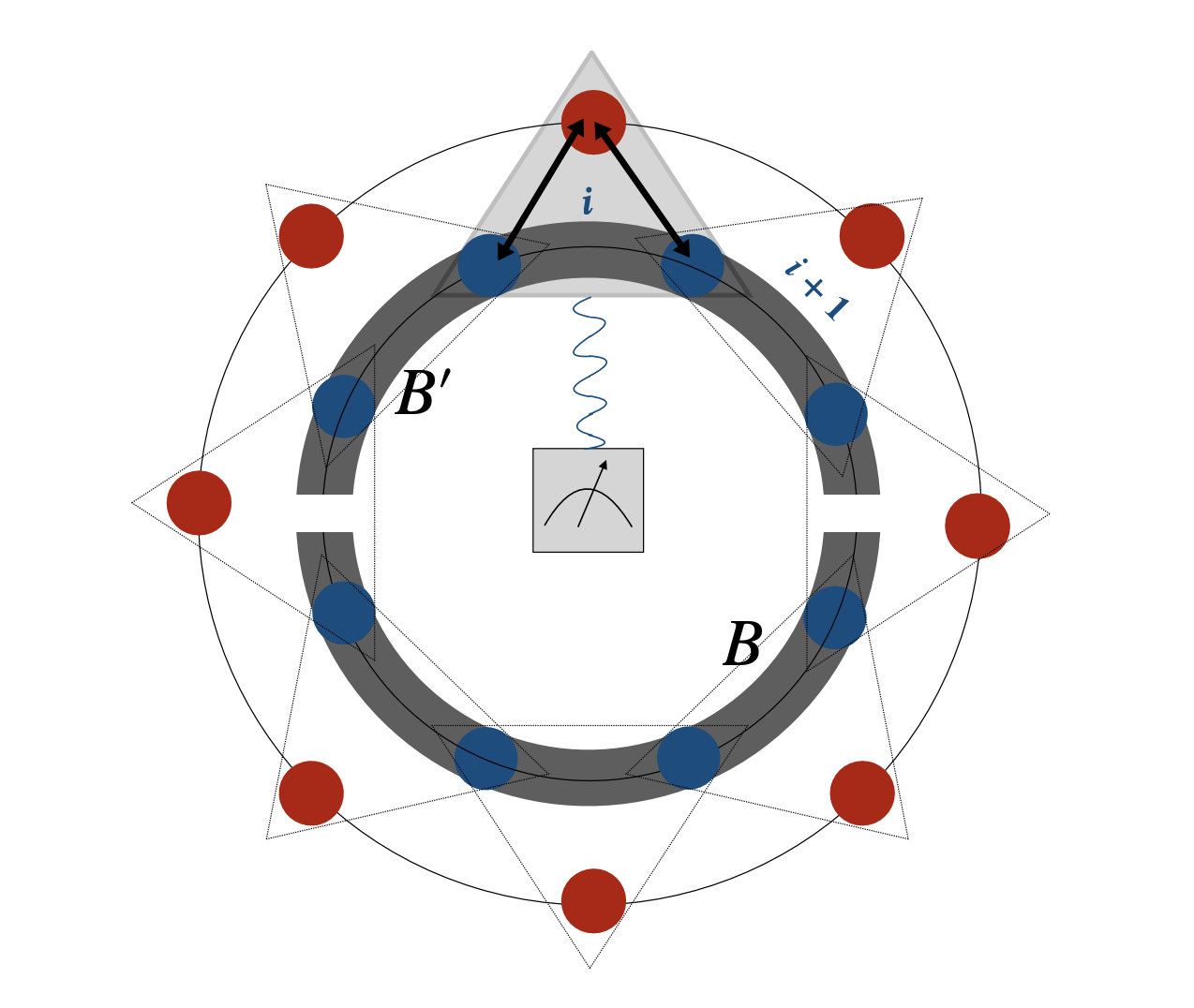
Scientists have engineered a novel approach to quantum dynamics, demonstrating that strong entanglement can be generated solely through repeated measurements, without relying on intrinsic system evolution. This work pioneers a measurement-only dynamics framework, challenging conventional understandings of entanglement generation. The study centers on a one-dimensional system comprising a main fermionic chain and an auxiliary chain, coupled to detector qubits. Crucially, the system lacks inherent unitary dynamics; entanglement arises entirely from the measurement process itself. The experimental setup involves a carefully orchestrated sequence of interactions and projections.
Detector qubits are coupled to the main and ancilla chains via quadratic hopping terms, establishing a connection between the system and the detectors. Following this interaction, a projective measurement is performed on each detector qubit, yielding a binary outcome. Researchers repeated these measurement steps numerous times, effectively driving the system towards a stationary state. By analyzing the statistics of entanglement measures, the team demonstrated the generation of volume-law entangled states between segments of the main chain. Remarkably, this strong entanglement was achieved using only measurements of one-body operators, simplifying experimental requirements. Scientists explored the use of higher-body operators to introduce kinetic constraints, allowing for control over entanglement generation. This measurement-only framework offers a powerful means of controlling entanglement, potentially enabling the engineering of complex quantum phases and the exploration of non-unitary dynamics.
Entanglement Generated Solely by Local Measurements
Scientists have demonstrated the generation of highly entangled quantum states solely through local measurements, without inherent unitary dynamics, challenging conventional understandings of measurement’s role in quantum systems. The research team constructed a one-dimensional model comprising a main fermionic chain and an auxiliary chain, performing generalized measurements by locally coupling the system to detector qubits. Results demonstrate the creation of long-time states exhibiting volume-law entanglement between parts of the main chain, achieved purely through non-unitary measurement dynamics. Remarkably, the team achieved this large-entanglement generation using only measurements of one-body operators, a significant departure from previous work.
Further experiments revealed that measurements of non-local higher-body operators can control and reduce entanglement generation by introducing kinetic constraints. The study meticulously analyzed the statistics of entanglement measures, revealing the approach to stationary distributions of entanglement and associated limited ergodicity within the measurement-only dynamics. This work establishes that volume-law entanglement, previously associated with interacting systems, can be selectively generated through carefully designed local measurements in a non-interacting system. The generated states exhibit volume-law scaling, meaning the entanglement entropy grows proportionally to the volume of the system. This breakthrough delivers a new understanding of non-unitary many-body dynamics and highlights the potential of non-random measurement protocols for controlled entanglement generation.
Entanglement Grows From Repeated Local Measurements
This research demonstrates the generation of substantial entanglement through a novel approach based solely on repeated local measurements, without relying on intrinsic unitary dynamics. Scientists successfully created long-lived, highly entangled states in a one-dimensional system comprised of a main chain and an auxiliary chain, by performing non-commuting measurements that locally couple the system to detector qubits. Importantly, this significant level of entanglement was achieved using measurements of simple, one-operator terms, revealing an unexpectedly efficient pathway to complex quantum states. The team further showed that entanglement generation can be controlled and reduced by incorporating measurements of more complex, non-local operators, effectively introducing constraints into the measurement process.
The study establishes that the probability distribution of entanglement entropy converges to stable, stationary distributions over time, regardless of the initial quantum state of the system. However, researchers also identified a limited form of ergodicity, finding that while entanglement distributions along individual trajectories align with those obtained from ensembles of trajectories, the specific stationary distributions differ depending on the initial state. This suggests that while the measurement process consistently generates entanglement, the precise characteristics of the resulting entangled state are sensitive to the system’s starting conditions.
🗞 Generation of Volume-Law Entanglement by Local-Measurement-Only Quantum Dynamics
🧠 ArXiv: https://arxiv.org/abs/2509.14329


