Quantum entanglement, a cornerstone of quantum mechanics, presents a significant challenge for educators due to its abstract and counterintuitive nature, but a new interactive tool promises to make this complex phenomenon more accessible. Researchers led by B. Folkers, A. van Rossum from the MESA+ Institute for Nanotechnology at the University of Twente, and A. Brinkman, alongside H. K. E. Stadermann, have developed electronic ‘quantum dice’ that visualise core principles through both tactile and visual feedback. These devices, representing six-state quantum systems, demonstrate superposition and measurement, and crucially, can simulate entangled states exhibiting anti-correlated outcomes, a key signature of entanglement. Initial trials with students suggest that the tangible and visual nature of these dice fosters intuitive understanding of these fundamental quantum concepts, offering a powerful new approach to science education.
Quantum States, Entanglement and Bell’s Theorem
Researchers are actively developing innovative approaches to teach quantum mechanics, focusing on core concepts and employing diverse educational tools. Investigations encompass fundamental principles, including the behaviour of qubits and two-level quantum systems, often visualized using the Bloch sphere, and methods for accurately characterizing quantum states through quantum state tomography. A significant area of study involves quantum entanglement and Bell’s theorem, exploring the implications of entanglement for our understanding of reality, with applications in quantum cryptography, secure communication methods, and quantum computing. Educational strategies include the ‘spins-first’ approach, prioritizing understanding spin concepts, and employing interactive simulations, material anchors, and game-based learning to enhance engagement and comprehension.
Researchers leverage virtual reality to create immersive learning environments and develop cost-effective demonstrations, using multiple-choice questions and modular kits for assessment and hands-on experiments. This work relies on tools and technologies including interactive simulations, virtual reality headsets, and 3D printing for creating physical models, alongside intense light sources, polarization optics, computers, and specialized software for simulations and data analysis. Researchers employ systematic literature reviews, concept inventories, and pre/post-tests to measure learning gains, while qualitative analysis helps understand student perspectives and experimentation validates theoretical concepts. The development of educational materials and usability testing ensures effectiveness and accessibility. Software plays a crucial role, enabling quantum circuit simulation, data visualization, virtual reality development, and 3D modelling, advancing both our understanding of quantum mechanics and our ability to effectively teach these complex concepts.
Entangled Dice Simulate Quantum Measurement Principles
Scientists have engineered interactive electronic dice to simulate core principles of quantum physics, addressing the challenge of teaching abstract concepts like entanglement. Each die represents a six-state quantum system, displaying all possible outcomes simultaneously to represent superposition before a roll, and then displaying a single value between 1 and 6 with equal probability, mimicking quantum measurement. Researchers implemented entanglement through careful programming, enabling a correlated state between two dice where rolling both with the same colour on top always yields a sum of 7, despite individual outcomes remaining unpredictable. The dice operate in three colour bases, allowing students to explore how measurement choices affect observed correlations, and represent a tangible approach to quantum education beyond elaborate optical setups or virtual simulations. The design aligns with Model Based Learning principles, enabling students to construct, test, and refine mental models of quantum phenomena through direct interaction, supporting embodied cognition and reducing cognitive load through multimodal sensory engagement. By focusing on simple quantum systems, the team adhered to the spin-first approach, prioritizing conceptual understanding, and made all hardware files and code open source for wider adoption.
Tangible Dice Simulate Quantum Superposition and Measurement
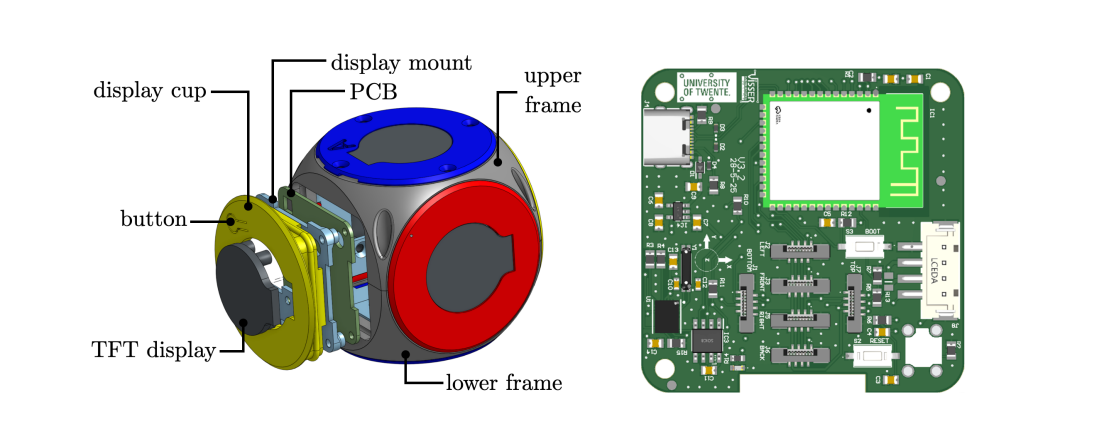
Scientists have developed interactive electronic dice to simulate quantum phenomena, offering a tangible way to understand complex concepts like superposition and entanglement. Each die features six faces with circular LCD displays, representing a six-state quantum system, and displays overlapping, semitransparent numbers to visually represent a superposition of all possible outcomes. Rolling the die simulates a measurement, with the upward-facing side indicating the outcome in its corresponding colour basis. When two dice are brought close, they enter an entangled state, represented by a colour shift in the superposition display, behaving as a single quantum system.
Experiments reveal that measurements on the entangled dice exhibit anti-correlation; when rolled in the same colour basis, the outcomes never match but always sum to seven. Each die measures 76x76x76 mm³ and operates on a rechargeable battery, with a complete set costing approximately €200, utilizing two custom printed circuit boards for reliability and wireless communication for proximity detection. The complete design files and software are open source, enabling widespread adoption and further development.
Quantum Dice Demonstrate Core Principles Visually
This research presents interactive electronic dice designed to simulate core concepts in quantum mechanics, specifically superposition, measurement, and entanglement. Each die represents a quantum system, and pairs can be prepared to demonstrate anti-correlated outcomes when measured in the same basis, mirroring the behaviour of entangled particles. The platform supports demonstrations ranging from basic quantum principles to simplified key distribution protocols, offering a tangible and visual approach to understanding these abstract concepts, and has shown effectiveness in aiding intuitive model formation in initial implementations with students. Effective implementation requires careful guidance from educators to ensure learners appropriately connect the dice’s mechanisms to authentic quantum systems, while understanding the limitations of the analogy. Future work includes developing detailed teaching guides and exploring expanded applications, such as simulating quantum teleportation, and a follow-up study will investigate how learners map the dice’s mechanisms onto quantum systems and how teachers integrate the platform into their lessons. The researchers provide open-source designs and code.
🗞 Visualising Quantum Entanglement Using Interactive Electronic Quantum Dice
🧠 ArXiv: https://arxiv.org/abs/2510.04931