

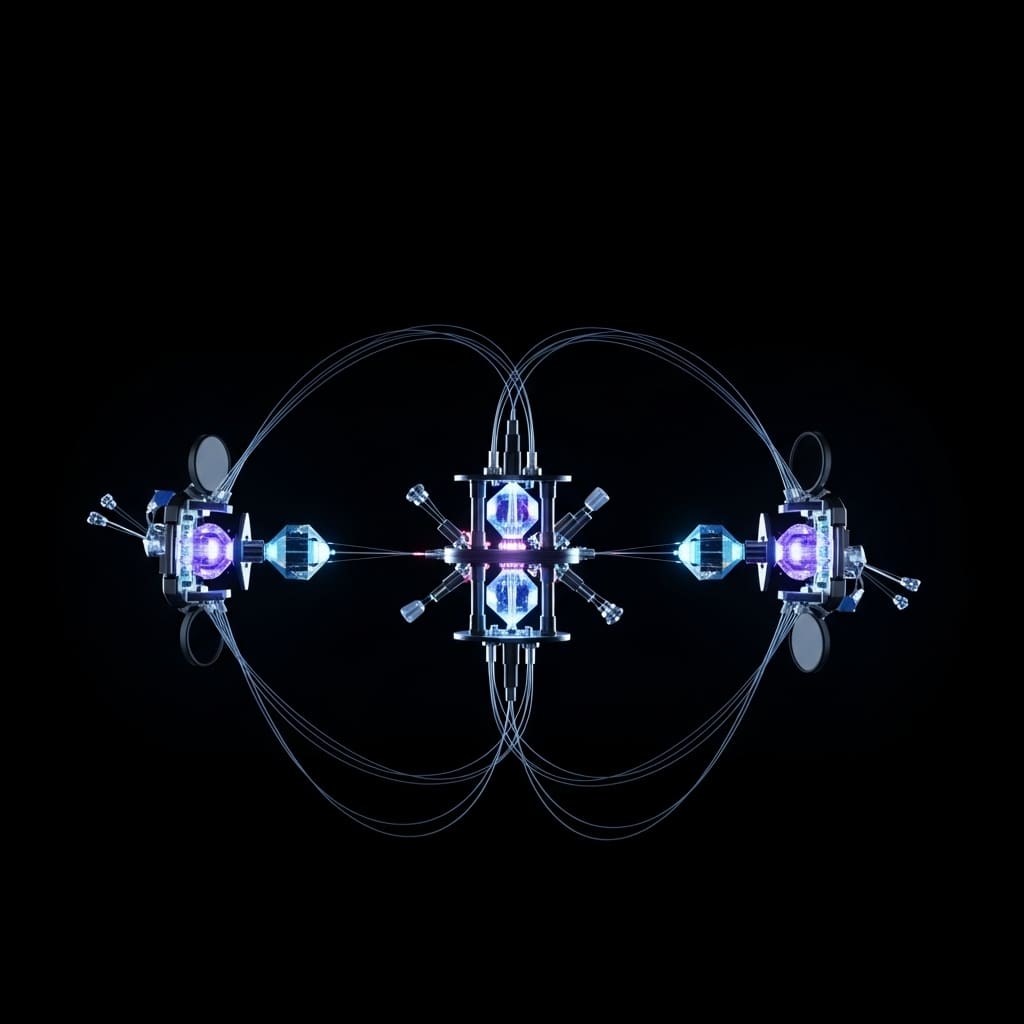
Quantum communication relies on distributing entanglement over long distances, a task hampered by signal loss, and researchers continually seek methods to extend the range and reliability of these connections. Hany Khalifa and Matti Silveri, from the University of Oulu, alongside their colleagues, now present a new approach to building quantum repeaters, devices that overcome these limitations. Their work details a gate-based microwave quantum repeater that utilises encoded bosonic grid states and a unique architecture for generating and swapping entanglement. This innovative design moves beyond traditional probabilistic methods, achieving deterministic entanglement generation and significantly reducing losses associated with signal routing, ultimately paving the way for more secure and efficient quantum communication networks, and demonstrating success probabilities exceeding those of conventional linear optics-based systems.
Their work details a gate-based microwave quantum repeater that utilises encoded bosonic grid states and a unique architecture for generating and swapping entanglement. This innovative design achieves deterministic entanglement generation, significantly reducing signal loss and paving the way for more secure and efficient quantum communication networks, demonstrating success probabilities exceeding those of conventional systems.
GKP Qubits Enable Long Distance Entanglement
This research details a quantum repeater architecture based on Gaussian-modulated coherent states, known as GKP qubits, and outlines the calculations for achieving long-distance entanglement. GKP qubits offer a degree of protection against certain types of noise, making them suitable for quantum communication. The system creates entanglement between adjacent repeater segments, calculating overlaps between GKP states to maximize fidelity. Entanglement swapping, performed using controlled-Z gates and projective measurements, extends entanglement over longer distances. The research addresses practical challenges like channel losses, gate errors, and detector imperfections, calculating success probabilities and fidelities to assess the protocol’s feasibility.
Key findings demonstrate that GKP qubits are a promising candidate for quantum repeaters due to their robustness. Entanglement swapping is essential for extending communication range, and error mitigation is crucial for practical implementation. Detailed calculations are necessary for performance analysis, making this research a valuable resource for those working in quantum communication and computing.
Bosonic Encoding Extends Qubit Lifetime Significantly
Researchers have demonstrated a new approach to quantum communication using encoded bosonic states within a gate-based microwave quantum repeater. The team designed a system where quantum information is stored and transmitted using these states, extending the lifetime of the logical qubit beyond that of its physical components without requiring continuous measurement. This advancement relies on a novel architecture employing transmon qubits and bosonic resonators, enabling deterministic entanglement generation and swapping, a significant improvement over probabilistic methods.
The key achievement lies in the development of an all-bosonic entanglement swapping Bell-state measurement, circumventing losses associated with traditional systems and confining them to stationary storage. Through simulations, the researchers demonstrate that their quantum repeater can achieve high entanglement generation and swapping success probabilities, surpassing the performance of existing methods, suggesting potential for secure chip-to-chip communication and distributed quantum computing. Future research will focus on optimizing system parameters and exploring scalability for longer-distance networks, but the current design represents a substantial step towards practical and efficient quantum repeaters based on readily available superconducting microwave technology.
👉 More information
🗞 Gate-Based Microwave Quantum Repeater Via Grid-State Encoding
🧠 ArXiv: https://arxiv.org/abs/2512.19896

