The fragile nature of quantum entanglement presents a significant challenge to realising the potential of exotic quantum states of matter, such as quantum spin liquids. Federico Garcia-Gaitan from the University of Delaware and Branislav K. Nikolic investigate how entanglement fares when a quantum spin liquid interacts with a realistic, disruptive environment. Their work explores the fate of multipartite entanglement in a prominent model of a quantum spin liquid, the Kitaev model, when suddenly coupled to a surrounding bath of energy. The researchers demonstrate that entanglement persists to surprisingly high temperatures, particularly when the interaction between the quantum spin liquid and its environment is strong and retains a ‘memory’ of past interactions, potentially paving the way for manipulating these materials through careful environmental design.
Kitaev QSLs Coupled to Bosonic Environments
Scientists are investigating how quantum spin liquids (QSLs), exotic states of matter with unusual magnetic properties, respond to interactions with their surroundings. They employ a sophisticated theoretical approach, combining Renormalized Coupling (RC) with polaron transformations, to model these interactions and understand their impact on the QSL’s quantum behavior. The RC method simplifies complex interactions by focusing on the most important connections, effectively “dressing” the QSL with a new bosonic mode to create a polaron, a quasiparticle formed by the interaction of an electron with its surroundings. By projecting the system onto its ground state, researchers derive an effective Hamiltonian that describes the QSL’s behavior after interacting with the environment.
Calculations reveal that local coupling, acting on individual spins, modifies but does not eliminate internal interactions within the QSL. However, global coupling, affecting all spins simultaneously, introduces new interactions, including ferromagnetic exchange. These findings demonstrate that even when coupled to an environment, a QSL’s exotic properties can be preserved, offering insights into the stability of these states in real materials.
Simulating Open Quantum Spin Liquid Dynamics
Researchers are developing more realistic models of quantum spin liquids (QSLs) by simulating their behavior as open quantum systems, acknowledging that real materials inevitably interact with their surroundings. They investigate how entanglement, a key quantum property, is affected by these interactions, using two distinct theoretical approaches to capture different coupling strengths. For weak coupling, scientists utilize the Lindblad quantum master equation to track the evolution of the QSL’s density matrix, modeling the exchange of energy with the surrounding environment and accounting for decoherence effects. When coupling is stronger, where the environment’s influence persists over time, researchers employ tensor network methods to accurately capture the non-Markovian dynamics.
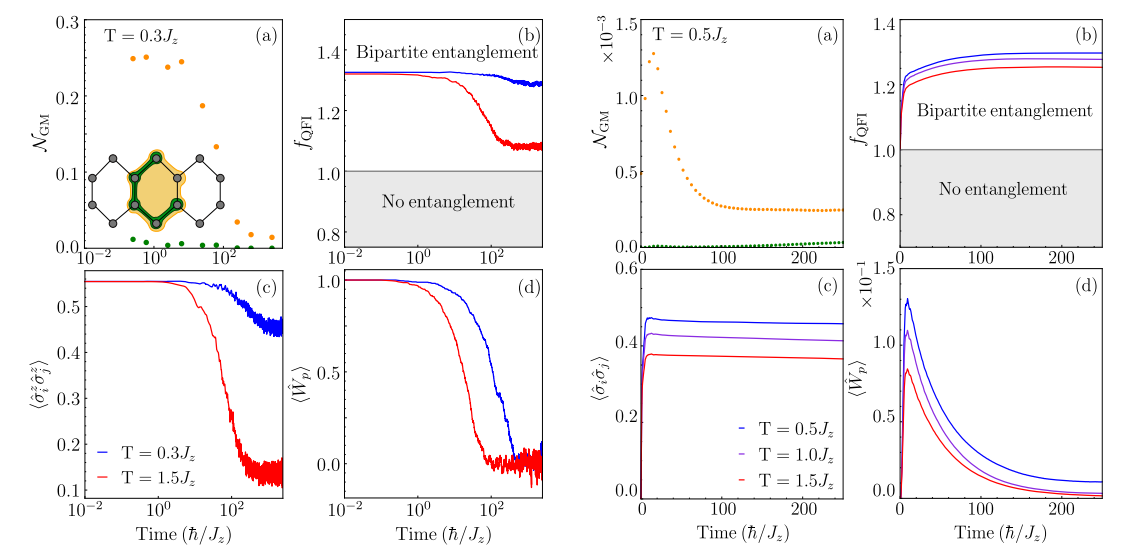
From the time-evolved density matrix, they extract key quantities, including genuine multipartite negativity (GMN), a measure of collective entanglement, quantum Fisher information, and spin-spin correlations. Results demonstrate that GMN remains non-zero in larger, loop-shaped regions of the QSL even at temperatures comparable to the strength of the internal interactions, mirroring recent discoveries in isolated QSL systems. Notably, in the non-Markovian regime, GMN persists to even higher temperatures and extends to smaller, non-loop-shaped regions, indicating enhanced entanglement stability. These findings suggest that non-Markovian dynamics can generate emergent interactions between spins, offering potential avenues for tailoring the properties of QSLs through environmental engineering.
Entanglement Persistence in Interacting Quantum Spin Liquids
Scientists are exploring how entanglement is affected by interactions with the environment in quantum spin liquids (QSLs). They utilize the Lindblad master equation for weak interactions and a tensor network method for stronger interactions, to model both Markovian and non-Markovian dynamics. By measuring genuine multipartite negativity (GMN), a measure of entanglement, researchers investigate how it persists at different temperatures. In the Markovian regime, GMN remains non-zero in larger, loop-shaped regions of the QSL up to temperatures comparable to the strength of the internal interactions, though it gradually diminishes as temperature increases.
Crucially, in the non-Markovian regime, with stronger environmental interactions and “memory effects,” GMN persists to even higher temperatures and remarkably appears in smaller, non-loop-shaped regions where it was previously absent in isolated systems. These calculations reveal that non-Markovian dynamics can generate new interactions between spins, opening possibilities for controlling QSL properties through environmental engineering. Entanglement in both loop-shaped and non-loop-shaped regions is maintained up to a temperature approximately 0. 7times the QSL’s interaction strength, slightly higher than in the Markovian case.
Entanglement Survives Environmental Noise in Spin Liquids
Researchers have demonstrated the surprising resilience of quantum entanglement in quantum spin liquids (QSLs), even when exposed to environmental disturbances. Their work focuses on the Kitaev model and investigates how entanglement behaves when the system interacts with a surrounding environment modeled as a collection of bosonic particles. They employ advanced computational techniques to simulate the evolution of entanglement, specifically using a measure called genuine multipartite negativity, within the spin liquid as it interacts with its surroundings. The results reveal that significant entanglement persists in larger, interconnected regions of the spin liquid at temperatures approaching the strength of the internal interactions, even when the system is subject to relatively weak environmental coupling, a regime known as Markovian dynamics. More remarkably, when the environmental coupling is stronger, leading to more pronounced “memory effects,” entanglement not only survives at higher temperatures but also emerges in smaller, previously unentangled regions of the spin liquid. This suggests that environmental interactions can, counterintuitively, enhance and redistribute entanglement within the system, potentially offering new avenues for controlling and tailoring the properties of quantum spin liquids.
🗞 Fate of entanglement in open quantum spin liquid: Time evolution of its genuine multipartite negativity upon sudden coupling to a dissipative bosonic environment
🧠 ArXiv: https://arxiv.org/abs/2510.02256