The long-standing challenge of unifying gravity with the principles of quantum mechanics receives fresh attention as researchers demonstrate that classical theories of gravity can, in fact, produce quantum entanglement. Joseph Aziz and Richard Howl, both from the Department of Physics at Royal Holloway, University of London, reveal that gravity, even when described by classical physics, possesses the capacity to link particles together in a way previously thought exclusive to quantum phenomena. This discovery stems from a refined understanding of how gravity interacts with matter, showing that it can transmit information necessary to create entanglement through purely physical processes. The findings not only offer a pathway to experimentally test the fundamental nature of gravity, but also provide crucial insights into the parameters and design of experiments aimed at definitively proving its quantum properties.
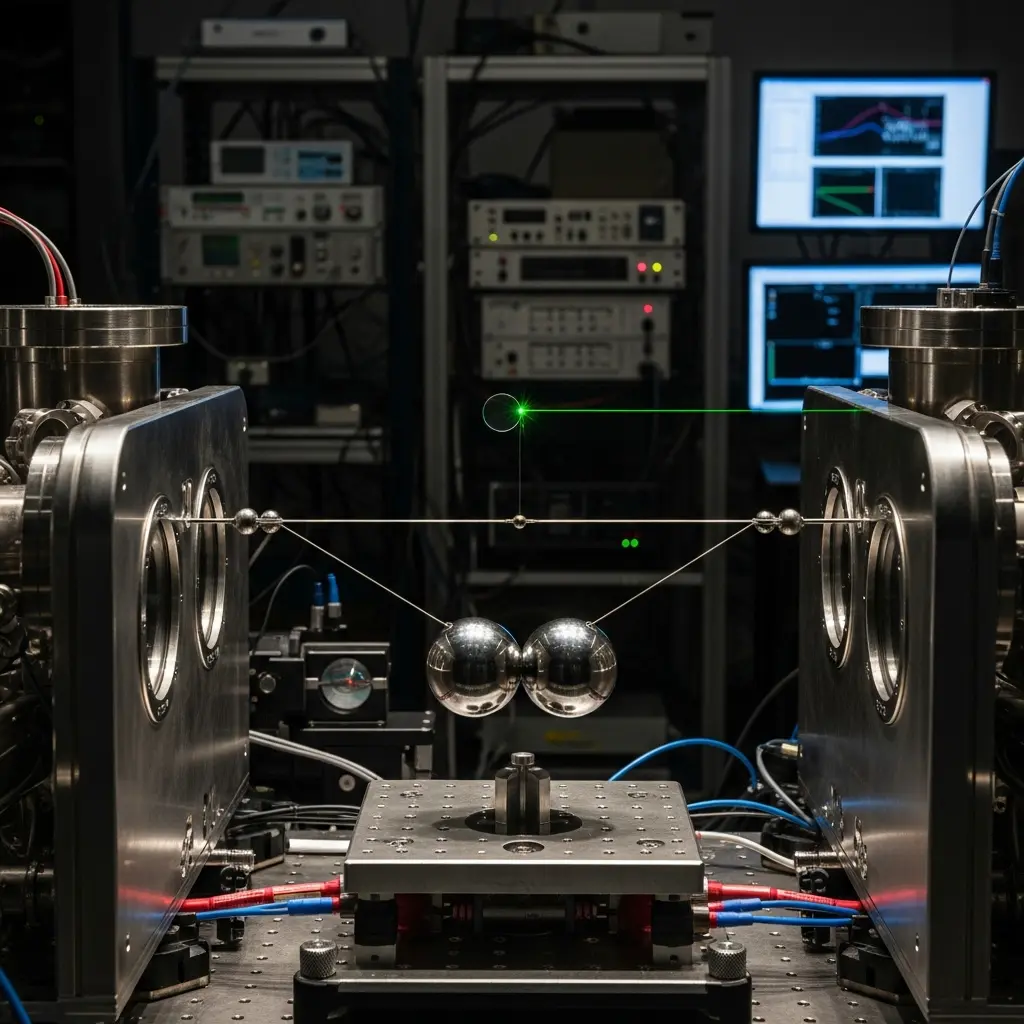
The research involves placing a massive object in a quantum superposition of two locations and allowing it to gravitationally interact with another mass. If the two objects subsequently become entangled, this constitutes unambiguous evidence that gravity obeys the laws of quantum mechanics. This conclusion stems from theorems that treat a classical gravitational interaction as a local interaction, capable of transmitting only classical, not quantum, information. The team extends the description of the gravitational interaction used in these theorems to the full framework of quantum field theory, finding that theories with classical gravity can then transmit quantum information, and thus generate entanglement.
Demonstrating Quantum Gravity through Entanglement
Entanglement Links Gravity and Quantum Mechanics
Experimental Basis for Gravity-Quantum Link
Scientists have achieved a crucial breakthrough in understanding the fundamental relationship between gravity and quantum mechanics, demonstrating a pathway to experimentally test their unification for the first time. The research involves placing a massive object in a superposition of two locations and observing its gravitational interaction with another mass, with the goal of detecting entanglement as evidence that gravity adheres to the laws governing quantum mechanics. Experiments reveal that entanglement arises when the initial light cone of one object encompasses the other, signifying a direct link between gravitational interaction and quantum entanglement. The calculations demonstrate that the quantum phase scales with the mass, experimental duration, and inversely with distance, providing a quantifiable measure of this entanglement.
Furthermore, the study establishes that the amplitude for entanglement is proportional to the integral of the squared wave functions of the objects, divided by the distance between them and the experimental time. This result confirms that entanglement is generated only once the initial light cone of one object contains the other, demonstrating a clear temporal constraint on gravitational entanglement. The research successfully upgrades previous calculations from point particles to spherical objects, providing a more accurate model for realistic experimental conditions. Key numerical findings reveal the conditions under which non-relativistic approximations are valid, and how the free evolution of the system contributes to the final state.
Exploring Theoretical Mechanisms for Entanglement
Entanglement from Virtual Matter Exchange
Generating Entanglement via Virtual Matter Exchange
This research demonstrates that entanglement can arise even within theories that are classically deterministic and locally realistic. The authors demonstrate this through a model where entanglement arises from the exchange of virtual matter particles mediating the gravitational interaction. This is a significant point because it challenges the assumption that entanglement is exclusively a quantum phenomenon. The proposed experiment involves two massive objects in a superposition of positions, and the interaction between these objects, mediated by virtual matter, creates entanglement.
The research addresses concerns about superluminal signaling and locality, acknowledging that traditional semi-classical gravity can lead to inconsistencies. The authors explore ways to modify semi-classical gravity to avoid these inconsistencies without affecting the entanglement effect, including making the collapse postulate relativistic, sourcing gravity from local states of matter, and using reduced density matrices of matter. These modifications do not change the entanglement result, reinforcing the idea that the entanglement isn’t dependent on problematic aspects of classical gravity. The study also considers the challenge of unique signatures for quantum gravity, noting that entanglement can be mimicked by classical models. The authors provide a detailed mathematical explanation of how the modifications to semi-classical gravity do not affect the entanglement calculation, demonstrating that the entanglement arises from the superposition of virtual matter propagators.
Implications of Classical Gravity Generating Entanglement
Impact: Classical Theories Generating Quantum Links
Gravity Entangles Mass Without Quantum Theory
This research demonstrates that theories incorporating classical gravity can, in principle, generate entanglement between massive objects through local physical processes, challenging previous assumptions rooted in quantum information theory. The team extended existing theorems concerning gravitational interactions to the framework of quantum field theory, revealing that classical gravity is not necessarily restricted to transmitting only classical information. This finding suggests that observing entanglement between massive objects does not automatically confirm the need for a fully quantized theory of gravity. The work provides crucial insight into the parameters and experimental design required to robustly test the quantum nature of gravity. By detailing how classical gravity can generate entanglement, the research establishes a clearer benchmark for experiments seeking to definitively demonstrate quantum effects in gravitational interactions.
🗞 Classical theories of gravity produce entanglement
🧠 ArXiv: https://arxiv.org/abs/2510.19714