

Research demonstrates that finite temperature and asymmetry significantly alter entanglement and coherence within a bosonic Josephson junction—a system of interacting atoms in a double-well potential. A phase model accurately describes strong tunneling regimes, enabling analytical calculations using a modified Boltzmann weight and effective temperature.
The behaviour of quantum systems at non-zero temperatures remains a central challenge in condensed matter physics. Understanding how entanglement and coherence – key quantum properties – degrade with increasing thermal fluctuations is crucial for realising practical quantum technologies. Researchers from the University of Padua, SISSA, INFN and CNR have investigated these effects in a specifically engineered system: an asymmetric bosonic Josephson junction. This system, comprising interacting atoms trapped in a double-well potential, provides a tractable model for exploring the interplay between temperature, asymmetry and quantum correlations. In a new study, Cesare Vianello, Matteo Ferraretto, and Luca Salasnich et al. detail their numerical and analytical investigations into the finite-temperature properties of this junction, presenting a refined description of its behaviour, particularly in regimes of strong atomic tunnelling, as outlined in their article “Finite-temperature entanglement and coherence in asymmetric bosonic Josephson junctions”.
Finite Temperature Effects on Asymmetric Bosonic Josephson Junctions
Detailed investigation into the behaviour of bosonic Josephson junctions at finite temperatures reveals the significant influence of both thermal effects and on-site energy asymmetry on quantum characteristics. These junctions, comprising interacting atoms confined within an asymmetric double-well potential, represent a key system in the emerging field of atomtronics – the manipulation of matter waves analogous to electronics.
Researchers employed the two-site Bose-Hubbard Hamiltonian – a standard model in condensed matter physics describing interacting bosons on a lattice – to numerically analyse the junction’s properties. This allowed calculation of several key observables, including spectral decomposition, thermodynamic entropy (a measure of disorder), entanglement entropy (quantifying quantum correlations), population imbalance (the difference in atom number between the two wells), Fisher information (a measure of parameter sensitivity), and coherence visibility (indicating the degree of quantum superposition).
The study establishes a phase model that accurately describes the junction across a range of interaction strengths. This simplification of the complex many-body problem allows for analytical treatment, particularly in the strong tunneling regime – where atoms readily move between the wells. Thermal averages within this regime are calculated using a modified Boltzmann weight, incorporating an effective temperature to account for the system’s thermal state.
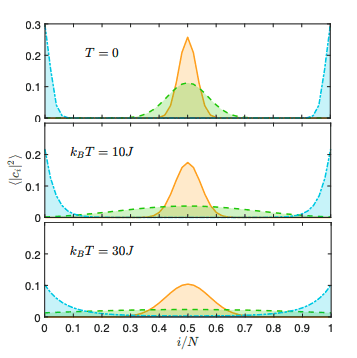
Numerical decomposition of the statistical ensemble of system states confirms that both temperature and asymmetry significantly reduce entanglement and coherence. Increased temperature introduces thermal fluctuations that disrupt quantum correlations. Asymmetry in the on-site energy – the energy experienced by atoms in each well – introduces a bias in the population distribution, favouring occupation of the lower energy well and further diminishing coherence.
The developed phase model effectively captures these effects, providing a valuable tool for predicting and controlling junction performance. This is crucial for the development of atomtronic devices, where precise control of quantum states is paramount.
Researchers suggest the effective description extends beyond the specific model investigated, potentially applicable to other systems exhibiting similar characteristics. This broader applicability enhances the significance of the findings, offering a versatile framework for analysing related quantum systems. Future work will focus on exploring junction behaviour in more complex environments, including the incorporation of external fields and investigation of potential applications in quantum sensing and information processing.
👉 More information
🗞 Finite-temperature entanglement and coherence in asymmetric bosonic Josephson junctions
🧠 DOI: https://doi.org/10.48550/arXiv.2506.06224


