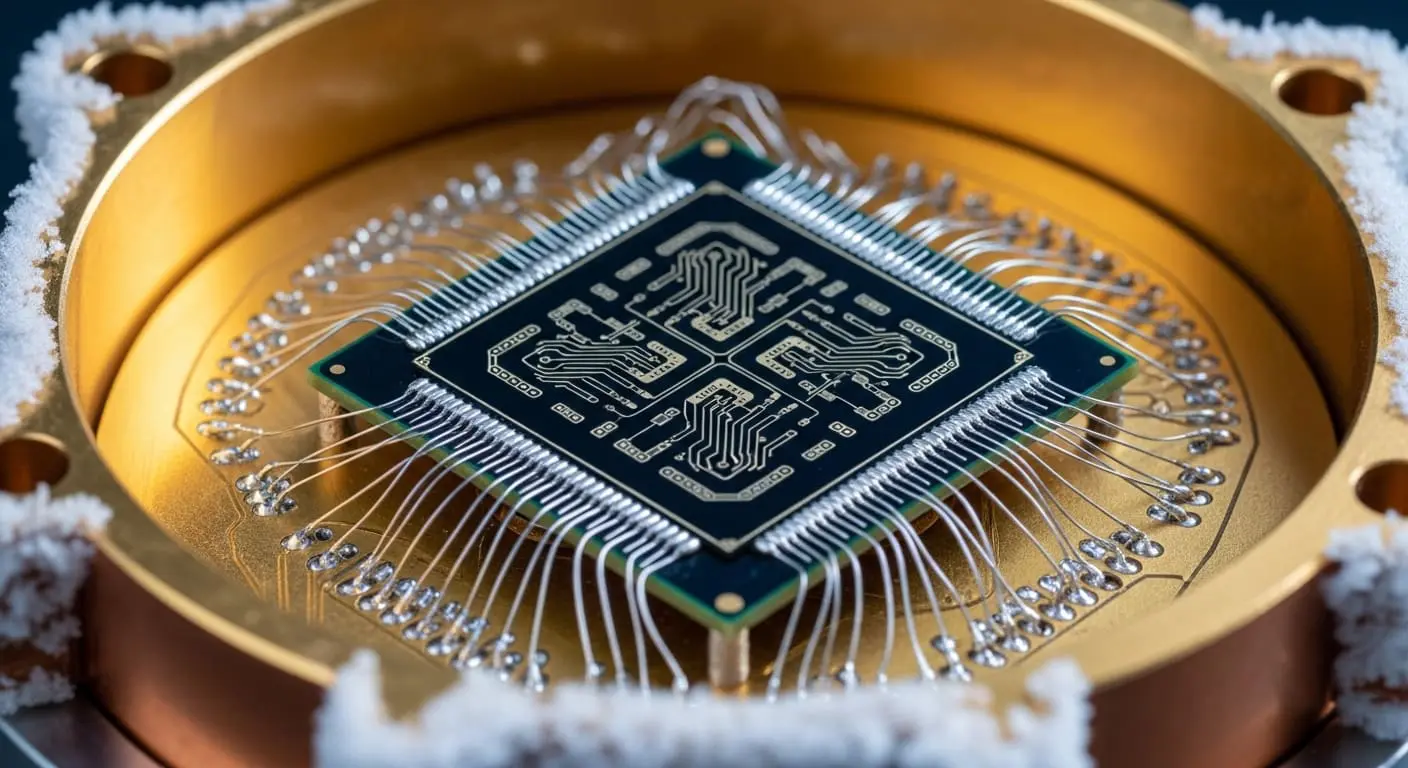
Alina Joch and collaborators from TU Dortmund University and DLR present an experimental evaluation of the emergent-coupling-based ansatz, a physically inspired method for representing the behaviour of disordered quantum systems. The evaluation, conducted on superconducting quantum processors with systems of up to 30 qubits, shows the ansatz achieves a relative energy accuracy of 96.47% and outperforms commonly used alternatives with a comparable number of quantum gates. The findings represent a key step towards more efficient and accurate quantum algorithms, particularly for modelling disordered materials and complex physical phenomena.
Emergent coupling ansatz unlocks high-accuracy quantum simulation of disordered systems
A relative energy accuracy of 96.47% signifies a sharp leap in quantum computation for disordered systems. Previously, accurately modelling these systems with up to 30 qubits was hampered by limitations in circuit complexity and the expressivity of available quantum circuit designs. The emergent-coupling-based ansatz, or ECBA, now surpasses these constraints, efficiently representing ground states and offering a pathway to simulate materials and phenomena intractable for classical computers. Disordered systems, characterised by randomness in their constituent parameters or interactions, present a significant challenge to traditional computational methods due to the exponential scaling of the Hilbert space with system size. This makes the development of efficient quantum algorithms crucial for gaining insights into their behaviour.
The ECBA’s performance arises from its ability to capture long-range entanglement, streamlining circuits and enabling efficient implementation on existing superconducting hardware. This advance represents a key step towards more powerful and accurate quantum algorithms, particularly for materials discovery and fundamental physics research. Demonstrating compatibility with hardware featuring two-dimensional square-lattice connectivity strengthens these findings, as it is vital for scalability by minimising the need for complex qubit rearrangements. The ECBA is rooted in a renormalization (semi-)group approach, a technique borrowed from condensed matter physics, which identifies the dominant effective couplings within the disordered system. By focusing on these key interactions, the ansatz significantly reduces the number of parameters required to describe the system, leading to shallower quantum circuits and reduced computational cost.
Detailed analysis revealed median T1 relaxation times of 36.53 microseconds on the Garnet device and 50.05 microseconds on the Emerald device, both from IQM. Superconducting quantum processors implemented an emergent-coupling-based ansatz (ECBA), which was then benchmarked on disordered Heisenberg chain models. Systems of up to 30 qubits were studied using classically pre-optimised parameters and error mitigation techniques, observing an experimental relative energy accuracy of 96.47% for the largest system. Combining Pauli Twirling, Twirled Readout Error Extinction and dynamical decoupling improved accuracy. The Heisenberg model, a fundamental model in quantum magnetism, was chosen as a testbed due to its well-understood properties and its relevance to a wide range of physical systems. The use of classically pre-optimised parameters is essential for achieving high accuracy, as it reduces the search space for the variational quantum eigensolver (VQE) algorithm. Error mitigation techniques, such as Pauli Twirling, Twirled Readout Error Extinction and dynamical decoupling, are crucial for suppressing the effects of noise and decoherence in near-term quantum devices. This figure represents performance on systems of up to 30 qubits and does not yet demonstrate the ability to scale to the hundreds or thousands of qubits needed to solve complex, real-world problems. The T1 relaxation times, indicative of qubit coherence, are critical parameters influencing the fidelity of quantum computations; longer T1 times allow for more complex circuits to be executed before information is lost.
Emergent coupling ansatz shows promise for scalable molecular simulations
Variational quantum eigensolvers offer a route to simulating materials and molecular structures beyond the reach of conventional computers, potentially leading to breakthroughs in fields like drug discovery and materials science. The success of these algorithms, however, hinges on designing effective ‘ansätze’, or quantum circuits, capable of accurately representing the systems being studied. This work establishes the ECBA as a viable option, achieving high accuracy on up to 30 qubits, and presents a promising new tool for near-term quantum computers. The VQE algorithm works by iteratively optimising the parameters of a quantum circuit to minimise the energy of the system, effectively finding the ground state.
Despite inherent hardware limitations, achieving 96.47% accuracy on a 30-qubit system demonstrates the ECBA’s potential to deliver meaningful results. Focusing on the most important connections between quantum bits, or qubits, this approach creates streamlined circuits that accurately represent complex materials, in contrast to traditional methods struggling with similar calculations. Its compatibility with common quantum processor layouts eases implementation, broadening its applicability beyond specialised architectures and accelerating progress in quantum simulation. The ECBA’s success stems from its ability to capture long-range entanglement, a quantum phenomenon key for understanding material behaviour, while minimising computational demands. Long-range entanglement, where qubits separated by large distances are correlated, is particularly important for describing systems with extended correlations, such as disordered materials and strongly correlated electron systems. Traditional ansätze often struggle to efficiently represent these correlations, requiring exponentially increasing circuit complexity. The ECBA’s ability to capture long-range entanglement with a relatively shallow circuit is a significant advantage.
Looking ahead, the researchers plan to explore the scalability of the ECBA to larger qubit systems and investigate its performance on more complex disordered models. Further research will focus on developing automated methods for optimising the ansatz parameters and integrating it with advanced error mitigation techniques. The ultimate goal is to leverage the ECBA to tackle challenging problems in materials science, such as designing new high-temperature superconductors and developing novel catalysts. The ability to accurately simulate disordered systems has far-reaching implications, potentially revolutionizing our understanding of fundamental physics and enabling the discovery of new materials with unprecedented properties.
The researchers successfully implemented the emergent-coupling-based ansatz on superconducting quantum processors, achieving 96.47% relative energy accuracy on systems of up to 30 qubits. This demonstrates the potential of this method to accurately model complex disordered materials using relatively shallow quantum circuits. The ECBA’s efficient design and compatibility with standard hardware connectivity simplifies implementation compared to other approaches. The authors intend to scale this ansatz to larger systems and explore its application to more complex models, furthering its development as a tool for quantum simulation.
👉 More information
🗞 Emergent-Coupling-Based Ansatz Evaluated on a Superconducting Quantum Processor
🧠 ArXiv: https://arxiv.org/abs/2603.28486