Understanding how opinions form, shift, and ultimately drive collective behaviour represents a long-standing challenge in the social sciences, and now, researchers are applying the principles of quantum mechanics to model these complex processes. Xingyu Guo, from the South China Normal University, and Xiaoyang Wang and Lingxiao Wang, both from RIKEN in Japan, demonstrate quantum simulations of opinion dynamics, utilising superposition, measurement and entanglement to represent realistic psychological and social interactions. Their work develops models that can be solved mathematically and implemented on quantum hardware, offering a new approach to understanding phenomena like consensus formation and social polarisation. The results illustrate how quantum effects can enhance our understanding of collective decision-making, and open exciting possibilities for using near-term quantum computers to model complex social systems with unprecedented accuracy.
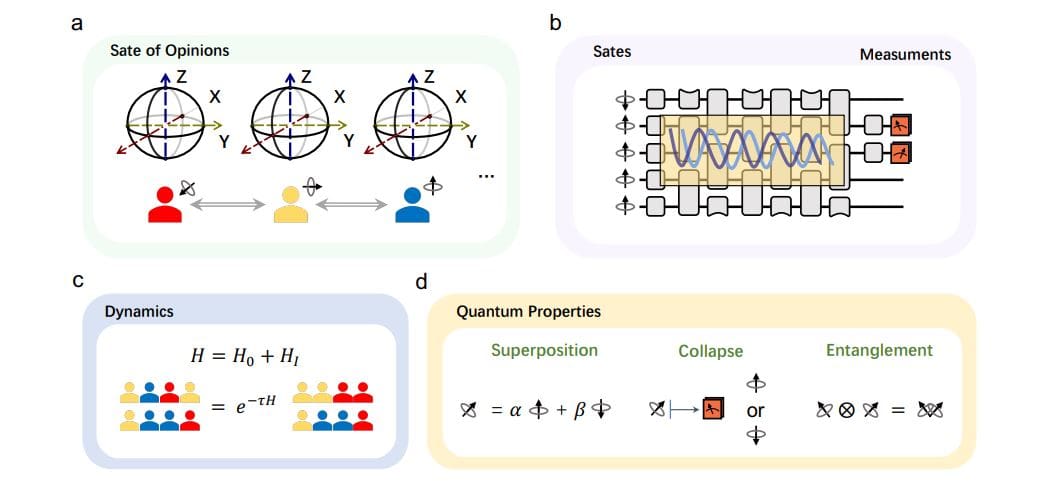
Quantum computing offers powerful new approaches for modeling complex social phenomena. This work proposes and demonstrates quantum simulations of opinion dynamics, leveraging quantum superposition, measurement-induced state collapse, and entanglement to model realistic psychological and social processes. Specifically, the researchers develop quantum models of opinion dynamics, solving them exactly and simulating them on IBM Quantum hardware, allowing for investigation of how opinions form, evolve, and spread within populations, potentially offering new insights into social behaviour and collective decision-making. This approach represents a significant step towards utilising quantum computers to address complex problems in the social sciences, moving beyond classical computational limitations.
Quantum Opinion Dynamics Simulation Methodology
This research details a comprehensive methodology for simulating opinion dynamics using quantum computation. The team meticulously explores the theoretical underpinnings and practical implementation of their approach, demonstrating a deep understanding of both quantum computation and social modelling. A strong emphasis is placed on demonstrating the feasibility of their approach on actual quantum hardware, highlighting the practical implications of their work. The research incorporates detailed theoretical and simulation analyses, presented in a series of appendices, exploring the measurement of two-body correlations beyond collective observables to examine the microscopic details of opinion formation.
The robustness of the model is demonstrated by testing it with various initial conditions, including random beliefs and polarized opinions, and investigating the impact of a leader agent on opinion dynamics, mirroring real-world social influence. A key component of the methodology is the variational quantum imaginary-time evolution (VarQITE) algorithm, used to simulate the opinion dynamics on near-term quantum computers. The team designed a specific quantum circuit to represent the opinion dynamics, employing the Euler method to evolve the parameters of the circuit over imaginary time. To mitigate the effects of noise on the quantum hardware, techniques like dynamic decoupling and randomized compiling were implemented. This work aims to demonstrate that quantum computation can offer an advantage over classical methods for modeling opinion dynamics, potentially offering a tool to study how social influence spreads in complex networks, and providing a relevant analogy to real-world social dynamics with the leader-follower model.
Quantum Simulation Models Opinion Polarization and Dynamics
Scientists have developed a framework for quantum simulation of opinion dynamics, representing individual opinions as quantum bits rather than classical binary states. The research demonstrates how quantum properties, superposition, measurement-induced state collapse, and entanglement, can model realistic psychological and social processes related to opinion formation. Researchers directly correspond the quantum description of a qubit to an agent’s opinion state, allowing for a novel approach to studying collective behavior. Unlike classical simulations, this quantum model accounts for the inability to clone quantum states, preventing simple alignment with neighbors’ opinions, and leverages the inherent symmetry of quantum state transitions, necessitating the incorporation of additional interaction terms to model varying probabilities of opinion shifts. Researchers systematically investigate how different initial beliefs, combined with varying interaction rules, shape the long-term steady-state outcomes of social systems, demonstrating the framework’s expandability through the use of round table and leader-follower models. The team computes observables such as magnetization, quantifying opinion alignment, and entanglement entropy, characterizing inter-agent correlations in individual opinions, providing a fresh paradigm to study consensus formation, polarization, and emergent collective intelligence in complex societies.
Quantum Simulation Reveals Opinion Dynamics Insights
This research establishes a new framework for simulating opinion dynamics using quantum computing, offering insights into complex social phenomena. By representing individual opinions as quantum bits and modeling interactions through established quantum mechanical principles, the team demonstrates how superposition and entanglement can enrich understanding of consensus formation and collective behaviour. Validating their theoretical models with both detailed calculations and implementations on actual quantum hardware, they observed consistent results that confirm the potential of quantum simulations to explore social systems in novel ways. The findings illustrate the ability of quantum computing to capture nonclassical correlations and dynamic patterns in opinion formation, opening avenues for investigation beyond traditional modelling approaches. While acknowledging the limitations inherent in current quantum hardware, the team successfully demonstrated the applicability of their framework on existing noisy devices, potentially offering new tools for understanding and predicting collective behaviour.
👉 More information
🗞 Quantum Simulations of Opinion Dynamics
🧠 ArXiv: https://arxiv.org/abs/2512.03770