

Quantum key distribution promises fundamentally secure communication, yet practical implementation faces significant challenges, particularly in generating reliable single photons. Yann Portella, Petr Steindl, and Juan Rafael Álvarez, along with colleagues at their respective institutions, now demonstrate a novel approach to this problem by combining single photons with conventional laser light. The team successfully benchmarks a hybrid system where information encodes on a mixture of these light sources, achieving nearly perfect agreement between theoretical predictions and experimental results. This work offers a flexible technology to overcome limitations in single-photon brightness and provides crucial insights into when and how single photons truly outperform classical laser sources in securing communications, paving the way for more practical and efficient quantum networks.
Weak Coherent Pulse Key Distribution Performance
Quantum key distribution is transforming privacy and security through the principles of quantum mechanics. This work benchmarks a practical quantum key distribution system employing weak coherent pulses, a common approach for long-distance communication. The team investigates how to optimise key rates and distances by carefully mixing single photons and laser light. Specifically, the research characterises the impact of different mixing strategies on the quantum bit error rate and the achievable secret key rate, crucial metrics for evaluating system security and efficiency. The study details a comprehensive experimental setup, allowing precise control and measurement of quantum states, and employs advanced data analysis techniques to extract key performance indicators. Results demonstrate the feasibility of achieving high key rates over significant distances by carefully balancing the contributions of single photons and weak coherent light, paving the way for more robust and practical quantum communication networks.
Single-Photon and Coherent Pulse QKD System
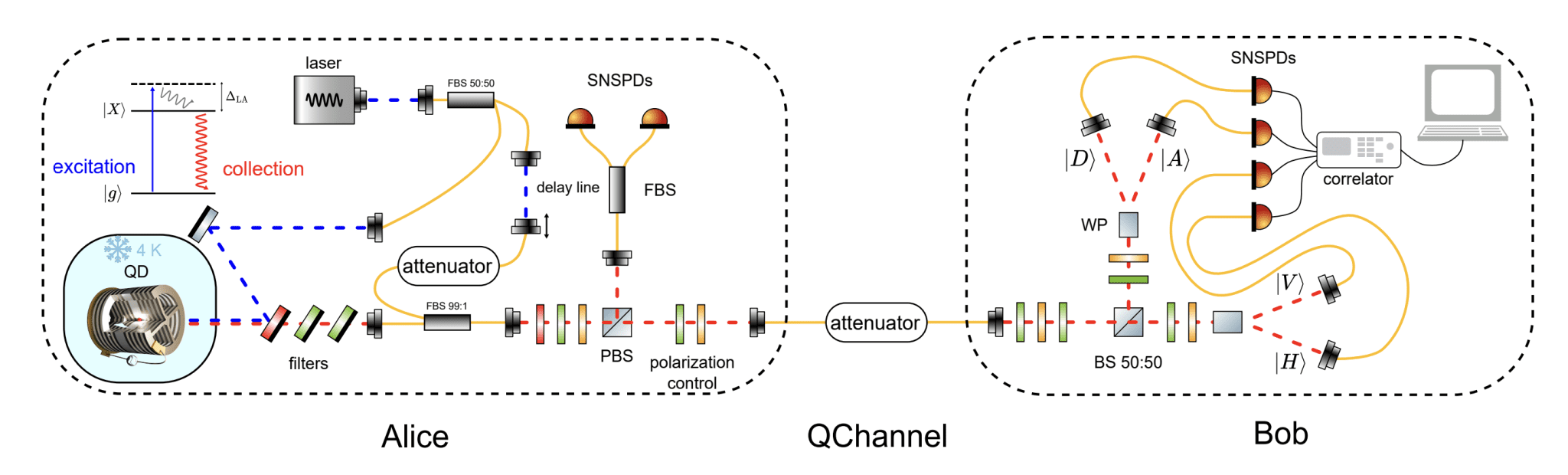
Researchers engineered a system harnessing both single photons and attenuated laser pulses, addressing limitations in brightness and performance. A quantum dot embedded within a micropillar cavity serves as a single-photon source, operating at a cryogenic temperature of 4K, excited by 10ps laser pulses. This source efficiently generates photons through the Purcell effect, maximising collection efficiency, with a repetition rate of 81. 96MHz. A key innovation lies in the incoherent mixing of single photons and laser pulses at the transmitter output, allowing precise control over the ratio of single photons to laser light.
Optimised filtering maintains high brightness and single-photon purity, achieving a detected count rate of 8MHz and a second-order correlation of g(2)(0) = 1. 2% measured at the output of the filtering stage. Polarisation of both the single photons and laser pulses is carefully aligned and controlled using waveplates and a polarising beam splitter, allowing researchers to investigate the interplay between single-photon purity and brightness, ultimately paving the way for enhanced secret key rates in realistic quantum communication scenarios.
Hybrid QKD Beats Pure Strategies
This research investigates optimising quantum key distribution (QKD) systems, specifically focusing on hybrid strategies that combine the strengths of both single-photon sources and classical laser light. The central argument is that a carefully balanced hybrid approach can outperform systems relying solely on either single-photon sources or lasers, particularly in realistic scenarios with imperfect devices and lossy channels. The research explores how to optimise the balance between the two sources to maximise the secret key rate and achievable distance in QKD. Simulations and analyses demonstrate that a hybrid QKD system can achieve a higher secret key rate and longer transmission distance compared to systems relying solely on either single-photon sources or lasers, leveraging the advantages of both technologies.
Optimising the laser power is crucial, and the optimal power depends on the brightness of the single-photon source and the characteristics of the communication channel. High single-photon purity is also important, and increasing the brightness of the single-photon source must be balanced with maintaining a high level of purity to minimise multi-photon emissions. The research highlights the impact of error rates on QKD performance, and the hybrid approach can be more robust to errors compared to pure strategies. The optimal laser power needed to maximise the secret key rate decreases as the brightness of the quantum dot source increases, suggesting that with brighter sources, the reliance on the laser can be reduced.
Hybrid QKD Extends Secure Communication Range
This research demonstrates a hybrid approach to quantum key distribution, successfully combining single-photon emission from a quantum dot with attenuated laser pulses. By incoherently mixing these light sources, the team achieved a flexible system capable of compensating for limitations in single-photon brightness, a common challenge in quantum communication. The results show that, at short distances, weak laser pulses transmit more secure key information, but single photons outperform them at longer distances, extending secure communication ranges by approximately 30 decibels. The team developed a model highlighting an efficiency threshold where single photons offer a clear advantage over laser light, and importantly, reveals the interplay between single-photon purity and brightness in achieving optimal performance. They propose an adaptive method, simply mixing laser light into the single-photon stream, to optimise secure key rates at shorter distances, a technique applicable to any single-photon source.
👉 More information
🗞 Benchmarking quantum key distribution by mixing single photons and laser light
🧠 ArXiv: https://arxiv.org/abs/2510.26337

