Quantum receivers utilising the unique properties of Rydberg atoms represent a promising new frontier in radio frequency technology, but achieving optimal sensitivity remains a key challenge. Anton Tishchenko, Demos Serghiou, Ashwin Thelappilly Joy, and colleagues at multiple institutions now demonstrate a significant step forward by integrating a specially designed metamaterial lens with a Rydberg atom-based receiver. Their experiments reveal that this lens, which manipulates light in unusual ways, amplifies the receiver’s response to radio frequency signals, effectively lowering the minimum detectable signal strength. This enhancement, achieved through careful analysis of the electromagnetically induced transparency effect in cesium vapour, overcomes inherent limitations of existing Rydberg receivers and opens up exciting possibilities for applications ranging from electromagnetic compatibility testing to advanced radar and wireless communication systems.
Recent investigations focus on enhancing the sensitivity of Rydberg-based radio frequency (RF) receivers, crucial for applications ranging from electric-field metrology to quantum radar. Researchers are actively developing innovative techniques to amplify the signals detected by these receivers, overcoming inherent limitations and expanding their capabilities. Studies demonstrate that careful manipulation of the electromagnetic environment surrounding the atoms can significantly improve performance, leading to more sensitive and reliable measurements.
Integrating Metamaterials for Enhanced RF Sensing
Integrating Metamaterials for Enhanced RF Sensing
One promising approach involves integrating the receiver with a gradient refractive index (GRIN) Luneburg-type metamaterial lens. This lens focuses incoming RF signals onto the receiver, effectively increasing the strength of the detected signal and improving the signal-to-noise ratio. Experiments demonstrate a substantial amplification of the electromagnetically induced transparency effect in cesium vapor when the lens is introduced, confirming theoretical predictions of local electric field enhancement. This improvement directly translates to a reduction in the minimum detectable electric field and an increase in the receiver’s sensitivity.
GRIN Lens Enhances Rydberg Receiver Sensitivity
Novel Engineering Approach Boosts Atomic Sensitivity
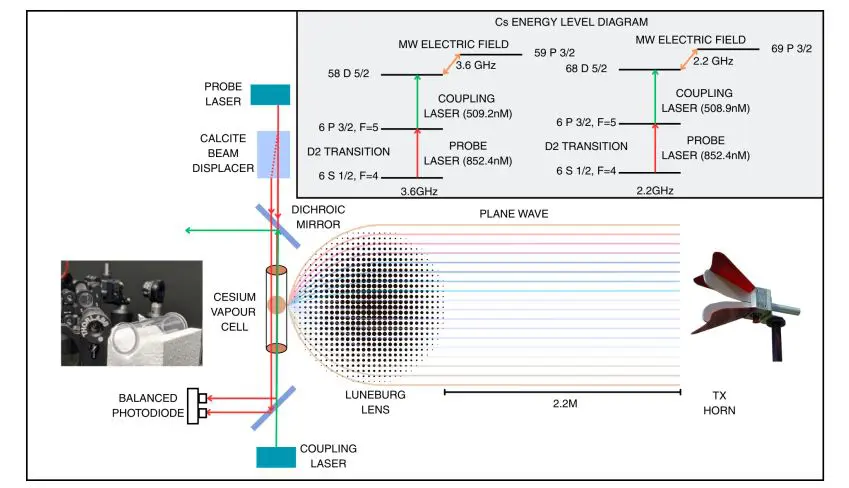
Scientists engineered a novel approach to enhance the sensitivity of atom-based Rydberg radio frequency (RF) receivers by integrating them with a gradient refractive index (GRIN) Luneburg-type metamaterial lens, demonstrating a significant advancement in RF sensing technology. The study pioneered the use of this lens to focus electromagnetic waves onto a Cesium vapor cell, aiming to amplify the electromagnetically induced transparency (EIT) effect and improve receiver performance at both 2. 2GHz and 3. 6GHz. Researchers meticulously designed, fabricated, and characterized a Luneburg-type GRIN lens, employing a three-dimensional printing technique with PLA material to create assembled fragments, and then rigorously tested its performance within an anechoic chamber.
Measurements focused on the EIT window, revealing a substantial amplification when the lens was introduced, consistent with theoretical predictions of local electric field enhancement. The team analytically modeled the lens’s focusing ability, deriving an equation to predict the enhancement of the Autler-Townes splitting, a key indicator of receiver sensitivity, and demonstrating a linear relationship between the focusing gain and the splitting. To validate the model, scientists measured the lens’s performance in the anechoic chamber, comparing the beam waist and focal length against simulations, confirming the accuracy of the design and fabrication process. The study established that the GRIN lens effectively increases the local field amplitude at the vapor cell, improving the signal-to-noise ratio and ultimately enhancing the receiver’s ability to detect weak RF signals, paving the way for applications in electromagnetic compatibility testing, radar systems, and wireless communications.
GRIN Lens Boosts Rydberg Receiver Sensitivity
Demonstrating Significant Sensitivity Gains in Practice
Scientists have demonstrated a significant enhancement in the sensitivity of atom-based Rydberg radio frequency (RF) receivers through the integration of a specially designed metamaterial lens. This lens, a gradient refractive index (GRIN) Luneburg-type structure, focuses incoming RF signals onto the receiver, amplifying the detected signal and improving performance. The research team experimentally validated the concept by analysing the electromagnetically induced transparency (EIT) effect in cesium vapor, comparing receiver performance with and without the lens at both 2. 2GHz and 3. 6GHz.
Measurements reveal a substantial amplification of the EIT transparency window when the GRIN lens is introduced, confirming theoretical predictions that the focused electric field at the vapor cell increases the signal-to-noise ratio (SNR) of the Rydberg RF receiver. Specifically, the team achieved a focusing gain of up to 8. 42 dB at the focal point of the lens at 3. 6GHz, measured within an anechoic chamber. This gain gradually decreased as measurements were taken further away from the focal point, aligning with established diffraction limits.
Quantifying Performance Gains Across Target Frequencies
Quantifying Performance Boosts Across Target Frequencies
Further experiments demonstrated that the EIT splitting, a key indicator of receiver sensitivity, effectively doubled with the lens in place at both 2. 2GHz and 3. 6GHz. This doubling directly translates to a significant increase in the SNR across a wide range of frequencies. The researchers fabricated the lens using 3D printing techniques, constructing a spherical structure from cubical lattices. The resulting receiver, incorporating the metamaterial lens, offers a low-cost solution for applications including electric-field metrology, quantum radar, and wireless communications.
Metamaterial Lens Boosts Rydberg Receiver Sensitivity
This research demonstrates a significant enhancement in the sensitivity of an atom-based Rydberg radio frequency receiver through the integration of a gradient refractive index Luneburg-type metamaterial lens. By carefully analysing the electromagnetically induced transparency effect in Cesium vapour, scientists successfully amplified the transparency window when the lens was introduced, confirming theoretical predictions of local electric field enhancement. This improvement directly translates to a reduction in the minimum detectable electric field and an increase in the signal-to-noise ratio of the receiver, representing a substantial step forward in the field. The findings validate the potential of metamaterial-assisted techniques to overcome inherent limitations in conventional Rydberg receivers, opening new avenues for applications in electromagnetic compatibility testing, radar systems, and wireless communications.
🗞 Experimental Sensitivity Enhancement of a Quantum Rydberg Atom-Based RF Receiver with a Metamaterial GRIN Lens
🧠 ArXiv: https://arxiv.org/abs/2512.04298