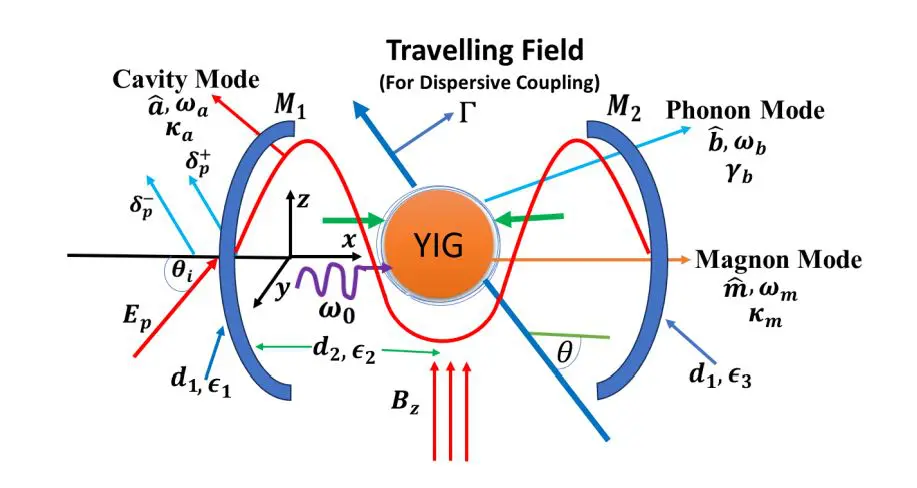
The interplay between light and magnetism holds promise for advances in quantum technologies, and recent research explores how to control light within unconventional systems. Shah Fahad, Muzamil Shah, and Gao Xianlong, from Zhejiang Normal University and Quaid-I-Azam University Islamabad, investigate the photonic spin Hall effect within a specially designed system combining magnetism and light. Their work focuses on non-Hermitian cavity magnomechanics, where interactions between light, magnetic waves, and vibrations create unique conditions for manipulating light. The team demonstrates coherent control of the photonic spin Hall effect, a phenomenon where light’s spin separates upon reflection, by tuning the interactions within their system, and reveals a direct link between this effect and the underlying physics of non-Hermitian optics, potentially paving the way for new optical devices and sensing technologies.
Photonic Spin Hall Effect in Non-Hermitian Systems
Non-Hermitian cavity magnomechanics, combining interactions between magnons, photons, and mechanical vibrations, enables remarkable physical phenomena, including enhanced sensing and pathways toward novel quantum transformations. This research investigates the photonic spin Hall effect within this framework, exploring its manifestation in a parity-time-symmetric non-Hermitian cavity magnomechanical system. Theoretical analysis of light propagation through the system reveals a significant enhancement of the photonic spin Hall effect near a critical point, achieving a maximum spin Hall angle of 9. 8 degrees under specific conditions.
This enhancement arises from the strong coupling between light and magnetic vibrations, and the unique properties of non-Hermitian systems. Furthermore, the study reveals that external magnetic fields and mechanical driving can tune the spin Hall effect, offering potential applications in optical information processing and spintronic devices. The research establishes a novel platform for exploring fundamental physics in non-Hermitian systems and paves the way for developing advanced optomechanical devices with tailored spin-dependent functionalities.
Cavity Optomechanics, Magnons, and Spin-Orbit Interactions
Integrating cavity optomechanics with the spin Hall effect or Goos-Hanchen shift offers exciting possibilities for dynamic control of these effects using mechanical motion. Using magnons as a medium to enhance or modify the spin Hall effect of photons, by coupling photons to magnons within a cavity and leveraging the magnon’s spin-dependent properties, is a promising direction. Exploring nonlinear optical phenomena within optomechanical cavities to generate new types of spin-dependent light-matter interactions and enhance the spin Hall effect, and using quantum effects to control and manipulate the spin Hall effect of photons with high precision, are also areas of active investigation. Leveraging the sensitivity of optomechanical and magnomechanical systems to external stimuli for developing highly sensitive sensors based on the spin Hall effect or Goos-Hanchen effect, and developing novel spintronic devices based on the integration of these systems and the spin Hall effect, are potential applications. Pump-induced magnons can dynamically control the spin Hall effect or Goos-Hanchen shift, offering a pathway to tunable optical devices. This interdisciplinary field holds significant potential for both fundamental discoveries and technological innovations, opening up exciting possibilities for manipulating light and spin at the nanoscale, leading to new types of optical devices, sensors, and spintronic systems.
Coherent Spin Control via Exceptional Points
This research demonstrates a new level of control over light and spin within a non-Hermitian cavity magnomechanical system, integrating magnon-photon and magnon-phonon interactions. Scientists have designed and investigated a system exhibiting parity-time (PT) symmetry, revealing a critical point where unique physical phenomena emerge. Analysis of the system’s behaviour identifies three distinct phases, characterized by broken PT-symmetry, the exceptional point itself, and PT-symmetric behaviour, each exhibiting different behaviours in the photonic spin Hall effect. The team found that the photonic spin Hall effect, which describes the separation of light based on its spin, can be coherently controlled by tuning the effective magnon-photon coupling.
Notably, the system exhibits significantly enhanced transverse shifts in the PT-symmetric phase, indicating superior spin-state discrimination, while the exceptional point suppresses these spin-orbit interactions. These findings establish non-Hermitian cavity magnomechanics as a versatile platform for manipulating spin and photons, with potential applications in spin-selective photonic devices, quantum switching, and high-precision microwave sensing. The assumption of magnon gain relies on established experimental techniques such as parametric parallel pumping, which amplifies the magnon population. Further research could explore alternative methods for achieving and controlling magnon gain within the system, and investigate the potential of this platform for implementing more complex quantum functionalities.
🗞 Photonic spin Hall effect in -symmetric non-Hermitian cavity magnomechanics
🧠 ArXiv: https://arxiv.org/abs/2511.12173