The interplay between information and energy conversion receives increasing attention as scientists explore the fundamental limits of thermal engines, and a new framework developed by Lindsay Bassman Oftelie and Michele Campisi, both from Istituto Nanoscienze-CNR and NEST Scuola Normale Superiore, addresses a long-standing puzzle in this field. Their work investigates how acquiring and utilising information impacts the efficiency of heat engines, specifically by modelling a system incorporating a ‘Maxwell’s demon’ that measures and responds to the engine’s state. This research establishes a unified approach to analysing such engines, treating the information-gathering component as integral to the thermal machine itself, and resolves the classic paradox surrounding Maxwell’s demon by placing the engine and its memory on equal footing. Remarkably, the team demonstrates that increasing information does not always improve performance, revealing a counterintuitive principle where limited knowledge can, in certain circumstances, yield greater efficiency.
Their work investigates how acquiring and utilising information impacts the efficiency of heat engines, specifically by modelling a system incorporating a ‘Maxwell’s demon’ that measures and responds to the engine’s state. This research establishes a unified approach to analysing such engines, treating the information-gathering component as integral to the thermal machine itself, and resolves the classic paradox surrounding Maxwell’s demon by placing the engine and its memory on equal footing. Their research explores how information acquisition influences the efficiency and power output of quantum heat engines operating between thermal reservoirs. The researchers consider scenarios where information about the engine’s state is obtained through measurement during operation, and this information is then used to modify the engine’s subsequent behaviour. Specifically, they analyse a three-state quantum heat engine and demonstrate that acquiring information about the working substance allows for feedback control strategies that enhance performance. The results show that, under certain conditions, the engine can achieve higher efficiency and power output than its feedback-free counterpart, highlighting the potential of information as a valuable resource in quantum thermodynamics. Furthermore, the study establishes a clear connection between the amount of information gained and the resulting improvement in engine performance, providing insights into the fundamental limits of information-enhanced quantum heat engines.
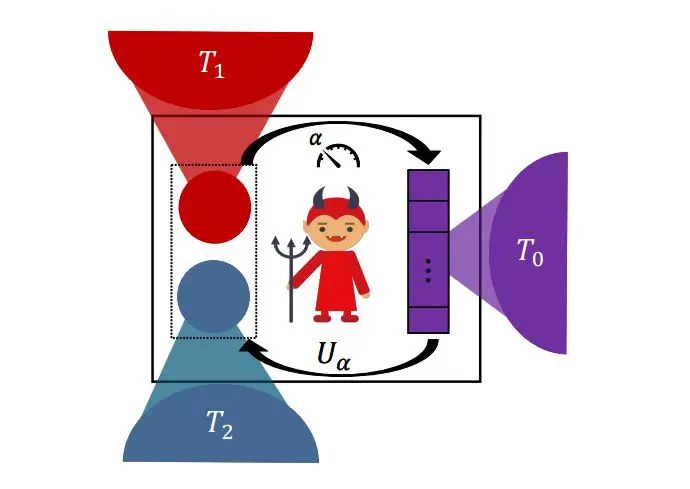
Clock-controlled engines have been presented, but a general framework for such machines remains lacking. Here, the researchers present a framework for a generic, two-stroke quantum heat engine interacting with multiple thermal baths and a Maxwell’s demon. The demon performs measurements on the engine’s working substance, recording the outcomes in a classical memory embedded in its own thermal bath. To implement feedback control, the demon enacts operations on the working substance, conditioned on the recorded outcomes. By considering the combined engine-memory as a hybrid system interacting with multiple thermal baths, the framework places the working substance and the memory on equal footing within a thermodynamic analysis.
Quantum Thermodynamics, Entanglement and Energy Conversion
This work explores the fundamental connections between quantum information, thermodynamics, and the limits of energy conversion. It investigates how quantum mechanics can be harnessed to improve the efficiency of heat engines and refrigerators, and how concepts like entanglement and feedback control play a crucial role. A central theme is the re-examination of Maxwell’s demon, a thought experiment challenging the second law of thermodynamics, in the context of quantum systems. The authors demonstrate that quantum mechanics offers pathways to circumvent traditional limitations on energy extraction and conversion, but also highlights the inherent costs associated with information processing and measurement.
The research establishes a comprehensive theoretical framework for understanding how information impacts the performance of thermal engines, specifically those incorporating feedback control and quantum mechanical principles. Researchers developed a model of a two-stroke heat engine interacting with thermal reservoirs and a Maxwell’s demon, treating the engine and the classical memory storing measurement outcomes as a unified system. This approach resolves longstanding paradoxes surrounding Maxwell’s demon by placing the engine and its memory on equal footing within a thermodynamic analysis. The team’s analysis reveals a nuanced relationship between information and energy conversion, demonstrating that acquiring more information does not always lead to improved engine efficiency. In certain scenarios, limiting the information available to the control mechanism can, surprisingly, yield better performance. This counterintuitive finding highlights the complex interplay between information, thermodynamics, and quantum mechanics.
👉 More information
🗞 Impact of Information on Quantum Heat Engines
🧠 ArXiv: https://arxiv.org/abs/2512.13371