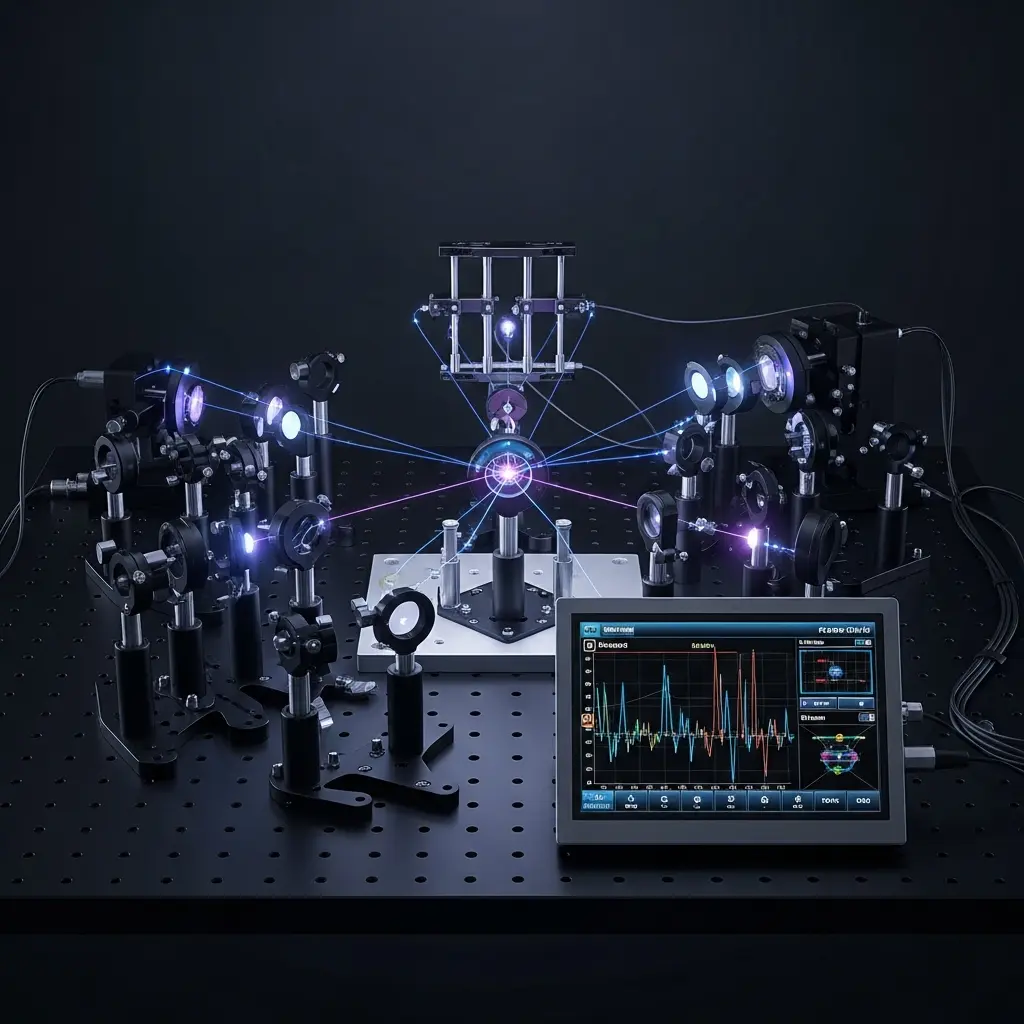
Scientists are increasingly focused on improving the precision of measurements, a field known as quantum metrology. Yu-Xin Wang (Joint Center for Quantum Information and Computer Science, NIST and University of Maryland), Flavio Salvati (Cavendish Laboratory, Department of Physics, University of Cambridge), and David R. M. Arvidsson-Shukur (Hitachi Cambridge Laboratory) et al. demonstrate how leveraging effective time reversals offers a powerful, yet surprisingly diverse, toolkit for enhancing measurement sensitivity. Their research identifies and unifies four distinct strategies , echo, weak-value amplification, closed timelike curve simulation, and indefinite causal order , under a common framework. This work is significant because it not only clarifies the underlying principles connecting these previously disparate techniques, but also highlights their potential to advance fields ranging from information science to solid-state physics.
Quantum precision via effective time reversal offers novel
Scientists have demonstrated a unified framework for Quantum metrology leveraging effective time reversal, a technique with potential applications spanning diverse fields from information science to solid-state physics. The research, published on January 30, 2026, identifies and categorises four distinct strategies for enhancing measurement precision by manipulating the flow of time at the quantum level. This breakthrough reveals that echo metrology, weak-value amplification, time-loop metrology simulating closed timelike curves, and indefinite causal order are all underpinned by a common principle of effectively reversing time’s arrow. The team established a clear relationship between these strategies under the banner of “time-reverse metrology”.
The Four Novel Metrology Strategies Explained
The study unveils that echo metrology begins with a preparatory unitary operation and concludes with its time-reversed counterpart, effectively amplifying the visibility of a small parameter being sensed. Weak-value amplification enhances the detectability of weak couplings, exhibiting counterintuitive retrocausal properties as described by a retrocausal model. Researchers proved that simulating closed timelike curves, theoretical worldlines looping back on themselves in time, can be achieved through manipulation of Quantum entanglement, potentially enabling optimal sensor initialisation even without prior knowledge. Furthermore, indefinite causal order, where quantum channels are applied in a superposition of orderings, can significantly improve parameter estimation, channel discrimination, and thermometry.
Experiments show that each of these four strategies offers robustness against specific types of noise, though they do not all require unitary inversion. The researchers meticulously compared the four classes, highlighting their similarities and differences. This comparison clarifies how each technique manipulates time, either through preparation and measurement with inverted unitaries, simulating CTCs, or inverting the order of two channels. The study details the mathematical foundations of parameter estimation, utilising the Fisher information to quantify the precision achievable with each method and establishing the quantum Crámer-Rao bound as a limit on estimator variance.
Bridging Quantum Theory and Diverse Physics Fields
This research establishes a novel perspective on quantum metrology, bridging several traditionally separate disciplines. The team outlines opportunities for this toolkit in quantum metrology, quantum information science, quantum foundations, atomic, molecular, and optical physics, and solid-state physics. By unifying these previously disparate approaches, the scientists open avenues for developing more sensitive and precise measurement techniques, potentially revolutionising fields reliant on accurate sensing and information processing. The work’s emphasis on effective time reversal provides a powerful new lens through which to view and advance quantum technologies, promising significant progress in both fundamental understanding and practical applications.
Weak-value amplification for Rydberg-atom sensing offers enhanced precision
Enhanced Precision via Rydberg-Atom Sensing Applications
Scientists are increasingly employing time-reversal strategies to enhance measurement precision across diverse fields. Experiments demonstrate the advantages of weak-value amplification, notably in Rydberg-atom sensing where Jiang et al. mapped a small microwave-induced phase shift to a measurable displacement of an optical probe. This readout achieved a sensitivity gain of 5 to 6 dB compared to a state-of-the-art superheterodyne scheme, potentially approaching the atomic shot-noise limit while mitigating technical noise. Huang et al. further advanced this approach by combining weak-value amplification with double-slit interferometry.
They weakly coupled an interarm time delay to a beam’s transverse spatial mode, generating a large real weak value through postselection. This enabled amplification of a small temporal delay τ into a spatial fringe displacement Awτ, allowing the resolution of few-attosecond delays using standard imaging optics. Their scheme improved the signal-to-noise ratio by up to two orders of magnitude compared to conventional interferometry. Researchers have implemented weak-value amplification using diverse platforms including tabletop optics, integrated optical waveguides, matter-wave interferometers, solid-state systems, superconducting circuits, trapped ions, and atomic-vapour cells.
The study also explores the apparent retrocausality inherent in weak-value amplification, noting that the probe’s final state depends on the target’s postselected state, despite postselection occurring after target-probe interaction. This is explained through contextuality, where the target’s initial and final states equally influence the probe. Scientists developed the two-state-vector formalism to reinterpret time in quantum mechanics, describing the system with forward- and backward-evolving states. The time-t weak value is then a time-symmetric expectation value conditioned on the system’s past and future.
Furthermore, the work pioneers generalised postselective metrology, capable of distilling information about L parameters from n states into m ≪ n states. To address information loss due to decoherence, researchers suggest applying analogies with ICO metrology or leveraging the equivalences between quantum experiments and retrocausal effects. Finally, the study investigates time-loop metrology, simulating closed timelike curves through entanglement manipulation and postselection, suggesting that this approach could enable metrological advantages akin to sending information backward in time.
Time Reversal Enhances Measurement and Displacement of quantum
Scientists have demonstrated four distinct strategies for enhancing measurements through time reversal techniques. These approaches amplify the visibility of parameters, utilising echo protocols that begin and end with a preparatory unitary transformation. Weak-value amplification increases the detectability of weak couplings, exhibiting counterintuitive retrocausal properties. Researchers also simulate closed timelike curves and employ indefinite causal order, characterised by superposition of channel orderings. Experiments revealed that preparing a target in the |amax⟩ state displaces a probe’s position distribution by the greatest possible amount, α amax.
Postselection of the target on |Ψf⟩ further displaces the probe’s position distribution by α Re(Aw), and weak-value amplification occurs when α Re(Aw) exceeds α amax. Data shows that this apparent retroaction can increase the Fisher information attainable per measured probe. The team measured the weak coupling strength, α, achieving maximum sensitivity by initialising the target in the A eigenstate associated with the greatest eigenvalue. Measurements confirm that the final probe state |Φf⟩ depends on the weak value of A, defined as Aw = ⟨Ψf| A|Ψi⟩ ⟨Ψf|Ψi⟩. Under conditions of a broad initial probe wave function and a weak interaction, the protocol translates the probe’s position-basis wave function by α Re(Aw).
The postselected Fisher information, Ips α ≈|Aw|2/ (∆φ)2, can exceed the non-postselected Fisher information, Iα ≈ A2 / (∆φ)2, by leveraging states |Ψf⟩ that increase |Aw|2 above ⟨A2⟩. Tests prove that weak-value amplification is a robust metrological tool, enabling the first observation of the spin Hall effect of light. Recent work by Jiang et al. applied this amplification to Rydberg-atom sensing, mapping a small microwave-induced phase shift to a measurable displacement of an optical probe, achieving a sensitivity gain of 5 to 6 dB over a state-of-the-art superheterodyne scheme. Furthermore, Huang et al. combined weak-value amplification with double-slit interferometry, resolving few-attosecond delays and improving the signal-to-noise ratio by up to two orders of magnitude compared to conventional interferometry.
Time Reversal Unifies Precision Measurement Strategies and offers
Scientists have identified and unified four distinct strategies that utilise time reversal to enhance measurement precision. These techniques, echo, weak-value amplification, simulation of closed timelike curves, and indefinite causal order, all leverage non-classical properties to amplify the detection of subtle parameters. Weak-value amplification, in particular, demonstrates a counterintuitive retrocausality, where the final state of a probe appears to depend on the post-selected state of the target, even though post-selection occurs after their interaction. This advantage over classical experiments arises from contextuality, a genuinely non-classical phenomenon, and is described effectively using the two-state-vector formalism, which reinterprets time in quantum mechanics as symmetric.
Furthermore, researchers explored generalised postselective metrology, a method for distilling information from numerous states into a smaller set, potentially improving parameter estimation even in the presence of decoherence. The investigation also considered the possibility of simulating closed timelike curves, theoretical pathways looping back on themselves in time, and their potential application within quantum systems. While acknowledging that current information distillation procedures lose information when faced with decoherence, the authors suggest exploring analogies with established techniques and leveraging the connection between quantum experiments and retrocausal effects to mitigate these losses. The authors note a limitation in the lack of a known optimal strategy for information distillation when dealing with decoherence. Future research could focus on applying insights from indefinite causal order metrology, which exhibits resilience to certain decoherence, or further investigating the relationship between retrocausality and improved channel discrimination. These findings offer a new toolkit for precision measurement with potential applications in diverse fields including information science, atomic physics, and solid-state physics, and contribute to a deeper understanding of the fundamental nature of time in quantum mechanics.
🗞 Quantum metrology enhanced by effective time reversal
🧠 ArXiv: https://arxiv.org/abs/2601.20952