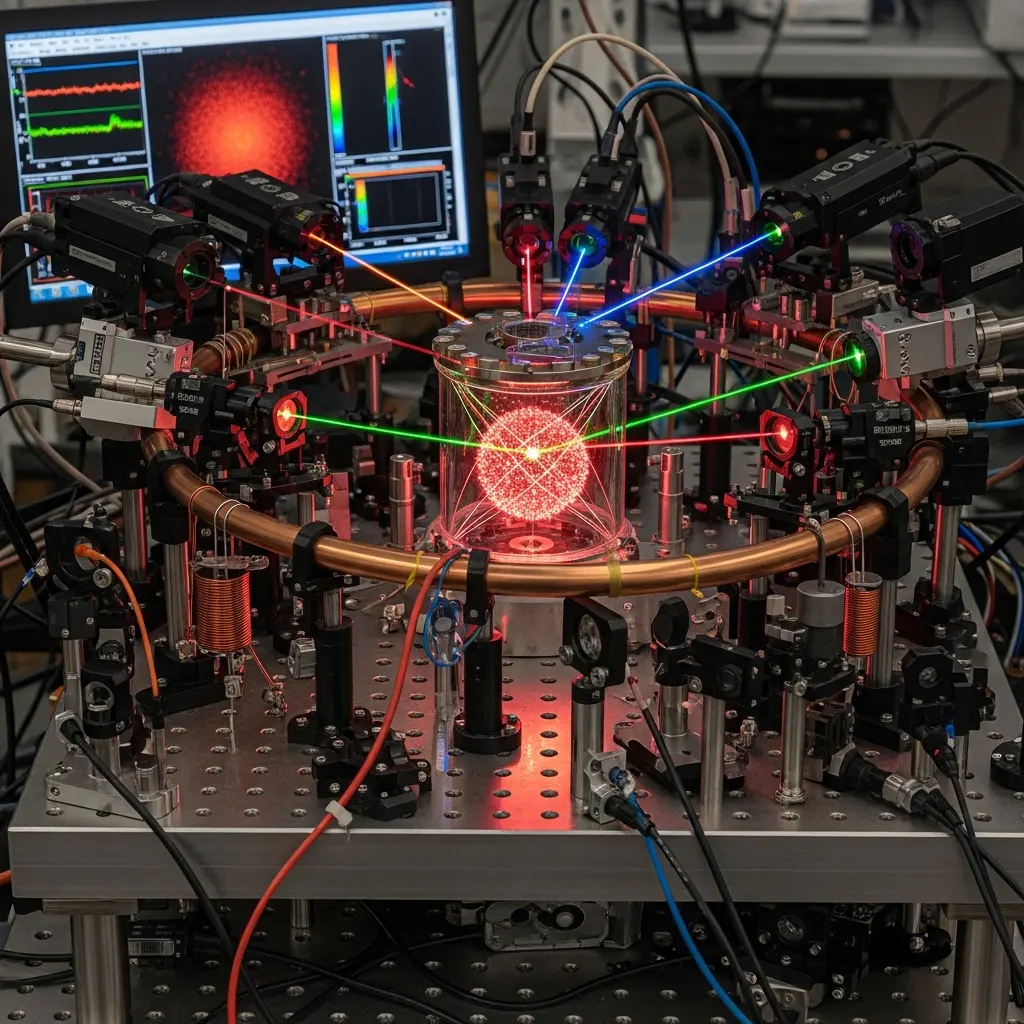
The pursuit of efficient thermal machines at the quantum scale receives a significant boost from new research into controlling complex systems, as Raymon S. Watson and Karen V. Kheruntsyan from the University of Queensland demonstrate. Their work explores how manipulating multiple parameters within a quantum system, specifically a one-dimensional Bose gas, enhances the performance of a quantum Otto engine, a device converting heat into work. The team reveals that simultaneously controlling both the external trap frequency and interparticle interactions leads to a substantial improvement in the engine’s net work output, exceeding the performance of engines controlled by single parameters or even the sum of their individual effects. This achievement establishes general principles for designing more efficient quantum heat engines and refrigerators, paving the way for advancements in nanoscale energy conversion technologies.
Scientists aimed to explore how manipulating interactions within the gas could extract work, or conversely, cool the system for refrigeration purposes. The study specifically investigates whether controlling multiple parameters simultaneously improves engine performance compared to cycles relying on a single control parameter. The work centers on the quantum Otto engine cycle, a thermodynamic cycle operating at the quantum level utilizing rapid changes in system parameters to drive the engine.
Researchers focused on a one-dimensional Bose gas, a system of particles exhibiting unique interactions due to their confinement, and considered the quasicondensate regime, a state where particles exhibit strong correlations. The team employed the Thomas-Fermi approximation, a method simplifying calculations by approximating the density profile of the gas. A crucial aspect of the analysis involves the correlation function, a measure of particle interactions within the Bose gas, essential for understanding the system’s behavior and calculating the work produced by the engine. The core investigation focuses on comparing a two-parameter control scheme with a single-parameter scheme, and exploring the possibility of using the same cycle to cool the system, effectively operating as a refrigerator.
Multi-Parameter Quench Control of Quantum Engines
Scientists developed a new method to investigate quantum thermal machines, specifically a quantum Otto engine cycle, by employing a rapid change in system parameters while simultaneously controlling multiple variables. This approach allows researchers to explore the operation of these engines in many-body systems where precise control is possible. The study focused on an experimentally realistic one-dimensional Bose gas, manipulating both the frequency of an external harmonic trap and the interparticle interaction strength with sudden changes. The key innovation lies in extending the established single-parameter control protocol to a multi-parameter scheme, enabling simultaneous control of multiple tunable parameters within the quantum system.
Researchers simplified the analysis by approximating the post-change state as unchanged from its initial thermal equilibrium, allowing them to rely on known thermal equilibrium values for calculating net work and efficiency. This simplification is crucial for navigating the complexity of simulating interacting many-body systems. To demonstrate the effectiveness of this method, scientists applied it to a harmonically trapped one-dimensional Bose gas, simultaneously changing both the harmonic trapping frequency and the interatomic interaction strength. This experimentally realizable engine cycle exhibited significantly enhanced performance compared to scenarios involving only single-parameter changes. The team derived a general inequality for the net work of this two-parameter Otto cycle, demonstrating superior performance as an engine and an enhanced coefficient of performance as a refrigerator.
Multi-Parameter Control Boosts Quantum Engine Performance
Scientists have demonstrated a novel approach to thermal machine operation by utilizing a one-dimensional Bose gas as a working fluid and simultaneously controlling both the interparticle interaction strength and the external harmonic trapping frequency. This research establishes a framework for investigating many-body systems as engines and refrigerators, revealing principles applicable to a wide range of controllable quantum systems. The team investigated a two-parameter Otto cycle and derived a general inequality demonstrating superior performance compared to single-parameter cycles. Experiments revealed that this multi-parameter control significantly enhances the net work produced by the engine, exceeding the combined effect of individual interaction and frequency changes.
Specifically, the net work is calculated using a formula incorporating changes in both the integrated local pair correlation function and the atomic position variance, allowing precise quantification of engine performance. The researchers calculated the net work produced by the engine, demonstrating that it depends on the difference between high and low energy equilibrium states of both the pair correlation function and the atomic position variance. Measurements confirm that the two-parameter Otto cycle delivers improved efficiency when functioning as a refrigerator, enhancing the coefficient of performance beyond that of single-parameter cycles. The team utilized the thermodynamic Bethe ansatz, a powerful numerical technique, to accurately model the non-uniform system at finite temperatures, enabling precise calculation of equilibrium expectation values. This work establishes a pathway for realizing highly efficient thermal machines based on controllable quantum systems, opening possibilities for advanced energy conversion and refrigeration technologies.
Synergistic Control Boosts Quantum Thermal Machine Performance
This research demonstrates that controlling multiple parameters simultaneously in quantum systems can significantly enhance the performance of thermal machines, specifically the quantum Otto cycle. By applying a rapid change to both the interparticle interaction strength and harmonic trapping frequency in a one-dimensional Bose gas, scientists achieved a net work output exceeding that of individual, single-parameter control cycles. This improvement extends beyond simply combining the effects of those individual cycles, indicating a genuine synergistic benefit from multi-parameter control. The team derived a general inequality proving this enhanced performance, and importantly, showed this principle applies not only to engines but also to refrigerators, thermal accelerators, and heaters.
Further analysis suggests this approach is broadly applicable, extending to other systems like harmonically trapped Fermi gases and the transverse-field Ising model, with potential for even greater gains through additional control parameters like spin polarization. While the study focused on a one-dimensional Bose gas, the underlying principles and derived inequality hold for any quantum Otto cycle where both controlled parameters increase under change, suggesting a versatile pathway to improved thermal machine efficiency. The authors acknowledge that their analysis relies on the rapid change approximation, which may not fully capture the dynamics of slower, more gradual changes. Future work could explore the impact of different control protocols and investigate the limits of this multi-parameter enhancement in more complex systems, potentially paving the way for novel quantum technologies with improved energy conversion capabilities.
🗞 A nonequilibrium quantum Otto engine enhanced via multi-parameter control
🧠 ArXiv: https://arxiv.org/abs/2511.01138