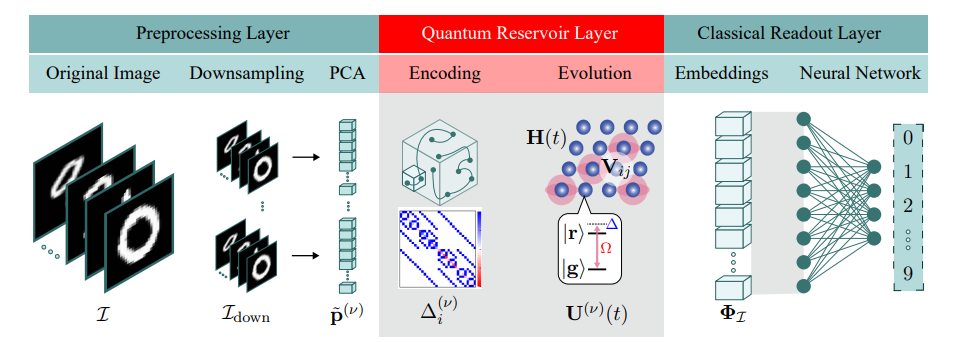
Quantum reservoir computing presents a promising new avenue for machine learning, exploiting the complex behaviour of quantum systems to efficiently process sequential data, and researchers are now exploring its potential to build more resilient artificial intelligence. Shehbaz Tariq, Muhammad Talha, Symeon Chatzinotas, and colleagues, from the University of Luxembourg and Kyung Hee University, systematically evaluate the ability of a quantum reservoir, built from interacting Rydberg atoms, to withstand adversarial attacks designed to fool machine learning models. Their work demonstrates that combining this quantum reservoir with a conventional machine learning readout layer significantly improves accuracy and robustness against such attacks, even when subjected to strong perturbations, offering a potential pathway towards more secure and reliable artificial intelligence systems. This hybrid approach establishes a clear advantage over purely classical models, revealing a new source of benefit from quantum-enhanced machine learning.
Quantum Reservoir Computing Defends Against Attacks
This research explores the potential of Quantum Reservoir Computing for building machine learning models that resist adversarial attacks, a significant security concern in applications like autonomous driving and image recognition. The authors demonstrate that QRC can offer improved robustness compared to classical machine learning models, addressing practical implementation challenges including the need for efficient hardware and software tools, such as CUDA Quantum for accelerating simulations. The study benchmarks QRC performance against classical models, evaluating both accuracy and robustness, and identifies promising avenues for future work, including the development of more scalable QRC hardware and novel adversarial defense techniques. This research contributes to the growing field of Quantum Machine Learning by demonstrating the potential of QRC for building more secure and reliable machine learning systems.
Rydberg Atom Reservoir for Robust Learning
Researchers pioneered a novel approach to machine learning by harnessing the complex dynamics of a quantum reservoir comprised of strongly interacting Rydberg atoms, aiming to enhance robustness against adversarial attacks. They engineered a system where the quantum reservoir, governed by a fixed Hamiltonian, naturally evolves, producing high-dimensional embeddings of input data, coupled with a lightweight multilayer perceptron functioning as a trainable readout layer. The team simulated the dynamics of this Rydberg atom array using NVIDIA’s CUDA-Q platform, leveraging GPU acceleration for efficient quantum evolution. They rigorously evaluated the system’s performance using the MNIST, Fashion-MNIST, and Kuzushiji-MNIST datasets, subjecting the model to the Fast Gradient Sign Method, Projected Gradient Descent, and DeepFool attacks with varying perturbation budgets. This innovative methodology revealed that integrating the Rydberg quantum reservoir with a classical readout consistently enhances adversarial robustness across all tested datasets and attack types, demonstrating a significant improvement in accuracy compared to purely classical models, even under strong adversarial perturbations. By configuring the Rydberg atom array with experimentally validated parameters, the researchers established a hardware-realistic pathway for robust quantum learning.
Rydberg Atoms Boost Adversarial Machine Learning
This work demonstrates a significant advancement in machine learning through the development of a quantum reservoir computing model exhibiting enhanced adversarial robustness. Researchers constructed a reservoir using an array of strongly interacting Rydberg atoms, leveraging their complex dynamics to create high-dimensional embeddings for processing data. The system employs a lightweight multilayer perceptron as a trainable readout layer, allowing for efficient learning. Experiments were conducted using the MNIST, Fashion-MNIST, and Kuzushiji-MNIST datasets to rigorously evaluate the model’s performance under various adversarial attacks, varying the perturbation strength to assess robustness against attacks like the Fast Gradient Sign Method, Projected Gradient Descent, and DeepFool.
Results show that the QRC model consistently achieved higher accuracy than purely classical models across all tested perturbation strengths. Measurements confirm that this approach further enhances robustness, with the QRC model consistently outperforming the classical multilayer perceptron across all datasets and attack types. The researchers utilized a custom-built simulation environment to model the Rydberg atom array and accurately capture the quantum dynamics of the reservoir.
Hybrid Quantum System Beats Adversarial Attacks
This research demonstrates a new approach to machine learning that combines classical and quantum computing, achieving improved accuracy and robustness against adversarial attacks. Scientists developed a quantum reservoir computing system using strongly interacting Rydberg atoms, which generates complex, high-dimensional embeddings of input data. This reservoir is coupled with a classical multilayer perceptron, forming a hybrid model that outperforms purely classical models on image recognition tasks. The team systematically evaluated the model’s robustness against several common adversarial attacks, including the Fast Gradient Sign Method, Projected Gradient Descent, and DeepFool, across a range of perturbation strengths.
Results consistently show that increasing the size of the quantum reservoir enhances both clean accuracy and resistance to these attacks, suggesting that the high-dimensional embeddings created by the Rydberg atom interactions provide a more resilient feature space. The research establishes Rydberg reservoirs as potentially scalable components for robust machine learning on near-term quantum processors. The authors acknowledge that overall robustness is dependent on the design of the quantum reservoir itself and highlight practical challenges like decoherence and parameter drift, suggesting future work should incorporate these noise effects for a more realistic assessment of performance.
🗞 Towards Quantum Enhanced Adversarial Robustness with Rydberg Reservoir Learnin
🧠 ArXiv: https://arxiv.org/abs/2510.13473