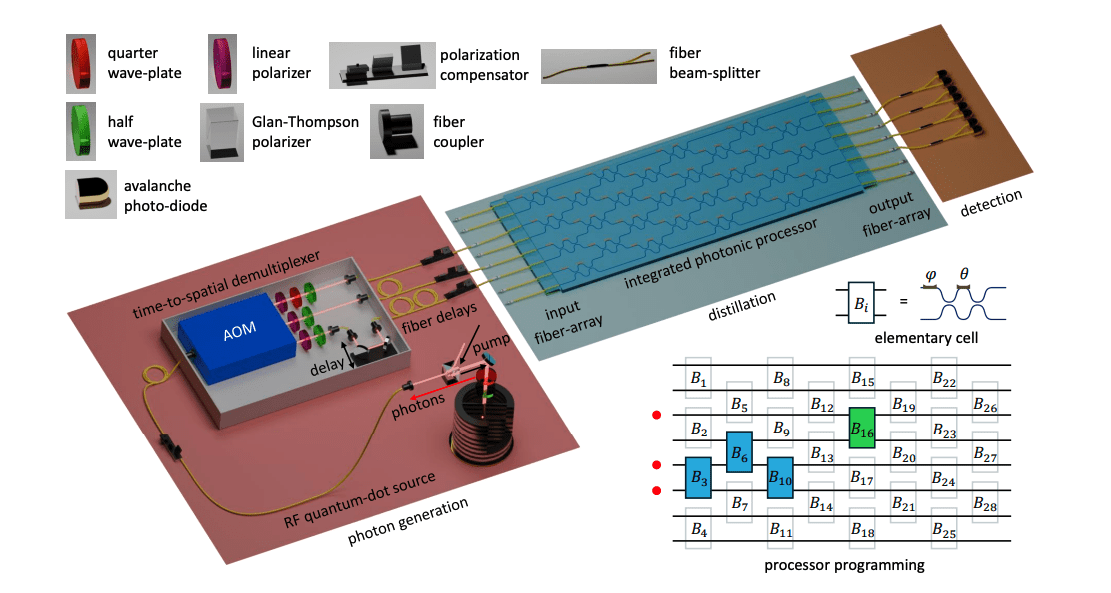
The quest for perfect single photons underpins many emerging quantum technologies; however, real-world photons invariably suffer from imperfections that limit their performance. Francesco Hoch, Anita Camillini, and Giovanni Rodari, alongside Eugenio Caruccio, Gonzalo Carvacho, and Taira Giordani, now demonstrate a significant advance in overcoming this challenge through a novel distillation protocol. Their research optimises the process of enhancing photons’ indistinguishability, a crucial property for quantum communication and computation, by carefully controlling quantum interference within compact photonic circuits. The team validates this protocol using a cutting-edge platform combining a quantum dot source with an integrated photonic processor, achieving substantial improvements in indistinguishability even with limited resources and across various challenging scenarios, thereby solidifying distillation as a viable technique for building practical photon-based quantum systems.
Improving Single Photon Indistinguishability for Quantum Technologies
Researchers continually refine methods to enhance the indistinguishability of single photons, a vital requirement for numerous quantum technologies including quantum computation, communication, and sensing. Achieving high degrees of indistinguishability proves challenging due to imperfections in photon sources and the paths they travel, limiting the clarity and reliability of quantum operations. Consequently, developing methods to mitigate these imperfections and improve photon indistinguishability remains paramount. A more efficient strategy involves actively manipulating the photons to reduce inherent imperfections, a process known as indistinguishability distillation. This work investigates a novel approach to photonic indistinguishability distillation using a specifically designed integrated photonic circuit. The circuit uses a series of beam splitters and phase shifters to control the interference of input photons, suppressing characteristics that distinguish them and enhancing their indistinguishability, paving the way for more robust and scalable quantum technologies.
Photonic Quantum Computation and Information Processing
This extensive list of references details research in quantum optics, photonic quantum computation, and related fields, covering a broad range of topics essential for building and advancing quantum technologies. Key themes include photonic quantum computation and information processing, single-photon sources and detectors, quantum gates and circuits, and quantum key distribution. Fundamental aspects of quantum optics, such as entangled photon pairs, non-classical light, and squeezed light, are also represented, alongside the growing field of integrated photonics, which aims to miniaturize and scale up quantum technologies. Research in quantum metrology, sensing, materials, and devices, alongside theoretical foundations of quantum optics and information, are also well represented, demonstrating the rapidly evolving nature of the field with a clear increase in publications, particularly in integrated photonics and experimental demonstrations. In summary, this bibliography provides a comprehensive overview of the current state of research in photonic quantum computation and related areas, highlighting key challenges and opportunities in this exciting and rapidly evolving field.
Three-Photon Distillation Boosts Photon Indistinguishability
Researchers have demonstrated a groundbreaking three-photon distillation protocol that significantly enhances the indistinguishability of photons, a critical factor limiting performance in photonic quantum communication and computation. The team achieved this by carefully optimising the protocol to maximise visibility gain while accounting for complex multi-photon effects, specifically collective photonic phases. The experiments utilized a novel platform integrating a demultiplexed quantum dot source with a programmable eight-mode laser-written integrated photonic processor, allowing for precise control and manipulation of the photons. By employing interferometers designed with a minimal number of modes, the researchers successfully distilled indistinguishability even with limited photonic resources and across various multi-photon distinguishability scenarios. The protocol’s performance was thoroughly validated by examining the indistinguishability gain and success probability across a range of input conditions, confirming its robustness and effectiveness. Researchers characterized the multi-photon distinguishability using a Gram matrix formalism, fully specified by three pairwise visibilities and a single collective phase, paving the way for more reliable and efficient quantum information processing.
Photon Distillation Improves Indistinguishability and Phases
This research demonstrates a three-photon distillation protocol designed to enhance the indistinguishability of photons, a crucial factor for improving the performance of photonic quantum technologies. By carefully optimising the protocol for multi-photon effects and utilising a programmable photonic processor, the team successfully implemented and validated the distillation process with limited photonic resources. The study highlights the importance of considering collective photonic phases in multi-photon experiments, demonstrating that outcome probabilities depend on these effects, not just pairwise visibilities. While the current work focuses on three photons, the developed protocol and insights are applicable to more complex systems.
👉 More information
🗞 Optimal distillation of photonic indistinguishability
🧠 ArXiv: https://arxiv.org/abs/2509.02296