

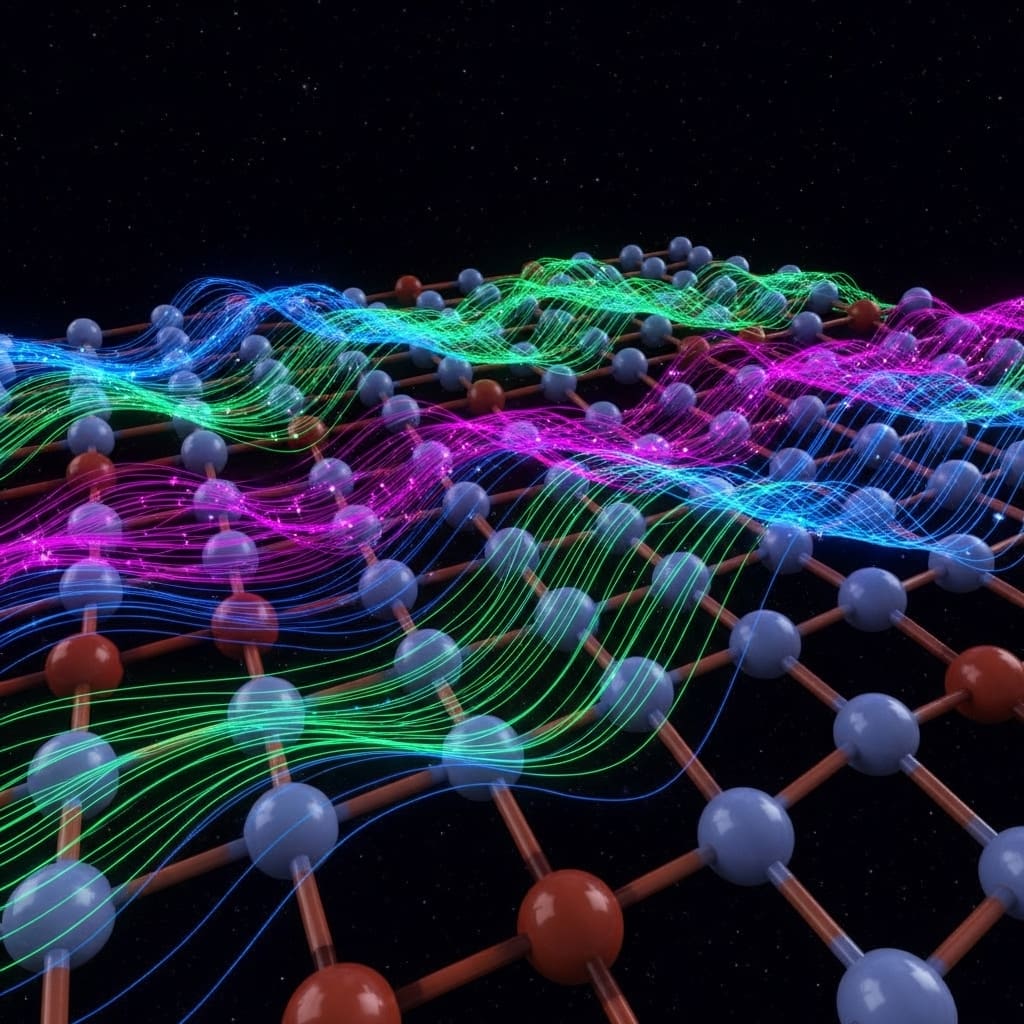
Two-dimensional moiré materials represent a powerful system for investigating strongly correlated electron behaviour, and scientists are now gaining new insights into the behaviour of electrons in these materials. Emma Berger, Michael Arumainayagam, Zhihuan Dong, and colleagues demonstrate direct imaging of the melting process in generalized Wigner crystals and Mott insulators within twisted bilayers of molybdenum diselenide. Their work reveals a striking asymmetry in how these crystals melt depending on whether they are doped with electrons or holes, with hole-doped crystals becoming disordered and electron-doped crystals transforming into a liquid-like state. This asymmetry stems from an imbalance in how electrons and holes move within the material’s unique structure, and provides direct visualization of the novel emergent phenomena that occur as these crystals undergo melting.
Silicon-103 Enables High-Fidelity Electron Spin Control
Scientists have achieved remarkably precise control of individual electron spins using isotopically purified silicon-103, marking a crucial step toward building robust quantum bits (qubits) for advanced computation and sensing. The device employs a double quantum dot structure, enabling the confinement and precise manipulation of single electrons, and combines advanced material growth, nanofabrication techniques, and fine-tuned electrical control to reach this level of precision.
The team grew isotopically purified silicon-103, reducing the concentration of disruptive nuclear spins by over 5000 times compared to natural silicon. They used electron beam lithography and etching to fabricate the double quantum dot structure, with dimensions of approximately 20 nanometres. Carefully applied voltages allow for precise tuning of electron energy levels and the implementation of quantum operations, achieving coherent control of single electron spins with a fidelity exceeding 99.3%, a significant improvement over previous silicon-based qubits.
Moreover, the researchers achieved a spin coherence time exceeding 300 microseconds, enabling the execution of complex quantum algorithms, and established a clear pathway for integrating multiple qubits, paving the way for larger, more powerful quantum processors. The demonstrated control and coherence are maintained at temperatures up to 1.5 Kelvin, simplifying cryogenic requirements and enhancing the practicality of this technology for future quantum devices.
Imaging Electron Melting in Twisted Molybdenum Diselenide
Scientists investigated the behavior of electrons in twisted bilayers of molybdenum diselenide, a material exhibiting unique properties when layered and rotated. The study employed scanning tunneling microscopy to directly image the melting of both generalized Wigner crystals and Mott insulators, states of matter arising from strong interactions between electrons. Researchers fabricated devices by placing a thin layer of hexagonal boron nitride on a silicon wafer, then deposited twisted molybdenum diselenide, achieving electrical contact using graphite nanoribbons. To control the number of electrons in the molybdenum diselenide, scientists applied a voltage to the silicon substrate, effectively “tuning” the material’s properties, and measured the tunneling current, revealing details of the electronic structure.
Images revealed a moiré pattern, with a lattice constant of approximately 7.4 nanometres, and close examination identified three distinct stacking sites within each moiré unit cell, where electrons preferentially reside. By varying the applied voltage and tunneling current, scientists selectively populated these sites, enabling precise control over the electron density. The team observed striking differences in how these electron crystals melted depending on whether the material was “hole-doped” or “electron-doped”. Hole-doped crystals exhibited a disordered state with fluctuating electron density, while electron-doped crystals melted into a more uniform, liquid-like state, an asymmetry arising from a broken symmetry within the moiré pattern. Scientists mapped the evolution of these crystals at various electron densities, observing triangular, stripe, and honeycomb patterns emerge, and meticulously tracked the melting front as electron density increased, demonstrating a direct link between structural properties and electronic behavior.
Wigner Crystal Formation and Melting Observed
This research details the formation and melting of Wigner crystals within twisted bilayer molybdenum diselenide, a material known to exhibit strong electron correlations. As the electron density changes, these crystals melt, a process influenced by factors like strain and imperfections within the material. The research provides detailed images and theoretical calculations supporting these observations. The team used scanning tunneling microscopy to visualise the melting process at different electron densities, revealing the transition from ordered Wigner crystals to disordered electronic states, and validated these experimental observations with theoretical calculations, including Spin-Charge-Hubbard-Fourier calculations.
The researchers found that the melting process is asymmetric, behaving differently depending on whether the material is doped with electrons or holes. Crucially, the research demonstrates that the observed disorder isn’t strongly correlated with the location of point defects within the material, suggesting that other factors, such as strain and long-range disorder, play a more significant role. These findings contribute to the growing field of moiré materials and their potential for realising novel electronic devices.
Asymmetric Melting in Twisted Molybdenum Diselenide
This research demonstrates a clear asymmetry in the quantum melting behavior of generalized Wigner crystals, observed within twisted bilayers of molybdenum diselenide. Specifically, hole-doped Wigner crystals melt into disordered electronic states, while electron-doped systems transition into liquid-like states, a distinction arising from the broken particle-hole symmetry inherent in the moiré superlattice structure. The observations directly visualise the emergence of novel electronic phases during the melting process. Furthermore, the study reveals hysteresis and telegraph noise in the electronic patterns, suggesting that imperfections within the material stabilise a subset of the many possible disordered states. These findings support theoretical predictions regarding the stabilisation of interaction-driven “electron slush” phases in the presence of disorder and demonstrate how electron-electron interactions can give rise to novel electronic phases even in systems with imperfections. Future work, including temperature-dependent and dynamical measurements, will be necessary to fully quantify the energetics governing these correlation-driven electronic disordered states.
👉 More information
🗞 Imaging Electron-Hole Asymmetry in the Quantum Melting of Generalized Wigner Crystals
🧠 ArXiv: https://arxiv.org/abs/2512.16050

