

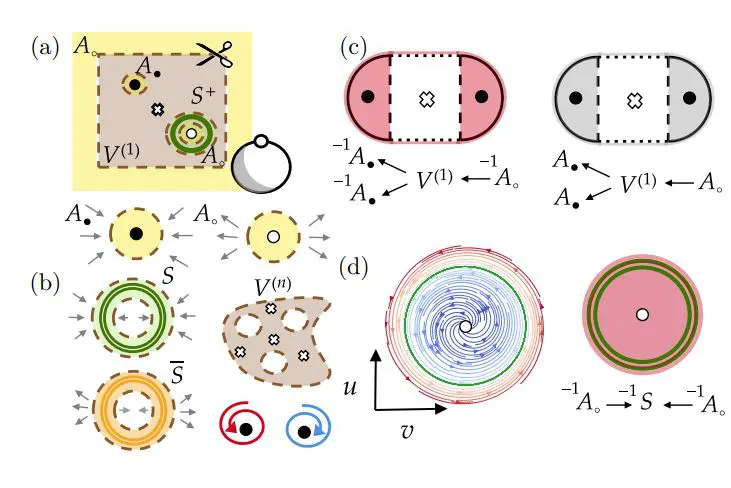
Self-oscillatory systems appear throughout nature and technology, and understanding their behaviour relies on characterising how stationary states, such as fixed points and limit cycles, organise within these systems. Alejandro S. Gómez and Javier del Pino, from Universidad Autónoma de Madrid, now demonstrate a new method for tracking changes in these dynamic patterns, moving beyond traditional spectral analysis. Their work introduces a topological graph invariant, termed the ‘molecule’, which maps the connections between these stationary states and reveals transitions in the system’s overall flow topology. This approach captures subtle changes in dynamics that would otherwise remain hidden, offering a more complete and unified way to identify and classify complex behaviours in self-oscillatory systems and providing insights into the underlying mechanisms governing their evolution.
Bifurcation Dynamics in Nonlinear Optical Systems
Scientists investigate the global dynamics of nonlinear optical systems, moving beyond simple local stability analysis to understand how a system’s behaviour changes as parameters are adjusted. This research focuses on identifying bifurcations, sudden shifts in behaviour, and mapping the entire range of possible states the system can occupy, crucial for designing and controlling complex optical devices. The team combines mathematical analysis with numerical simulations to map the system’s behaviour and pinpoint these critical changes, meticulously tracking how the system evolves and revealing the sequence of bifurcations that occur as parameters are varied. This detailed analysis reveals specific events, including the destruction of oscillations, rearrangements of flow patterns, and the creation or annihilation of stable and unstable states, validated by numerical simulations confirming the accuracy of the mathematical predictions. Detailed mapping of the system’s phase space reveals the interplay between fixed points, oscillating patterns, and the pathways connecting them, with important implications for the design and control of optical devices, including lasers and optical oscillators, and contributing to the broader field of nonlinear optics and the development of quantum technologies.,.
Topological Framework Reveals Oscillator Dynamics
Scientists have developed a novel topological framework to characterise dynamical phases in self-oscillating systems, moving beyond the limitations of traditional spectral analysis. This research centres on a mathematical construct called the ‘molecule’, which captures the connections between fixed points and limit cycles within the system’s phase space, encoding the global topological constraints governing rearrangements of attractors and clarifying when such changes impact the system’s oscillatory modes. To implement this framework, the team constructed a model system consisting of a nonlinear oscillator, subject to both gain and loss, capturing core mechanisms found in diverse quantum platforms including trapped ions and superconducting circuits. Scientists then meticulously analysed the phase space of the system, identifying fixed points and limit cycles that define the system’s attractors, and developed a method to calculate the ‘molecule’ for different parameter settings, effectively condensing the full dynamics into a single visual object. By tracking changes in this molecule as parameters are varied, scientists can predict phase transitions and identify topological invariants that dictate allowed or forbidden transitions, revealing signatures in transient states even when these transitions are not clearly visible in the system’s spectrum.,.
Topological Invariant Reveals Quantum Oscillation Phases
Scientists have developed a novel topological framework for understanding self-oscillatory behaviour in quantum systems, revealing previously hidden dynamical phases. This work introduces a new invariant, termed the ‘molecule’, which captures the connections between fixed points and limit cycles, fundamental attractors defining the system’s long-term behaviour, and provides a means to classify distinct dynamical patterns like relaxation pathways. The molecule effectively encodes the global topological constraints governing rearrangements of these attractors and their surrounding basins, clarifying when such changes impact the system’s oscillatory modes. The team demonstrated that the molecule condenses the full dynamics into a single visual object, allowing for the prediction of physical signatures in transient states, even when these transitions are not apparent in the system’s spectrum. Applying this framework to a parametrically driven resonator, a model capturing core mechanisms across diverse quantum platforms, researchers analysed the system’s evolution and identified dissipative transitions when its real part closes. Measurements confirm that the molecule accurately captures the arrangement and chirality of fixed points and limit cycles, with fixed point chirality determined by a mathematical measure in the high-excitation limit, dictating allowed topological changes at bifurcations and revealing transitions that might otherwise remain hidden.,.
Tracking Dynamical Transitions With Molecular Invariants
Researchers have developed a novel topological invariant, termed the ‘molecule’, to characterise dynamical changes in systems, revealing transitions that might otherwise be obscured by conventional spectral analysis. This invariant captures the connections between fixed points and limit cycles within the system’s phase space, identifying changes in dynamical patterns, such as relaxation pathways, as discrete alterations in its structure, offering a more comprehensive understanding of system behaviour than traditional methods. The team demonstrated how the molecule tracks the evolution of dynamical states through a series of transitions, specifically observing the formation and subsequent annihilation of repelling patterns and fixed points, influenced by alterations in system parameters and impacting the overall flow topology and stability of trajectories. The researchers acknowledge that the method’s sensitivity relies on the system exhibiting decisive dynamics, where trajectories strictly attract or repel, avoiding ambiguous neutral directions, suggesting potential for exploring the application of this topological approach to more complex systems and investigating its potential for predicting and controlling dynamical behaviour in a wider range of physical contexts.
👉 More information
🗞 Quantum Dynamical Signatures of Topological Flow Transitions in Limit Cycle Phases
🧠 ArXiv: https://arxiv.org/abs/2512.11747


