Hydrogen hydrates represent a fascinating class of materials where hydrogen molecules become trapped within a crystalline water structure, and recent research focuses on understanding their behaviour under extreme conditions. Loan Renaud, Tomasz Poreba, and Simone Di Cataldo, alongside colleagues from institutions including Sorbonne Université and École Polytechnique Fédérale de Lausanne, investigate the complex interplay between hydrogen and water within these hydrates, specifically focusing on a structure known as filled ice. Their work reveals a remarkable ‘dual quantum locking’ effect, where the hydrogen and water molecules become strongly coupled at high pressures, exhibiting coordinated behaviour not seen in either substance alone. This discovery significantly advances our understanding of hydrogen’s properties under intense confinement and establishes hydrogen-filled ices as a potentially valuable platform for developing new hydrogen-rich materials with tailored characteristics.
Hydrogen and Deuterium Rotation in High-Pressure Ice
Investigations reveal how the rotational behavior of hydrogen and deuterium molecules changes within high-pressure ice, transitioning from free rotation to quantum oscillator-like motion. Raman spectroscopy observed the rotational energy levels of these molecules, demonstrating that increasing pressure broadens and shifts these levels, indicating altered rotational dynamics. This reveals a clear transition where the molecules behave as quantum harmonic oscillators, confined by the surrounding water ice. Molecular dynamics simulations determined the temperature at which the system transitions between disordered and ordered phases, calculating a global order parameter reflecting the degree of order.
This identified a threshold value for a fluctuating orientation factor, predicting the transition temperature within a more efficient quantum embedded model. The isotopic effect is also observed, with deuterium exhibiting weaker rotational energy levels and a different evolution under pressure. Detailed Raman analysis clarifies the evolution of rotational energy levels at high pressures, confirming the influence of the water ice cage on the rotational dynamics of trapped molecules. By tracking the center of mass of specific rotational energy levels, scientists pinpoint the transition from free rotation to quantum oscillator behavior, providing a detailed understanding of the rotational dynamics of hydrogen and deuterium within high-pressure ice.
Hydrogen Hydrate Stability Under Extreme Conditions
Scientists investigated the stability of hydrogen hydrates, crystalline materials containing hydrogen molecules within a water framework, under extreme pressure and temperature. Combining computational modeling and high-pressure experiments, they mapped the phase diagram of a cubic hydrate structure, notable for its strong hydrogen-hydrogen and hydrogen-water interactions. Experiments, including Raman spectroscopy and synchrotron X-ray diffraction, tracked changes in the hydrogen sublattice within the hydrate, revealing three distinct regimes governed by temperature and the coupling between hydrogen and the surrounding water lattice. X-ray diffraction and Raman spectroscopy characterized structural transformations as pressure increased and temperature decreased.
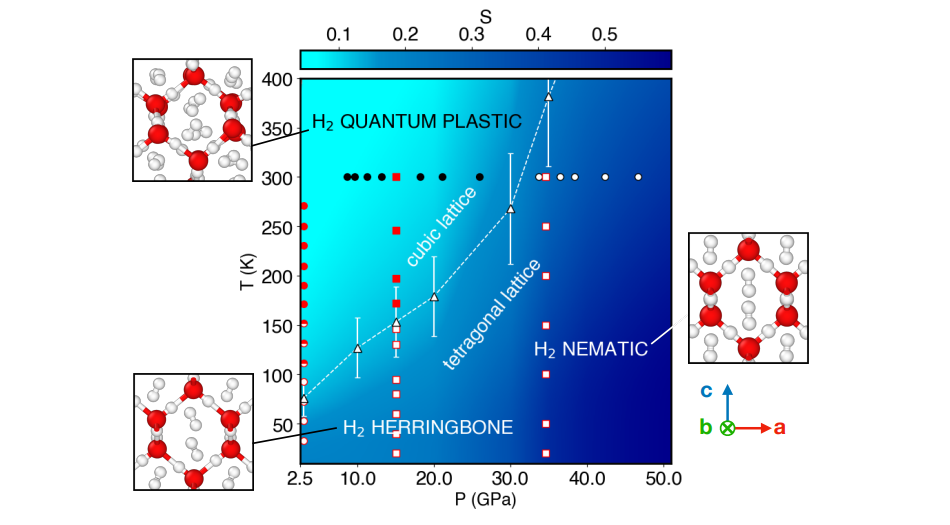
Scientists developed an orientation factor, quantified through quantum embedded calculations, to measure the alignment of hydrogen molecules, validating it against molecular dynamics simulations. At high temperatures and below 30 GPa, the hydrogen sublattice exhibited a quantum plastic crystal phase, characterized by translational order but dynamic orientational disorder, where hydrogen molecules behaved as nearly free quantum rotors. Upon decreasing temperature or increasing pressure, the team observed orientational ordering of hydrogen molecules, leading to a herringbone-like arrangement and ultimately a nematic phase with molecules aligned along the crystal’s axis. Raman spectroscopy, sensitive to rotational energy levels, revealed how the anisotropic crystal field lifted the degeneracy of rotational levels, providing insights into the quantum behavior of hydrogen within the hydrate structure. This detailed analysis establishes hydrogen-filled ices as promising materials for hydrogen storage and related applications.
Hydrogen Hydrate’s Quantum Plastic Crystal State
Researchers constructed a detailed pressure-temperature phase diagram using computational modeling and low-temperature Raman spectroscopy and synchrotron X-ray diffraction, probing the behavior of hydrogen within the C2 phase of hydrogen hydrates. Experiments demonstrate that at high temperatures and pressures below 30 GPa, the hydrogen sublattice exists in a “quantum plastic crystal” state, exhibiting translational order but with dynamically disordered orientations due to quantum fluctuations. Each hydrogen molecule behaves as a nearly free quantum rotor, despite being positioned on a diamond-type lattice. As pressure increases or temperature decreases, the hydrogen molecules undergo orientational ordering, aligning along the crystal’s axis, quantified by an “orientation factor” ranging from 0 to 1.
Measurements confirm that this orientational ordering is driven by hydrogen-bond symmetrization within the water lattice, occurring at 26 GPa, significantly lower than in standard ice VII. Researchers established that this proton symmetrization triggers nematic alignment of the hydrogen sublattice, subsequently driving tetragonal distortion of the host framework. The team precisely characterized three distinct regimes of hydrogen behavior, linking microscopic events to macroscopic observations and establishing a fundamental mechanism connecting proton symmetrization, guest orientational order, and host lattice deformation within the C2 phase, establishing hydrogen-filled ices as a promising platform for the design of hydrogen-rich materials.
Hydrogen Hydrate Orientational Ordering Revealed
Through a combination of computational modeling and high-pressure experiments, scientists have mapped the pressure-temperature phase diagram of a specific hydrogen hydrate structure, revealing how hydrogen molecules behave under extreme conditions. The team discovered that orientational ordering, the alignment of hydrogen molecules, occurs at significantly lower pressures within the hydrate than in pure solid hydrogen, due to the strong interactions with the surrounding water network. Specifically, the research identifies three distinct states of hydrogen within the hydrate. At high temperatures and moderate pressures, hydrogen molecules exhibit a “quantum plastic” phase, possessing translational order but retaining free rotational movement due to quantum effects. As pressure increases or temperature decreases, the hydrogen molecules transition to an ordered state, aligning along the crystal’s axis, demonstrating the degree of collective hydrogen molecule alignment with an orientation factor. The authors acknowledge that the precise nature of the transition between these phases requires further investigation, particularly at very high pressures, with future work focusing on refining the understanding of these transitions and exploring the potential of these hydrogen-rich materials for various applications.
🗞 Dual quantum locking: Dynamic coupling of hydrogen and water sublattices in hydrogen filled ice
🧠 ArXiv: https://arxiv.org/abs/2510.25707