The pursuit of topologically ordered phases of matter, which promise robust quantum computation, typically relies on complex interactions rarely found in natural systems. Hans Peter Büchler, Tobias F. Maier, Simon Fell, and colleagues at the University of Stuttgart address this challenge by tackling the inverse problem, designing realistic systems that exhibit desired topological properties. Their work demonstrates how to engineer topological order using simple blockade interactions between Rydberg atoms, constructing Hamiltonians that realise topological phases described by non-abelian double models. This achievement represents a significant step forward, providing both analytical proof of topological order and efficient methods for creating and manipulating these states, ultimately paving the way for practical exploration of non-abelian anyonic statistics through controlled braiding protocols.
D(S3) Model And Anyonic System Foundations
This document explores the mathematical and physical foundations of non-abelian anyonic systems, specifically within the framework of the quantum double model D(S3). These systems are of great interest for topological quantum computation because the unique way anyons interact, through braiding their paths, offers a potentially robust method for performing quantum calculations, shielded from local disturbances. The D(S3) model serves as a manageable example for understanding the underlying principles and performing concrete calculations. The research establishes a foundation by defining key concepts, including anyons, quasiparticles exhibiting unusual exchange statistics, and quantum doubles, a mathematical framework for describing anyonic systems.
Fusion rules dictate how anyons combine, while braiding statistics describe how their quantum state changes when their paths are exchanged. Non-abelian braiding statistics are crucial for topological quantum computation, offering a pathway to robust quantum gates. A central focus is the Hilbert space, which describes the possible states of the system. The research details how to define a space for four anyons fusing to the vacuum, revealing the non-abelian nature of their interactions. Different mathematical bases are introduced to simplify calculations, and braid generators are defined to describe the exchange of anyons. The work culminates in a demonstration of how braiding operations change the quantum state, illustrating the potential for quantum computation. This comprehensive analysis provides a solid foundation for exploring non-abelian anyons and their applications in quantum information processing.
Rydberg Atoms Realize Controlled Anyon Creation
Scientists have engineered a novel method for creating and manipulating non-abelian anyons, fundamental particles with exotic quantum properties, using Rydberg atoms. This work addresses a long-standing challenge in physics by demonstrating how to realize topological order with interactions achievable in a laboratory setting. The team pioneered a technique to construct Hamiltonians that realize topological orders described by non-abelian double models, moving beyond theoretical constructs to a physically realizable system. To create well-defined flux anyons, the team implemented a precise procedure, starting with a topological ground state where all sites were in a zero-flux state.
A special “flux factory” site was then detuned, creating an imbalance that allows for the injection of fluxes into the system. This site serves as the origin for creating pairs of flux anyons and their antiparticles. By carefully controlling detunings, the team created a state where two flux anyons are pinned at adjacent sites. Crucially, the team demonstrated deterministic and adiabatic creation of flux anyons in a well-defined fusion channel, ensuring predictable interactions. After initial creation, the researchers showed how to move areas encompassing the anti-flux anyon around the system, effectively transporting the anyons.
This allows for the controlled braiding of anyons, a process essential for probing their non-abelian statistics and demonstrating their potential for quantum computation. To probe the fusion channels of these anyons, scientists harnessed Wilson loop operators, measuring the total flux enclosed around flux-carrying holes. This measurement provides insight into the interactions between the anyons and confirms their non-abelian character. The study then applied this toolbox to the simplest non-abelian quantum double derived from the permutation group S3, featuring eight anyon types and an eight-fold ground state degeneracy on a torus. This work establishes a complete protocol for exploring non-abelian anyons, encompassing ground state preparation, deterministic creation, adiabatic transport, and probing of fusion channels.
Rydberg Atoms Realize Topological Order with Blockade Graphs
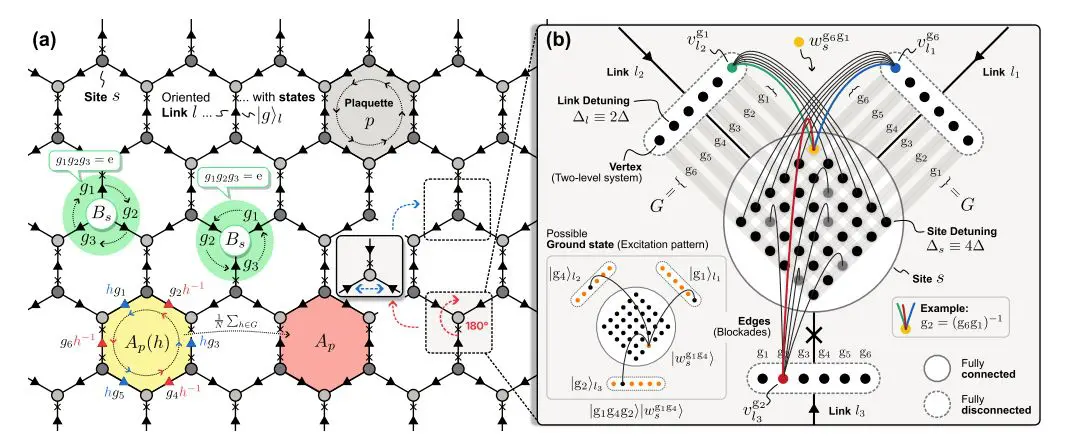
Scientists have achieved a significant breakthrough in constructing Hamiltonians that realize topologically ordered phases of matter using Rydberg atoms. This addresses a longstanding challenge in physics by providing a pathway to explore exotic states of matter and potentially enable fault-tolerant quantum computation. The research overcomes the typical requirement for complicated interactions by utilizing simple blockade interactions between two-level systems, making the realization of these topological phases more accessible. The core of this achievement lies in a novel construction of blockade graphs, which encode the spatial arrangement of two-level systems.
These graphs are meticulously designed to correspond to Hamiltonians that exhibit topological order in their ground states. Researchers analytically proved the existence of this topological order, demonstrating a robust and verifiable characteristic of the system. Furthermore, the team developed efficient schemes to prepare these topologically ordered states, paving the way for experimental realization and manipulation. Crucially, the study introduces protocols for the controlled adiabatic braiding of anyonic excitations, allowing scientists to probe their non-abelian statistics. This braiding process confirms the non-trivial nature of the created states and their potential for information processing.
The construction is remarkably generic, applicable to doubles for any finite group, and was specifically illustrated for the simplest non-abelian double. The team’s Hamiltonian is defined by a blockade interaction, where two-level systems interact strongly when within a blockade radius and negligibly beyond. This interaction is encoded in a vertex-weighted blockade graph, where vertices represent the two-level systems and edges denote blockade interactions. The resulting Hamiltonian incorporates both the blockade interactions and site-dependent longitudinal fields, creating a versatile platform for realizing complex quantum states. Measurements confirm that the constructed Hamiltonians realize all topological phases of Kitaev’s quantum double models on a honeycomb lattice, assigning a quantum state to each link and site. The research demonstrates the ability to create a system where the three states on links adjacent to a site obey a “no-flux” constraint, ensuring the topological order is maintained.
Rydberg Atoms Realize Robust Topological Order
This research demonstrates a method for creating topologically ordered phases of matter using realistic interactions between individual atoms, specifically leveraging the strong blockade interactions found in Rydberg atom systems. The team successfully designed Hamiltonians that reliably exhibit topological order described by quantum double models for a range of finite groups. Analytical proof confirms the existence of this topological order within the ground state of these systems, and efficient protocols were developed to prepare these states and manipulate anyonic excitations. The work extends beyond simply demonstrating topological order, providing a complete set of tools for exploring the non-abelian character of these systems. This includes methods for preparing ground states, creating and controlling anyonic excitations, and probing their fusion channels through measurements of Wilson loops. The researchers highlight the adaptability of their approach, noting that the construction can be generalized to various lattice structures and parameter choices, building upon earlier formulations of quantum doubles.
🗞 Quantum doubles in symmetric blockade structures
🧠 ArXiv: https://arxiv.org/abs/2511.04414