

Strong coupling between light-emitting semiconductor nanocrystals and nanoscale metallic structures holds immense promise for developing advanced optical technologies, but achieving this reliably at room temperature remains a significant challenge. Kseniia Mamaeva, Louise Bradley, and colleagues at Trinity College Dublin and the Tyndall National Institute now demonstrate a robust method for integrating quantum dots with individual gold nanoantennas, resulting in exceptionally strong light-matter interactions. The team precisely positions quantum dots at the tips of specially designed gold bipyramid nanoantennas using a technique that exploits enhanced light fields, achieving a substantial energy splitting in their experiments. This simplified approach to quantum dot integration, confirmed through detailed simulations, paves the way for scalable solid-state devices and opens new avenues for exploring exciton-plasmon interactions under ambient conditions, potentially revolutionising fields such as optics and nanophotonics.
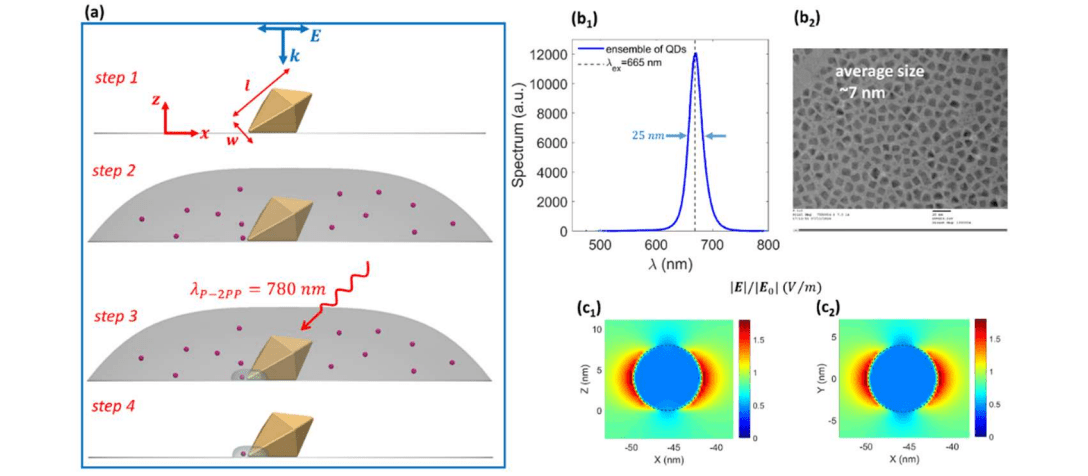
Applications demand precise control over the positioning of light-emitting materials relative to plasmonic nanostructures. This work demonstrates strong coupling between quantum dots and a single gold nano-bipyramid at room temperature, a significant advance in nanophotonic technologies. The team addressed the challenge of precisely positioning quantum emitters by employing plasmon-triggered two-photon polymerization, a technique that selectively deposits quantum dots at the tip of the gold nano-bipyramids, creating a highly localized interaction.
Plasmonic Nanostructures for Strong Coupling
This research focuses on manipulating light at the nanoscale, specifically achieving strong coupling between light and matter, which holds promise for advancements in quantum technologies, materials science, and sensing. The work utilizes plasmonics, employing metallic nanostructures like gold and silver to confine and enhance light, creating hotspots for increased interaction with nearby materials. Quantum dots and two-dimensional materials serve as the matter component, possessing quantized energy levels that strongly interact with light to form exciton-polaritons, hybrid light-matter quasiparticles with unique properties. The research also explores confining light in optical or plasmonic cavities to enhance light-matter interaction and utilizes metasurfaces, artificially engineered surfaces that control light with unprecedented precision.
Strong Coupling Between Quantum Dots and Nano-bipyramids
Scientists have achieved strong coupling between quantum dots and individual gold nano-bipyramids at room temperature, demonstrating a significant advance in nanophotonic technologies. The team employed a novel technique, plasmon-triggered two-photon polymerization, to selectively deposit quantum dots at the tip of the gold nano-bipyramids, creating a highly localized interaction. Experiments revealed a substantial Rabi splitting of 349. 3 meV and a coupling strength of 175. 68 meV in a system incorporating three quantum dots and a single nano-bipyramid.
This strong coupling, confirmed through simulations, indicates efficient energy exchange between the excitons of the quantum dots and the localized surface plasmons of the gold structure. The use of a nano-bipyramid’s single hotspot, with its very small mode volume, is central to achieving this strong interaction. This method simplifies the integration of quantum dots for strong coupling systems compared to previous approaches, and demonstrates a scalable platform for solid-state quantum technologies, enabling exploration of exciton-plasmon interactions and paving the way for advancements in quantum optics and sensing under ambient conditions. The ability to achieve such strong coupling at room temperature is particularly significant, as it removes the need for cryogenic cooling, making these technologies more practical for real-world applications.
Quantum Dots Localized by Plasmonic Coupling
This research demonstrates the successful localization of colloidal semiconductor quantum dots at the tip of individual gold bipyramids using plasmon-assisted two-photon polymerization. By leveraging the significantly enhanced electric field at the bipyramid tip, scientists precisely positioned the quantum dots, achieving strong coupling between the excitons within the dots and localized surface plasmon polaritons within the gold nanostructure. This approach overcomes key challenges associated with integrating quantum emitters at the hotspot of a plasmonic nanostructure, offering a reproducible and simplified method using a single open nanocavity. The resulting three-quantum dot-bipyramid system exhibited a room-temperature Rabi splitting of 349.
3 meV with a coupling strength of 175. 68 meV, findings which were further verified through simulations and semi-analytical calculations. This work provides a feasible approach for integrating colloidal quantum dots with single nanoresonators, paving the way for the development of practical solid-state quantum devices that operate at room temperature and have potential applications in quantum sensing and advanced nanophotonics.
👉 More information
🗞 Integration of quantum dots at the tips of single plasmonic bipyramid nanoantennas for strong coupling at room temperature
🧠 ArXiv: https://arxiv.org/abs/2511.03409


