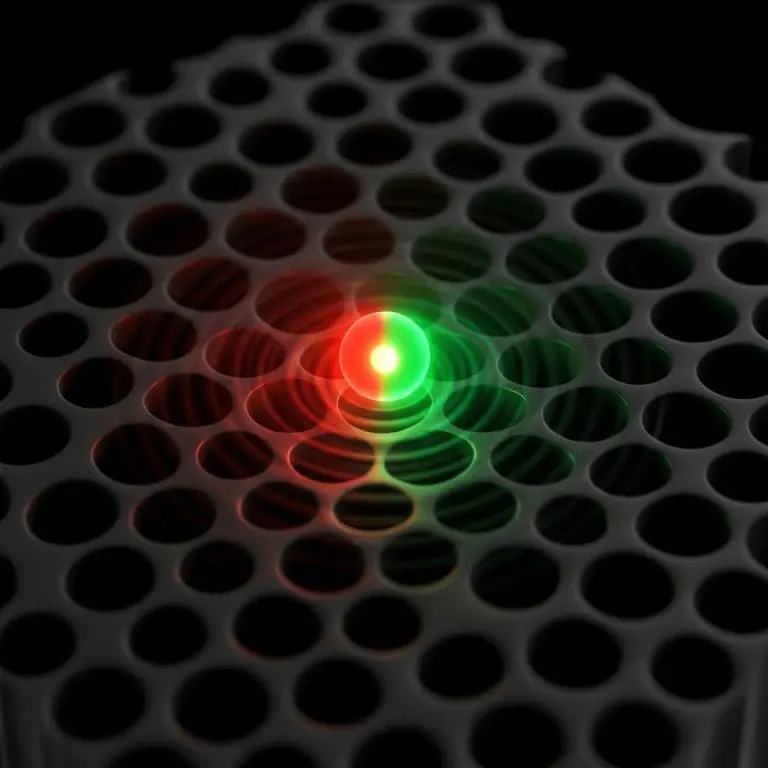
Researchers are increasingly exploring the intersection of quantum and mechanical systems, and a new study details how quantum dots can be effectively coupled to elastic waves within a phononic crystal waveguide. Led by Jakub Rosiński, Michał Gawełczyk, and Matthias Weiß from the Wrocław University of Science and Technology and the University of Münster respectively, alongside colleagues, this work presents a comprehensive theoretical investigation into these crucial interactions. By modelling both InGaAs/GaAs and GaAs/AlGaAs quantum dot structures, the team demonstrate how symmetry dictates distinct coupling mechanisms, predicting significant energy shifts , up to 0.7 meV , in response to acoustic waves. This deep understanding of quantum dot-acoustic coupling promises to unlock optimal designs for acousto-optic interfaces and pave the way for advanced quantum technologies.
Quantum Dot-Phonon Coupling via Mode Symmetries
This significant modulation highlights the sensitivity of the quantum dots to even minute acoustic disturbances. Researchers employed a detailed numerical approach, combining k·p and configuration-interaction methods with a simplified effective approach to accurately model the complex interactions within the system. The design incorporates a gigahertz-range waveguide, essential for achieving the resolved sideband regime and enabling precise control over the quantum dot’s interaction with acoustic phonons. Simulations focused on optimizing the quantum dot position within a two-dimensional snowflake-type phononic crystal pattern and its vertical alignment relative to the suspended membrane, maximizing the coupling efficiency.
Experiments show that radio-frequency elastic waves can effectively control a wide range of quantum systems, including superconducting qubits, optically active quantum dots, and single spins. The use of phononic crystals, periodic composite structures that tailor elastic properties, offers promising routes to control acoustic propagation and enhance manipulation capabilities. Specifically, suspended phononic crystal membranes provide a platform for achieving high quality factors, small mode volumes, and the integration of various components into a two-dimensional structure. Optically active epitaxial QDs, with their tunable emission wavelengths and compatibility with electrical devices, offer significant advantages for hybrid quantum architectures, enabling transduction into the optical frequency range and coupling to dynamic strain via deformation potential or piezoelectric mechanisms.
Quantum Dot Phononic Coupling via k·p-CI modelling
Researchers developed a detailed numerical approach to characterise the coupling between acoustic-wave-induced strain fields and QD charge states, utilising conduction- and valence-band deformation-potential, alongside strain-induced piezoelectric fields. The study pioneered the design of a waveguide capable of operating at gigahertz frequencies, crucial for achieving the resolved sideband regime required for advanced quantum transduction. Simulations were performed to determine the optimum QD positioning within the two-dimensional snowflake pattern and perpendicular to the suspended membrane centre, optimising interaction with tailored GHz-range elastic waves. The team constructed phononic crystal (PnC) structures consisting of hexagonal arrays of snowflake-shaped inclusions within thin GaAs and Al0.4Ga0.6As plates, selecting materials compatible with both self-assembled InAs and droplet-etched GaAs QDs.
Experiments employed a W1 waveguide created by removing a row of snowflake holes, further modified to a W1m structure by shifting and removing additional snowflake arms, enabling precise band-gap tuning and a broadened mechanical gap. The team harnessed piezoelectric constitutive equations to model the coupling between mechanical and electrostatic degrees of freedom, defining stress tensors, elastic stiffness, displacement fields, piezoelectric tensors, and electric potential. Floquet and periodic boundary conditions were applied during finite-element simulations along the x and y directions, respectively, within a supercell of the designed PnC waveguide, ensuring accurate modelling of wave propagation and QD interaction.
Quantum Dot Phononic Coupling via Strain and Piezoelectricity
The piezoelectric effect, dominated by polarizability, also contributes to a quadratic response, leading to frequency doubling in the QD response to mechanical waves and generating non-harmonic time traces when linear and quadratic effects contribute equally. The work details the band structure of the phononic crystal structures, establishing a foundation for understanding QD responses to external strain and electric fields. Finite-element simulations using COMSOL Multiphysics were employed, utilising Floquet and periodic boundary conditions to model the PnC structures and supercells accurately, stress-free boundary conditions were applied to ensure precise calculations of the mechanical behaviour. Researchers calculated the components of the strain tensor, defining their complex amplitudes and phases, and derived the electric field components from the spatial derivatives of the electric potential, providing a detailed map of the electromagnetic landscape within the structure. Tests prove that elastic waves in a piezoelectric medium couple to charge distributions via strain fields and strain-induced piezoelectric fields, described by the piezoelectric constitutive equations. The team solved the equations of motion for elastic waves in the frequency domain, enabling the calculation of eigenmodes and the decomposition of field gradients into complex amplitudes and phases.
👉 More information
🗞 Coupling Quantum Dots to Elastic Waves in a Phononic Crystal Waveguide
🧠 ArXiv: https://arxiv.org/abs/2601.14162