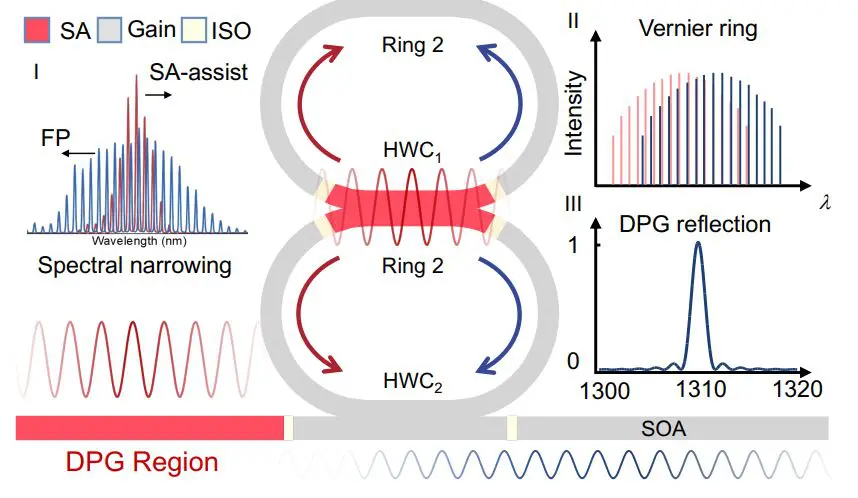
Achieving stable, single-mode operation remains a significant challenge in the development of integrated semiconductor lasers, often requiring complex and costly fabrication techniques. Xiangpeng Ou, Artem Prokoshin from King Abdullah University of Science and Technology (KAUST), Hongyan Yu, and Xin Yao et al. now demonstrate a surprisingly simple solution using quantum-dot lasers and a phenomenon called dynamic population gratings. Their research reveals that these lasers can achieve stable single-mode lasing through a straightforward cavity design, creating self-aligned feedback unattainable in conventional devices. This innovative approach delivers exceptional performance, including high side-mode suppression and a broad tuning range, while also proving resilient to external optical feedback and supporting high-speed data transmission, establishing a scalable route to advanced on-chip photonic systems for communication and beyond.
Researchers exploit the spatial hole burning effect to create a self-formed grating that preferentially supports the fundamental mode, achieving precise control over grating strength and stable operation across a wide range of injection currents. This technique offers a simpler and more versatile alternative to conventional mode control methods, paving the way for more compact and efficient integrated laser devices.
Quantum Dot Lasers with Dynamic Population Gratings
Researchers engineered a new semiconductor laser platform leveraging quantum dots to achieve stable single-mode operation through dynamic population gratings. The study pioneered integrating reverse-biased saturable absorbers into the laser cavity, introducing nonlinear, mode-dependent loss that preferentially suppresses weaker modes. This facilitates the formation of a strong standing-wave induced carrier grating, providing adaptive, wavelength-selective feedback unattainable in conventional quantum well devices. The team fabricated dual-ring Vernier lasers, incorporating spatially separated gain sections and the saturable absorber, to achieve both coarse wavelength selection and fine-tuned feedback.
Through precise control of the laser structure, researchers demonstrated a side-mode suppression ratio exceeding 52. 6 dB and a wide wavelength tuning range exceeding 46nm in the dual-ring configuration. Analysis of the saturable absorber section revealed that the standing-wave pattern induces a periodic modulation of carrier density, effectively creating an optically driven Bragg grating. Calculations and device fabrication confirmed that quantum dots exhibit significantly reduced lateral carrier diffusion compared to quantum wells, resulting in a stronger and more stable carrier grating profile. Experiments demonstrated the laser’s resilience to external optical feedback, maintaining single-mode operation under reflections up to -10 dB and supporting isolator-free data transmission at 32 Gbps, establishing a scalable route to compact, tunable, and feedback-resilient on-chip light sources.
Dynamic Population Gratings Enable High-Performance Quantum Lasers
This work demonstrates a breakthrough in semiconductor laser design, achieving stable single-mode operation through the innovative use of dynamic population gratings in quantum dot lasers. Researchers successfully integrated reverse-biased saturable absorbers into the laser cavity, creating a mechanism for self-aligned, mode-selective feedback unattainable in conventional quantum well devices. Experiments reveal that a single-ring laser achieves an impressive side-mode suppression ratio of 46 dB, effectively isolating the desired lasing wavelength. Further advancements are demonstrated with a dual-ring Vernier laser, which delivers a broad wavelength tuning range exceeding 46nm while maintaining high performance, reaching up to 52.
6 dB side-mode suppression ratio. Continuous-wave operation was sustained up to 80°C, demonstrating the thermal stability of the design. The team measured ultra-low linewidth enhancement factors in the quantum dot material, contributing to the laser’s resilience against external optical feedback. Tests confirm stable single-mode lasing even under -10. 6 dB external reflections, enabling isolator-free data transmission at 32 Gbps.
The underlying principle relies on the formation of a dynamic population grating within the saturable absorber, induced by a standing-wave pattern and enhanced by the unique properties of quantum dots. Specifically, the reduced lateral carrier diffusion in quantum dots, compared to quantum wells, allows for a high-contrast and stable carrier grating. This grating functions as a Bragg reflector, selectively reinforcing the dominant mode and suppressing unwanted side modes, resulting in exceptionally pure and stable laser output. These results establish a simple and scalable route to tunable, feedback-resilient on-chip light sources for applications in communication, sensing, and reconfigurable photonic systems.
Tunable Lasers With High Feedback Tolerance
This research demonstrates a new approach to achieving stable, single-mode operation in quantum dot lasers, utilizing dynamic population gratings within a simple cavity design. The team successfully created lasers that exhibit high side-mode suppression, reaching up to 52. 6 dB, and a continuous tuning range of 46nm. This was achieved through the formation of a self-aligned carrier grating in a reverse-biased saturable absorber, a mechanism not previously attainable in conventional well-based devices. The resulting lasers maintain continuous wave operation up to 80°C and preserve single-mode lasing even under significant external optical feedback, enabling isolator-free data transmission at speeds of 32 Gbps. The authors establish this technique as a scalable route to tunable, feedback-tolerant on-chip light sources suitable for communication, sensing, and reconfigurable photonic systems.
🗞 Mode Control and Dynamic Population Gratings in Quantum-Dot Lasers
🧠 ArXiv: https://arxiv.org/abs/2512.09740