Domain walls, boundaries between regions of differing topological order, present a fascinating frontier in understanding the strong force that binds atomic nuclei, described by quantum chromodynamics, or QCD. Suat Dengiz from OSTIM Technical University and İzzet Sakallı from Eastern Mediterranean University, along with their colleagues, investigate the emergence of stable, localized structures called domain wall skyrmions within a holographic model of QCD. This research reveals how these skyrmions, carrying baryon number two, arise on domain walls formed by chiral soliton lattices and exhibit unique energetic properties influenced by magnetic fields and density. The team’s systematic analysis establishes a phase diagram showing how these skyrmions become energetically favoured under specific conditions, offering a geometrical understanding of dense baryonic matter via string theory duality and potentially shedding light on the extreme conditions found within neutron stars.
Scientists explore the possibility of chiral symmetry restoration and the formation of exotic phases of matter at very high densities, aiming to refine our understanding of the equation of state, which describes the relationship between pressure and density. Understanding this equation of state is crucial for accurately modeling neutron stars, interpreting gravitational wave signals from neutron star mergers, and simulating the behaviour of matter created in heavy-ion collisions. The team utilizes a holographic approach, specifically the Sakai-Sugimoto model, a theoretical framework derived from string theory, to study dense baryonic matter.
This model provides a powerful tool for exploring strongly coupled systems, where traditional methods are often insufficient. Researchers analyze the behaviour of mesons and baryons within this holographic model at varying densities, calculating their properties and investigating the effects of chiral symmetry restoration. The findings demonstrate evidence for chiral symmetry restoration at high densities within the holographic model, a crucial result with significant implications for the equation of state of dense matter. The research suggests the possibility of exotic phases of matter emerging at high densities, potentially related to novel states of matter. This provides insights into the behaviour of matter in neutron stars and heavy-ion collisions.
Domain Wall Skyrmions in Holographic QCD
Scientists investigated domain wall skyrmions, topologically stable configurations of matter, using holographic chromodynamics, a theoretical framework derived from string theory. They employed the Sakai-Sugimoto model to understand quantum chromodynamics (QCD), the theory describing the strong force. Building upon previous work concerning chiral soliton lattices in strong magnetic fields, the study focused on the emergence of localized skyrmions formed on domain walls created by these lattices, realizing them as undissolved configurations within a broader structure. Researchers systematically explored how magnetic field strength, pion mass, and baryon chemical potential influence the stability of these configurations.
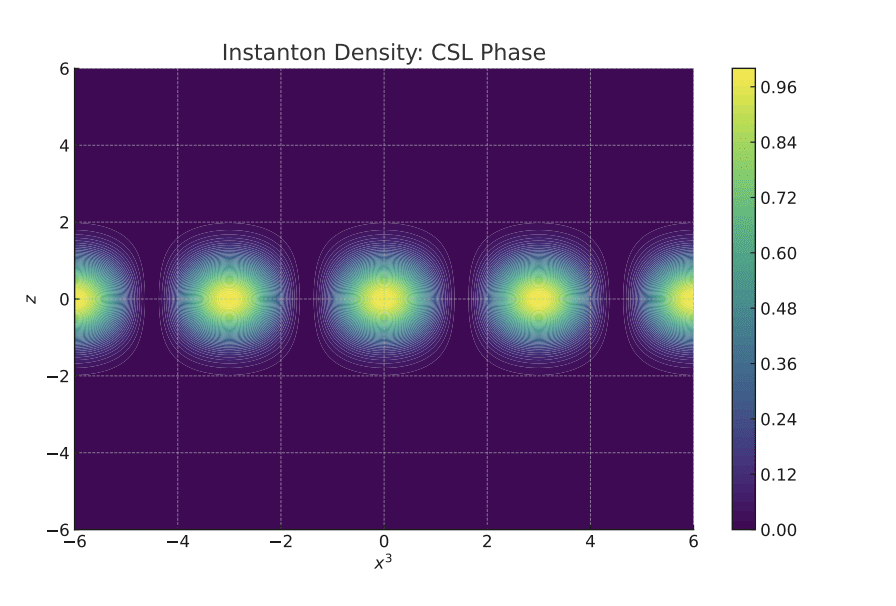
The team performed detailed energy analysis to establish that domain wall skyrmions become energetically favourable when the baryon chemical potential exceeds a critical value, approximately 0. 2 in their holographic framework. This analysis revealed three distinct regions: a chiral soliton lattice at low chemical potential and magnetic field, domain wall skyrmions at intermediate scales, and a conjectured skyrmion crystal at the highest densities. Instantons exhibited sharp localization within the domain wall skyrmions, contrasting with the smooth distribution characteristic of the pure chiral soliton lattice configuration.
Scientists harnessed the AdS/CFT correspondence, a duality between gravity and quantum field theory, to translate the strongly coupled QCD problem into a classical gravitational problem in higher dimensions. This allowed for a geometrical description of non-perturbative phenomena, such as confinement and chiral symmetry breaking. The research extended the holographic description of chiral soliton lattices to investigate the emergence and stability of domain wall skyrmions, characterizing them as localized configurations embedded within a broader structure, offering insights into baryonic matter in dense QCD and providing a geometrical picture of topological solitons with potential applications to neutron star physics.
Domain Wall Skyrmions Emerge in Holographic QCD
Scientists investigated domain wall skyrmions, topologically stable configurations of matter, using a holographic model of quantum chromodynamics. Building upon previous work with chiral soliton lattices in strong magnetic fields, the research reveals the emergence of localized skyrmions formed on domain walls created by these lattices, realizing them as undissolved configurations carrying a baryon number of two. Experiments demonstrate that these skyrmions become energetically favourable when the baryon chemical potential exceeds a critical value, approximately 0. 2 in their holographic framework.
The team established a comprehensive phase diagram revealing three distinct regions: a chiral soliton lattice at low chemical potential and magnetic field, domain wall skyrmions at intermediate scales, and a conjectured skyrmion crystal at the highest densities. Detailed energy analysis confirms that domain wall skyrmions exhibit a lower energy state than the chiral soliton lattice under specific conditions, indicating their stability. Measurements of instanton density profiles show sharp localization within the domain wall skyrmions, contrasting with the smooth distribution characteristic of the pure chiral soliton lattice configuration. The study meticulously analyzed energy contributions from Dirac-Born-Infeld and Chern-Simons terms to determine phase stability, and systematically investigated the influence of magnetic field strength and baryon chemical potential on the topological structure and energetic favorability of different ground state configurations. Researchers implemented a uniform magnetic field and a finite baryon chemical potential to modify the vacuum structure, providing insights into dense baryonic matter relevant to neutron star interiors. These findings offer a geometrical picture of topological structures via string theory duality, with potential applications to understanding neutron star physics and the behaviour of quantum chromodynamics under extreme conditions.
Skyrmion Stability and Baryon Number Concentration
This research presents a detailed investigation into the behaviour of domain wall skyrmions within the framework of holographic quantum chromodynamics, building upon established theoretical work concerning chiral soliton lattices. Scientists demonstrated the emergence of these skyrmions, realized as localized configurations within a broader chiral background, and explored their stability under varying magnetic fields and baryon chemical potentials. The analysis establishes that these skyrmions represent topologically protected concentrations of baryon number, exhibiting distinct characteristics from the more diffuse charge distribution found in pure chiral soliton lattices. Through systematic energy calculations, the team identified a critical threshold, approximately μB|B| ∼4.
5 in their holographic model, beyond which domain wall skyrmions become energetically favoured. This finding is captured in a comprehensive phase diagram delineating three distinct regions: a chiral soliton lattice at low densities, domain wall skyrmions at intermediate scales, and a potential skyrmion crystal at high densities. This work offers new insights into the behaviour of baryonic matter under extreme conditions, potentially informing our understanding of dense astrophysical environments such as neutron stars and the broader quantum chromodynamics.
👉 More information
🗞 Domain Wall Skyrmions in Holographic Quantum Chromodynamics: Topological Phases and Phase Transitions
🧠 ArXiv: https://arxiv.org/abs/2509.15034