

Calculating the ground state properties of molecules presents a significant challenge for emerging quantum computers, limited by both the expressivity of available quantum circuits and the inherent errors in current hardware. Qi-Ming Ding, Jiawei Peng, and Junxiang Huang, alongside their colleagues, address this problem with a novel hybrid classical-quantum framework. Their method actively purifies data obtained from noisy quantum devices, enforcing mathematical conditions that ensure accuracy while remaining computationally efficient, and guided by a calibration protocol designed for practical implementation. The team demonstrates exceptional accuracy in calculating the ground-state energies of small molecules, and importantly, achieves precise results for a larger, more complex molecule, establishing a scalable pathway toward reliable simulations of complex molecular systems on near-term quantum hardware.
Two-Reduced Density Matrix Bounds Quantum Errors
Scientists have established theoretical limits on the errors that arise in quantum computations due to noise, a critical step towards building practical quantum computers. This research quantifies how much the results of a quantum calculation will deviate from the ideal, error-free outcome. The team investigated the two-reduced density matrix, which represents correlations between a subset of qubits, and defined error bounds based on the probability of errors occurring at each gate within the quantum circuit. These theorems help scientists develop strategies to mitigate noise and guide the design of more robust quantum circuits.
Understanding how error scales with the size of the circuit is crucial for building larger, more powerful quantum computers. While the theorems rely on specific noise models, they provide a valuable framework for understanding and quantifying the impact of noise on quantum computations. Future research could explore more complex noise patterns and develop methods to improve the tightness of these bounds.
Purifying Noisy Density Matrices with Semidefinite Programming
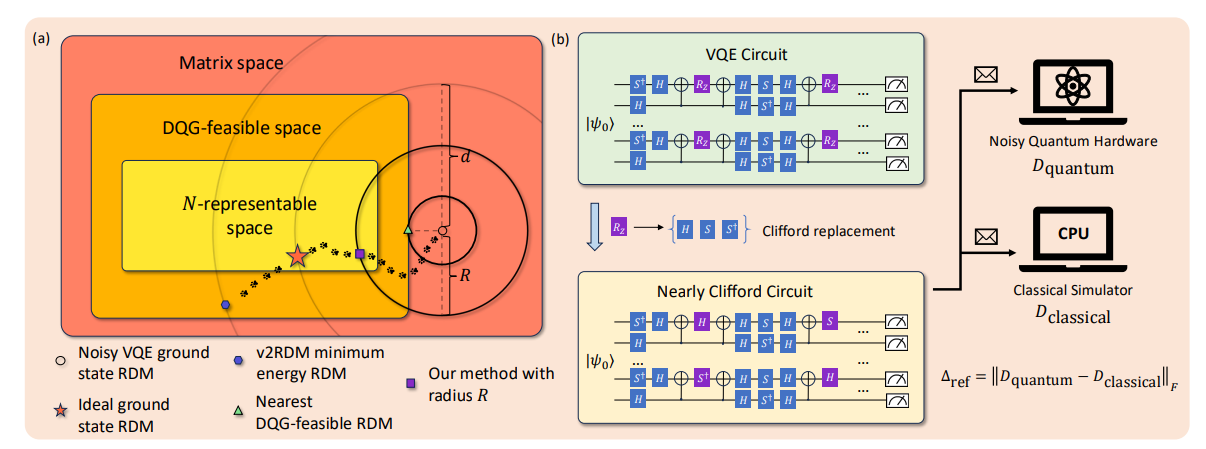
Scientists have developed a new hybrid quantum-classical method to overcome limitations in ground-state calculations on noisy quantum computers. This approach addresses both the restricted expressivity of current quantum circuits and unavoidable hardware errors. The team pioneered a method for systematically purifying noisy two-electron reduced density matrices obtained from quantum devices by enforcing mathematical conditions that ensure the data represents a physically valid state, enhancing the expressive power of the quantum circuits and mitigating the effects of noise. To calibrate this purification process, researchers designed a hardware-efficient protocol based on Clifford circuits, enabling precise control and calibration of the quantum system. They implemented this framework to compute ground-state energies for several molecular systems, achieving accuracy comparable to highly accurate calculations for hydrogen, lithium hydride, and tetramethylsilane, and extended the method to calculate precise scattering intensities for cyclohexene. This work establishes a powerful strategy for reliable quantum chemistry computation on noisy devices.
Noisy Data Yields Accurate Molecular Energies
Scientists have developed a new method for calculating the ground state energies of molecules using noisy quantum computers, achieving accuracy comparable to ideal, noiseless systems. This breakthrough addresses fundamental limitations posed by both the restricted expressivity of current quantum circuits and unavoidable hardware errors, establishing a scalable route toward practical quantum advantage. The research team systematically purifies noisy two-electron reduced density matrices obtained from quantum devices by enforcing mathematical conditions that ensure the data corresponds to a physically valid state. The method utilizes a hybrid classical-quantum framework, guided by a constraint that keeps the corrected data close to the original experimental results.
A key component is a hardware-efficient calibration protocol based on Clifford circuits, which allows for accurate estimation of the noise present in the quantum computations. Experiments demonstrate accuracy comparable to highly accurate calculations for hydrogen, lithium hydride, and dihydride, surpassing the accuracy of conventional methods, and successfully reproduced ultrafast electron diffraction intensities for cyclohexene with high fidelity. This work establishes a powerful strategy for reliable quantum chemistry computations on near-term intermediate-scale quantum devices, paving the way for advancements in chemistry and materials science.
N-Representability Improves Quantum Ground State Accuracy
Scientists have established a new quantum-classical framework that systematically refines outputs from quantum computers to determine ground-state properties with high precision. The method enforces mathematical conditions, known as N-representability, on experimentally measured two-electron reduced density matrices, ensuring physical realism within a defined trust region linked to the hardware’s noise characteristics. Researchers developed a practical calibration protocol, based on classically simulable circuits, to establish this link and effectively manage the impact of noise. Demonstrations across molecules including hydrogen, lithium hydride, and tetramethylsilane validate the approach, achieving accuracy comparable to highly accurate calculations for ground-state energies and precise computation of scattering intensities. This framework simultaneously addresses limitations inherent in quantum circuits and corrects for hardware noise, representing a step toward reliable calculations on near-term devices. The team acknowledges the scalability of the classical post-processing, particularly when combined with symmetry considerations, suggests potential for application to systems containing over 30 electrons.
🗞 Obtaining Accurate Ground-State Properties on Near-term Quantum Devices
🧠 ArXiv: https://arxiv.org/abs/2510.21255


