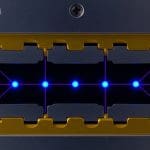
Researchers from the University of Oxford and the University of Basel have developed a physics-aware machine-learning approach to bridge the gap between reality and simulation in solid-state quantum devices. The team used a combination of a physical model, deep learning, Gaussian random field, and Bayesian inference to infer the disorder potential of a nanoscale electronic device from electron-transport data. This approach could help optimize and scale quantum devices by providing a quantitative measure of disorder, which is a major contributor to the reality gap. The findings were published in the Physical Review X journal.
Addressing Disorder in Quantum Devices
One of the major contributors to the reality gap is disorder induced by the unpredictable distribution of material defects. The team used an approach combining a physical model, deep learning, Gaussian random field, and Bayesian inference to infer the disorder potential of a nanoscale electronic device from electron-transport data. This inference was validated by verifying the algorithm’s predictions about the gate voltage values required for a quantum-dot device to produce current features corresponding to a double-quantum-dot regime.
The Role of Machine Learning in Bridging the Reality Gap
Machine learning plays a crucial role in narrowing the gap between a model and the real world, especially when a machine learning model is trained on a simulation before being applied to real systems. The reality gap is widened further when there are quantities that are not directly observable. Such unobservable quantities may be estimated through their influence on other characteristics of the system.
The Impact of Disorder on Quantum Devices
Solid-state quantum devices of nominally identical design often display different characteristics due to disorder. This variability hinders the scalability of otherwise promising qubit realizations. Being able to observe disorder potentials and provide a quantitative measure of the extent to which disorder impacts transport properties could inform the growth of semiconductor platforms for quantum device fabrication.
The Use of Physics-Aware Machine Learning Approach
The team used a physics-aware machine learning approach to gain insight into the disorder’s potential. This approach produces disorder potentials through the combination of a physical model accelerated by deep learning, Bayesian inference informed by indirect experimental measurements, and dimensionality reduction of the 2D disorder potential using inducing points and random Fourier features.
The Role of Electrostatic Simulations and Deep Learning
To infer the disorder potential, the team used a combination of transport measurements and predictions from an electrostatic simulation. To accommodate the need for many simulations with different parameter settings without extreme computation times, they developed a fast approximation of the model using deep learning. This made their approach scalable to large device architectures.
The Validation of the Physics-Aware Machine Learning Approach
The performance of the inference results was assessed by using the disorder potentials produced by the algorithm to predict the electron-transport regime of new measurements. These predictions provided good agreement with the experiment, indicating that the physics-aware method is effective. The physical model can determine the number of quantum dots at a given voltage location.
Published on January 4, 2024, in the Physical Review X, this article explores the use of machine learning in quantum devices. The authors, David Latch Craig, Hyun-Joo Moon, Federico Fedele, Dominic T. Lennon, Barbara van Straaten, Florian Vigneau, Leon C. Camenzind, Dominik M. Zumbühl, G. Andrew D. Briggs, Michael A. Osborne, Dino Sejdinović, and Natalia Ares, delve into the potential of physics-aware machine learning in bridging the reality gap in quantum devices. The full article can be accessed via its DOI: 10.1103/physrevx.14.011001.