

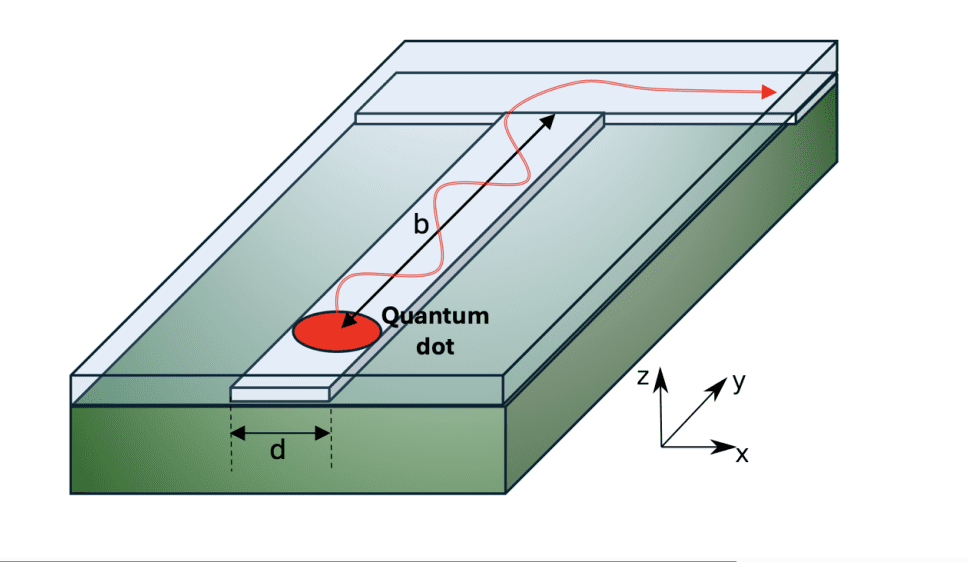
The behaviour of electrons in nanoscale structures presents a significant challenge for developing advanced quantum technologies, and understanding their movement is crucial for controlling these devices. Researchers B. Szafran and P. Wojcik investigate how electrons released from tiny semiconductor structures, known as quantum dots, move within a waveguide, revealing unexpectedly complex paths. Their work demonstrates that these electrons follow snakelike trajectories, deflected by a phenomenon called the spin Hall effect, and that the precise shape of this path depends on the electron’s initial quantum state. This discovery offers a new method for detecting the internal state of electrons within the quantum dot, even under realistic conditions with imperfect initial spin alignment and weak magnetic fields, potentially paving the way for more robust and reliable quantum devices.
Researchers have investigated the movement of electrons emitted from quantum dots within semiconductor materials, revealing that their paths are strongly influenced by spin-orbit interaction. By employing time-dependent simulations, they observed that electrons, when subjected to an electric field, follow snakelike trajectories within a guiding channel. The precise shape of this path is determined by the electron’s initial spin state, offering a potential method for reading out the quantum state of the electron within the dot. This discovery provides insight into electron transport in nanoscale devices and opens possibilities for manipulating electron trajectories using spin-orbit interactions.
The simulations, validated by semiclassical calculations, demonstrate that the snake-like trajectory persists even under a small external magnetic field and with incomplete initial electron spin polarization. This robustness is particularly significant, as it suggests the method could function effectively even when perfect spin control is not achievable. The research, focused on indium antimonide, reveals a clear connection between the electron’s energy, spin orientation, and the resulting path within the semiconductor channel. These findings contribute to a deeper understanding of electron behaviour in nanoscale systems and could pave the way for novel electronic devices and advanced quantum information processing techniques.
Semiconductor Spin Qubits Demonstrate Scalable Control
Scientists are actively developing spin qubits based on quantum dots and nanowires fabricated from semiconductor materials, aiming to create scalable and robust platforms for quantum computing. These qubits utilize the spin of electrons confined within these nanoscale structures to represent quantum information. Controlling and manipulating these electron spins is central to this research, and scientists are employing various techniques including electric and magnetic fields, and strain engineering to achieve precise control. A crucial aspect of this work is the exploitation of Rashba and Dresselhaus spin-orbit interaction, which allows for electrical control of spin, a key requirement for scalability and integration with existing electronics.
Researchers are focused on improving gate fidelity, the accuracy of operations on qubits, and minimizing decoherence, the loss of quantum information due to environmental interactions. Challenges include mitigating the effects of charge noise and nuclear spin, which can disrupt the fragile quantum states. Current research explores hybrid structures, quantum dot arrays, and nanowire networks to enhance qubit performance and scalability. The ultimate goal is to build a fault-tolerant quantum computer capable of solving problems beyond the reach of classical computers. However, the potential applications extend beyond computation, encompassing quantum simulation of complex systems, the development of highly sensitive quantum sensors, and the creation of new spintronic devices. This research builds upon the foundational work of scientists who have pioneered the field of semiconductor-based quantum information science and nanotechnology. The ongoing efforts represent a significant step towards realizing the promise of quantum technologies.
Spin-Dependent Electron Trajectories Reveal State Readout
Scientists have demonstrated that electrons released from a quantum dot within a semiconductor channel exhibit unique trajectories influenced by spin-orbit interaction. Through detailed simulations and calculations, they showed that an applied electric field causes electrons to follow snakelike paths, with the precise shape of the path revealing information about the electron’s initial spin state. This sensitivity offers a potential method for reading out the quantum state of the electron within the quantum dot, a crucial step for many quantum technologies. The observed trajectories remain robust even under weak magnetic fields and with incomplete initial spin polarization, suggesting practical applicability in devices where perfect spin control is challenging.
The calculations, performed using parameters relevant to indium antimonide, reveal a clear correlation between the electron’s energy spectrum, spin orientation, and the resulting trajectory within the channel. While the current work focuses on demonstrating the principle and validating the simulations, future research could explore the use of these spin-dependent trajectories in novel electronic devices or for advanced quantum information processing. This research contributes to a deeper understanding of electron behaviour in nanoscale systems and opens new avenues for manipulating electron spin for technological applications.
👉 More information
🗞 Snakelike trajectories of electrons released from quantum dots driven by the spin Hall effect
🧠 ArXiv: https://arxiv.org/abs/2509.24824

