Superfluid helium presents a unique state of matter for exploring the principles of quantum physics and is increasingly recognised for its potential in advanced detection technologies and quantum applications. Alexander R. Korsch, from Fudan University and Westlake University, alongside Niccolò Fiaschi and Simon Gröblacher, addresses a significant challenge in this field: the difficulty of conducting complex experiments with superfluid helium due to the need for sealed, cryogenic environments. They report the design and construction of a new helium chamber, capable of operating at extremely low temperatures within a dilution refrigerator, and crucially, incorporating both electrical connections and optical fibre access. This innovative setup allows for precise control over superfluid helium films, demonstrated through the tuning of film thickness at the sub-nanometer level and the observation of optomechanically induced phonon lasing, offering a versatile platform for a wide range of fundamental and applied research in this exciting area.
Superfluid helium represents a compelling quantum liquid and has become a prominent platform for the study of quantum many-body physics. Recently, its outstanding mechanical and optical properties, including low mechanical dissipation and low optical absorption, have positioned superfluid helium as a promising material for applications ranging from dark matter and gravitational wave detection to quantum computation. This work reports on the design and construction of a helium.
Superfluid Helium and Mechanical Resonator Coupling
This research investigates superfluid optomechanics, specifically coupling superfluid helium-4 to mechanical resonators, such as micro-resonators and photonic crystals, to explore quantum phenomena and potentially build novel sensors and quantum devices. The central idea is to leverage the unique properties of superfluid helium, its zero viscosity and quantized vortices, to enhance the sensitivity and performance of optomechanical systems. Scientists are also investigating phononic crystals within superfluid helium to manipulate phonons, the quantized units of sound, and enhance optomechanical coupling. The ultimate goal is to observe and control quantum phenomena like entanglement and squeezed states of light and motion within these superfluid optomechanical systems.
This work aims to develop highly sensitive sensors for detecting gravitational waves and dark matter, and potentially build quantum devices based on superfluid optomechanics. The experimental setup involves creating and maintaining superfluid helium at extremely low temperatures, fabricating micro-resonators, and coupling light into and out of the superfluid. The team also developed a theoretical framework for understanding the behavior of these superfluid optomechanical systems, including the effects of superfluidity on mechanical modes and the interaction between light and motion.
Sub-Nanometer Control of Superfluid Helium Films
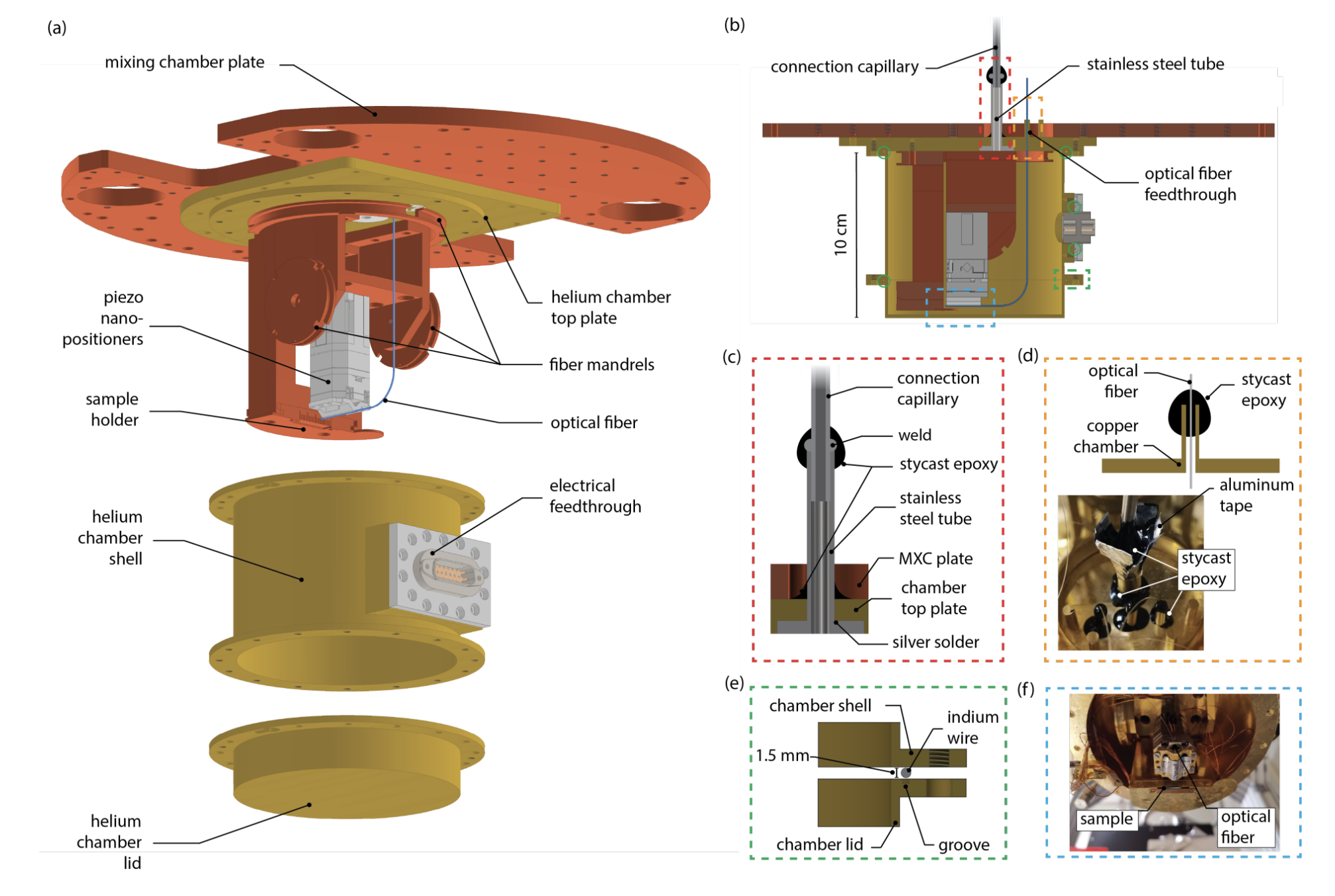
Researchers have developed a novel experimental setup for studying superfluid helium at extremely low temperatures, specifically within a dilution refrigerator operating at Millikelvin levels. This innovative chamber incorporates both electrical and fiber optic access, overcoming a significant barrier to entry for experiments utilizing this unique quantum liquid. The team successfully implemented an automated gas handling system, enabling precise control over helium gas levels within the chamber and making it particularly well-suited for investigating superfluid thin films and phenomena like superfluid thin film optomechanics. The setup allows for unprecedented control over superfluid helium film thickness, achieving tuning on the sub-nanometer scale using silicon nanophotonic resonators.
By leveraging this exceptional tunability, scientists demonstrated optomechanically induced phonon lasing of third sound modes within the superfluid film, revealing a crucial dependence of the lasing threshold on film thickness. The large internal volume of the chamber, measuring 1 liter, facilitates the integration of diverse electrical and measurement techniques, establishing a versatile platform for both fundamental and applied research into superfluid helium. This breakthrough delivers a significant advancement in the field, enabling investigations into areas such as dark matter detection and gravitational wave sensing. Experiments utilizing this setup have already explored strong optical coupling through superfluid Brillouin lasing, and have begun to investigate the potential for detecting continuous gravitational waves with superfluid helium. Furthermore, the platform supports research into ultralight dark matter detectors, and provides a means to explore quantum optomechanics in liquid systems, opening new avenues for understanding and harnessing the properties of this remarkable quantum fluid.
Superfluid Helium Chamber with Full Access
This work details the design and construction of a cryogenic chamber for experiments with superfluid helium thin films, addressing a key challenge in the field by providing both optical and electrical access alongside precise control over film thickness. The researchers successfully built a chamber with automated gas handling, enabling sub-nanometer control of the superfluid helium film, and demonstrated this capability using silicon nanophotonic resonators. The chamber’s large internal volume and multiple feedthroughs for electrical and optical signals facilitate integration of complex measurement and control techniques. This setup overcomes limitations of previous approaches, which either lacked in-situ tunability of film thickness or combined optical access with non-reusable, sealed cells.
The ability to open and reseal the chamber using indium wire seals allows for repeated use and adaptation to different experimental needs. The researchers highlight the potential of this versatile platform for both fundamental investigations into superfluid helium and applied research, including explorations of quantum systems based on this unique material. Future research could involve integrating multiple quantum systems within the chamber to explore hybrid quantum phenomena.
🗞 A cryogenic chamber setup for superfluid helium experiments with optical fiber and electrical access
🧠 ArXiv: https://arxiv.org/abs/2508.19962