

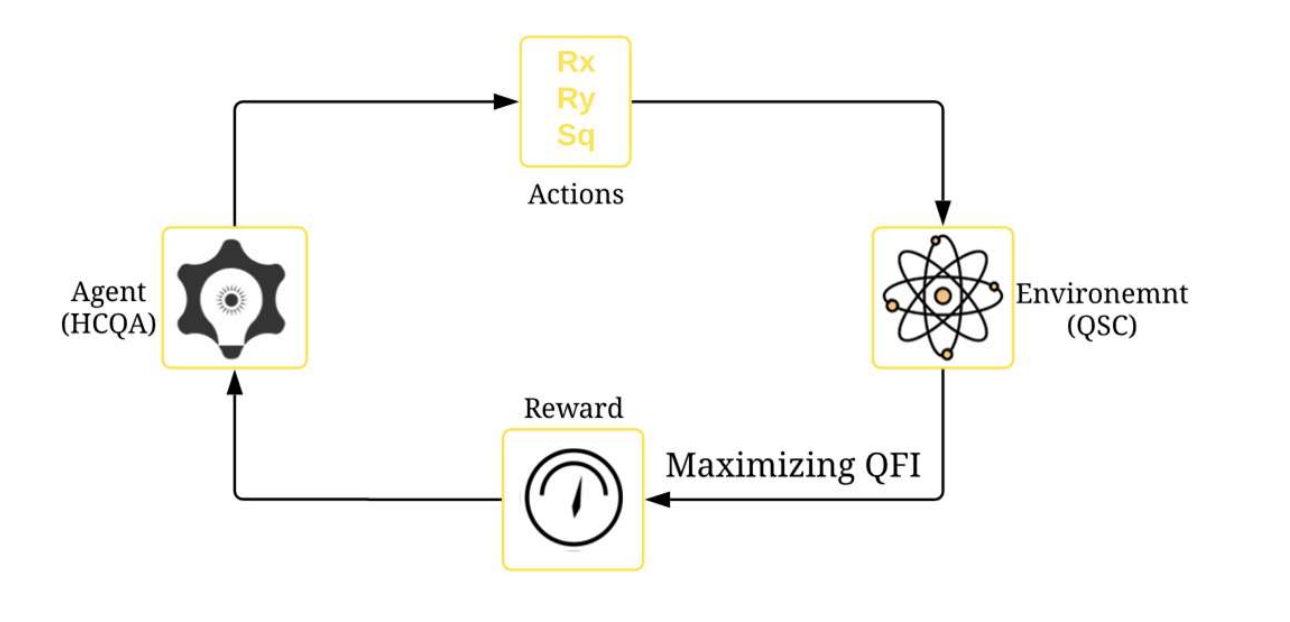
Designing optimal quantum circuits presents a significant challenge in realising the full potential of quantum sensing, and researchers are now employing artificial intelligence to overcome this hurdle. Ahmad Alomari and Sathish A. P. Kumar, from Cleveland State University, lead a team that introduces a Hybrid Classical-Quantum Agent (HCQA) capable of autonomously generating circuits tailored for specific sensing tasks. The HCQA combines the power of deep learning with the principles of quantum mechanics, allowing it to explore a vast design space and identify circuits that maximise sensing sensitivity while minimising complexity. This innovative approach demonstrates a powerful synergy between artificial intelligence and quantum computation, paving the way for automated discovery of advanced quantum sensor designs and improved state estimation capabilities.
Quantum Sensor Design via Reinforcement Learning
This research investigates the use of Reinforcement Learning (RL) and Quantum Computing to design and optimize Quantum Sensor Circuits (QSCs), aiming to create autonomous agents that can automatically generate circuits for specific tasks and potentially exceed the performance of manually designed circuits. It focuses on automating the design process and harnessing quantum advantages in sensing, opening possibilities for more sensitive and precise measurement technologies. Reinforcement Learning forms the core of this approach, where agents learn through trial and error, receiving rewards for actions that move them closer to a desired outcome. Quantum Computing provides the platform for the sensor circuits, offering potential benefits like increased sensitivity and precision.
A crucial metric for evaluating circuit performance is the Quantum Fisher Information, which indicates the precision of the sensing process; higher values signify better performance. The research utilizes squeezed states, specific quantum states that enhance sensor sensitivity, and Variational Quantum Circuits, building blocks for QSCs that allow for optimization through combined classical-quantum algorithms. Several different RL-based agents were explored, including designs leveraging Grover’s algorithm to accelerate the search for optimal circuits, representing a significant advancement in the field. The study demonstrates the feasibility of using RL to automate QSC design, reducing the need for manual intervention.
The proposed agents show promise in generating circuits with improved performance compared to traditional designs, and the research compares different RL algorithms, highlighting their strengths and weaknesses. This hybrid classical-quantum approach combines the power of machine learning with the unique capabilities of quantum computing for optimization, applicable to various sensing applications, including precise measurements and wave interference analysis. The research emphasizes the importance of using squeezed states to enhance sensor sensitivity and maximizing the Quantum Fisher Information to achieve optimal performance. The application of the RL agents to optimize Ramsey interferometry, a technique used for precise frequency measurements, is also discussed, exploring the potential of entanglement as a resource for improving sensing precision.
The study provides background information on fundamental concepts in Quantum Computing, including qubits, gates, and algorithms, and explains the principles of Quantum Metrology and Interferometry. Basic concepts in Machine Learning, such as Reinforcement Learning and Deep Learning, are also explained, providing a comprehensive foundation for understanding the research. The authors suggest further research to explore more complex QSC designs and apply the approach to a wider range of sensing applications. The system aims to maximize the Fisher Information, a key measure of precision in quantum parameter estimation, while simultaneously minimizing the number of gates required in the circuit. The method achieves precise control by maximizing Fisher Information, indicating increased sensitivity to parameter changes, and minimizing gate complexity, making the circuits practical for implementation on existing quantum computers. This innovative approach allows the agent to autonomously discover optimal circuit designs for improved sensing and estimation tasks, moving beyond traditional methods vulnerable to real-world imperfections. The breakthrough delivers a framework for generating optimal QSCs, demonstrating how reinforcement learning can guide quantum circuit synthesis in a data-efficient manner, and provides a proof of concept for scaling to more complex systems and incorporating noise models.
🗞 HCQA: Hybrid Classical-Quantum Agent for Generating Optimal Quantum Sensor Circuits
🧠 ArXiv: https://arxiv.org/abs/2508.21246


