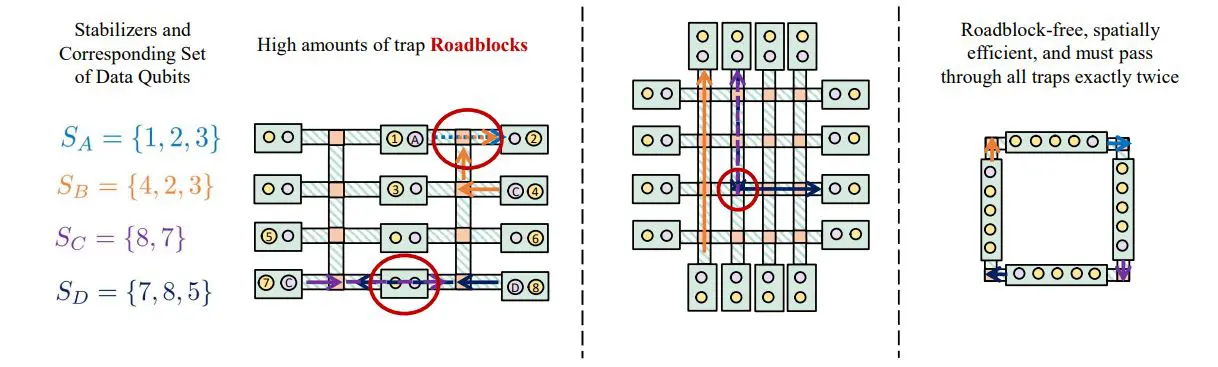
Efficient and scalable quantum memory represents a critical challenge in the development of practical quantum computers, and researchers are now exploring novel architectures to overcome existing limitations. Sahil Khan, Abhinav Anand, and Kenneth R. Brown from Duke University, alongside Jonathan M. Baker from the University of Texas at Austin, present a new approach called Cyclone, a circular design for quantum charge-coupled devices (QCCDs) that significantly boosts performance. Unlike conventional grid-based systems which suffer from operational bottlenecks, Cyclone employs a flexible ring topology allowing for greater parallelism and eliminating roadblocks to data flow. This innovative codesign achieves substantial speedups in execution time, up to four times faster than existing architectures, and dramatically improves logical error rates, by up to two orders of magnitude with HGP codes and three with BB codes, paving the way for more reliable and efficient quantum computation.
Scalable Trapped-Ion Control with Localized Addressing
This research introduces Cyclone, a new trapped-ion quantum computer architecture designed for scalability and efficient control. Current architectures struggle to scale because controlling each ion becomes increasingly complex as their number grows, limiting connectivity and introducing errors during ion movement. Cyclone overcomes these challenges with a modular, two-dimensional array of zones, each containing a small number of ions and featuring localized control lines, dramatically simplifying the control system. Zones within Cyclone connect via photonic interconnects, enabling long-range entanglement and communication between ions across different zones.
This hybrid approach combines localized radio frequency control within each zone with photonic entanglement for interactions over greater distances. The modular array can be expanded to increase the number of qubits, and photonic connections minimize the need for extensive ion shuttling. The localized control and modular design enable the construction of larger quantum computers, while photonic interconnects provide flexible and efficient connectivity. Simulations demonstrate that Cyclone achieves high-fidelity gate operations and is well-suited for compiling complex quantum algorithms, with performance scaling favorably as the number of qubits increases. Compared to other trapped-ion architectures, Cyclone offers improved scalability and connectivity, leading to faster and more reliable computations.
Circular Ion Traps Enable Parallel Quantum Operations
Scientists engineered Cyclone, a novel quantum computing architecture that overcomes limitations in existing grid-based systems when executing complex error correction codes. The team pioneered a circular, ring-like topology for shuttling ions, departing from traditional two-dimensional grid layouts that often create operational bottlenecks. This design directly addresses the challenges of achieving high parallelism when implementing codes like Hypergraph Product codes and BB codes, which require non-uniform and long-range interactions between qubits. To overcome these roadblocks, the team developed a system where ancilla qubits move in lockstep around a circular track, symmetrically traversing balanced partitions of data.
This approach bounds the total movement required for syndrome extraction and enables a high degree of parallelism, significantly reducing the time needed to complete quantum error correction cycles. Software routines coordinate the parallelized shuttling operations, ensuring all ancilla qubits move simultaneously and predictably. Experiments demonstrate that Cyclone achieves up to a fourfold speedup in execution times compared to standard grid architectures. With Hypergraph Product codes, the system achieves up to a two orders of magnitude improvement in logical error rate, and with BB codes, this improvement reaches up to three orders of magnitude. Furthermore, the spatial efficiency of Cyclone reduces the number of required traps and ancilla qubits, exhibiting an overall spacetime improvement of up to 20times compared to conventional two-dimensional designs.
Cyclone Achieves Faster, More Accurate Quantum Computation
The research team presents Cyclone, a novel hardware and software codesign for modular trapped-ion quantum computers, addressing limitations found in conventional grid-based architectures. Current grid designs often create bottlenecks when implementing high-rate quantum codes, hindering the potential for parallel processing and increasing error rates. Cyclone departs from these traditional layouts by adopting a circular, ring-shaped topology that eliminates these roadblocks and allows for greater operational parallelism. This innovative design achieves significant improvements in both speed and accuracy.
Results demonstrate up to a fourfold increase in execution speed when compared to standard grid architectures, and logical error rates are reduced by up to three orders of magnitude with certain quantum codes. Furthermore, Cyclone proves spatially efficient, requiring fewer traps and potentially allowing for denser configurations, thereby conserving valuable resources. The team highlights that Cyclone maintains a constant number of control signals, simplifying qubit wiring and easing implementation challenges. While further research is needed to explore optimal implementations of logical operations, this work establishes Cyclone as a promising alternative to conventional architectures, potentially reshaping the construction of dense quantum memory in fault-tolerant trapped-ion systems and offering transferable principles to other quantum computing platforms.
🗞 Cyclone: Designing Efficient and Highly Parallel QCCD Architectural Codesigns for Fault Tolerant Quantum Memory
🧠 ArXiv: https://arxiv.org/abs/2511.15910