

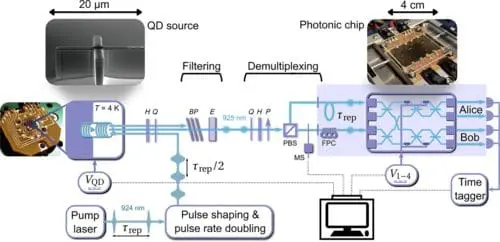
Researchers from Quandela, Quantum Engineering Technology Labs at the University of Bristol, and Université Paris-Saclay CNRS Centre de Nanosciences et de Nanotechnologies have developed a method for generating certified randomness on a compact device. This is crucial for applications such as cryptography and quantum computing. The team addressed the ‘locality loophole’ that can compromise security, using novel theoretical tools and a method to detect adversarial manipulation of the device. The research could revolutionise a range of industries and pave the way for more secure, compact quantum devices.
What is Certified Randomness and Why is it Important?
Certified randomness is a crucial component in a variety of algorithms and applications, including numerical simulations, statistical sampling, and cryptography. The outcomes of measurements on entangled quantum states can violate Bell inequalities, thus guaranteeing their intrinsic randomness. This forms the basis for certified randomness generation. However, this certification requires spacelike separated devices, making it unfit for a compact apparatus.
The strictest requirements on randomness sources are typically destined for cryptographic applications. Here, randomness should ideally be both unpredictable and private, so that no information about the generated sequence can be gained by an eavesdropper either prior to or immediately after its generation. Quantum sources admit certification of these properties by exploiting links between the unpredictability of quantum behavior and the violation of Bell inequalities.
A guarantee that numbers have been sampled from empirical data exhibiting Bell nonlocality or more generally contextuality can suffice to certify unpredictability and privacy. However, these certification protocols are susceptible to loopholes. One way to close the locality or more generally the compatibility loophole is to ensure spacelike separation between the players of the nonlocal game. However, that is not an option for a practical compact device.
How Can We Address the Locality Loophole?
The locality loophole, which can compromise theoretical analyses and security proofs even outside of adversarial scenarios, must be carefully addressed. This is particularly important for future on-chip quantum information processing, which will be susceptible to such effects.
In this work, the researchers introduce novel theoretical tools to address the locality loophole. These tools are demonstrated in a randomness certification protocol performed on a compact two-qubit photonic processor. Idealized analyses typically lead to relations between relevant figures of merit such as fidelities, rates, and guessing probabilities on the one hand, and Bell violations or more general contextuality measures on the other hand.
However, the researchers provide relations suited to realistic devices, which allow the evaluation of the relevant figures of merit in terms of both beneficial contextuality and detrimental crosstalk. Moreover, they introduce a method to upper bound the amount of crosstalk by computing how far the device’s observed behavior is from the set of quantum correlations approximated by the Navascués-Pironio-Acín (NPA) hierarchy. This enables detection of adversarial manipulation of the device that may seek to exploit the locality loophole to spoof certification.
What is the Proposed Certification Method?
The researchers propose a certification method that is secure against quantum side information, meeting the highest security standards. This method requires acquiring large statistics while maintaining high photon purity and indistinguishability, which places knock-on constraints on hardware efficiency and stability.
The theoretical contribution of the researchers, bridging the gap between ideal situations and realistic implementations, combined with finely controlled and robust hardware, allows them to implement the first on-chip certified quantum random number generation protocol with a full security proof.
What are the Practical Implications of this Research?
The practical implications of this research are significant. The ability to generate certified randomness on a small-scale, application-ready device could revolutionize a range of industries, from cryptography to quantum computing.
The researchers’ novel theoretical tools to address the locality loophole could also pave the way for more secure, compact quantum devices in the future. By providing a method to upper bound the amount of crosstalk, they have also made it possible to detect adversarial manipulation of the device, further enhancing the security of these devices.
Who are the Key Players in this Research?
This research was conducted by a team of scientists from Quandela, Quantum Engineering Technology Labs at the University of Bristol, and Université Paris-Saclay CNRS Centre de Nanosciences et de Nanotechnologies. The team includes Andreas Fyrillas, Boris Bourdoncle, Alexandre Maïnos, Pierre-Emmanuel Emeriau, Kayleigh Start, Nico Margaria, Martina Morassi, Aristide Lemaître, Isabelle Sagnes, Petr Stepanov, Thi Huong Au, Sébastien Boissier, Niccolo Somaschi, Nicolas Maring, Nadia Belabas, and Shane Mansfield.
Publication Date: 2024-05-30
Authors: Andreas Fyrillas, Boris Bourdoncle, Alexandre Maïnos, Pierre-Emmanuel Emeriau, et al.
Source: PRX Quantum 5, 020348
DOI: https://doi.org/10.1103/PRXQuantum.5.020348


