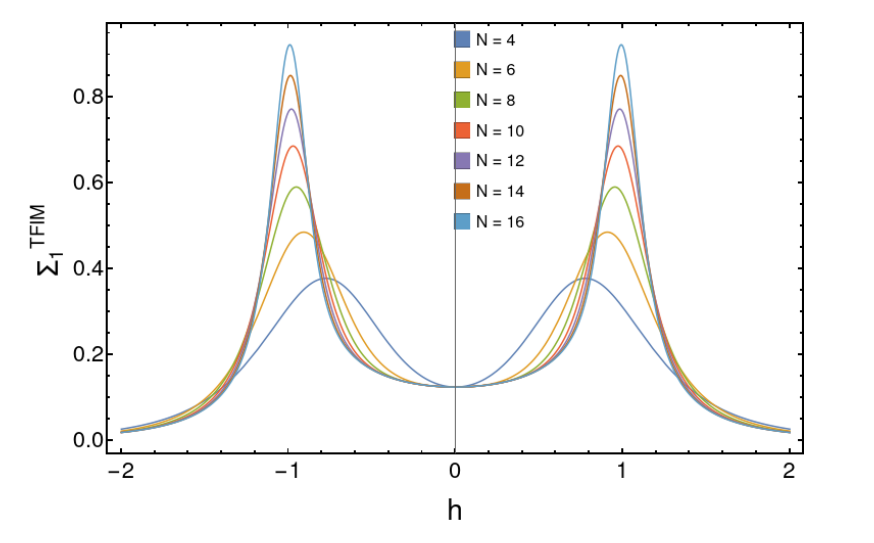
Quantum criticality, the point at which materials undergo dramatic changes in their properties, remains a central challenge in modern physics, and identifying universal indicators of this behaviour is crucial for understanding complex systems. Pritam Sarkar, Diptiman Sen, and Arnab Sen, from institutions including the Indian Association for the Cultivation of Science and the Indian Institute of Science, investigate a novel approach to detecting these critical points by examining how relative entropy responds to changes in a material’s properties. Their work focuses on measuring the ‘metric response’ of relative entropy in spin chains, effectively charting how sensitive entanglement is to external influences, and reveals distinct patterns in this response depending on the material’s underlying structure. This research demonstrates that the resulting susceptibility, which indicates the uncertainty of entanglement gradients, accurately pinpoints critical points and offers a powerful new tool for characterising quantum phase transitions in both integrable and non-integrable systems, even under conditions where traditional methods fail.
Researchers propose that the way entanglement changes near a critical point, where materials undergo dramatic shifts in behavior, can be described using the principles of Riemannian geometry, a branch of mathematics dealing with curved spaces. This geometric description reveals intrinsic properties of the system and offers a new way to characterize these transitions, connecting these features to the well-established framework of conformal field theory, a powerful tool for understanding critical phenomena. The study investigates the transverse-field Ising model and a three-spin Ising model, meticulously calculating thermodynamic quantities and deriving the Riemannian metric that describes the system’s geometry.
Detailed analysis of the entanglement structure reveals how the geometry of the parameter space changes as the system approaches a critical point, providing insights into the underlying physics of the transition. This research’s novelty lies in its use of Riemannian geometry to characterize quantum phase transitions, offering a new perspective on understanding these fundamental shifts in material properties. This has potential applications in diverse areas, including condensed matter physics, quantum information science, and potentially even quantum gravity, and underscores the growing recognition of entanglement as a central concept in modern quantum physics.
Quantum Critical Points Via Relative Entropy Mapping
Researchers have pioneered a new method for identifying quantum critical points by examining the metric response of quantum relative entropy. This measure quantifies how different two quantum states are, and the team’s approach focuses on how this difference changes when a small adjustment is made to the system’s parameters. By tracing out all but a small number of adjacent sites, they developed a sensitive probe of quantum behavior. The core of this method involves calculating the quantum relative entropy between infinitesimally separated parameter values, establishing a Riemannian metric on the parameter space that represents the system’s sensitivity to parameter changes.
This metric response, denoted as Σ, is then used to identify critical points, where the system exhibits maximum sensitivity. To validate this approach, scientists investigated the integrable transverse field Ising model and a non-integrable Ising chain with three-spin interactions. Experiments employed finite-size scaling to analyze the behavior of this quantum relative entropy susceptibility, demonstrating a square logarithmic divergence at the critical point for the integrable model and a power-law divergence for the non-integrable chain. This innovative method provides a model-agnostic approach to determine criticality, offering a robust and versatile tool applicable across diverse quantum many-body systems.
Relative Entropy Detects Quantum Critical Points
Scientists have achieved a breakthrough in understanding how quantum systems respond to change, revealing a new method for detecting critical points in complex materials. This work centers on the metric response of relative entropy, a measure of how different two quantum states are, and how it changes when a small adjustment is made to the system’s underlying parameters. By focusing on a limited portion of the system, researchers developed a sensitive probe of quantum behavior. The team measured the susceptibility of this relative entropy and discovered it diverges at critical points, offering a new tool for materials science and quantum information theory.
Experiments revealed distinct scaling behaviors of this susceptibility depending on the material studied, specifically a square logarithmic divergence in the transverse field Ising model and a power-law divergence in a non-integrable Ising chain. Further analysis demonstrates that this susceptibility encodes information about the uncertainty in the gradients of the entanglement Hamiltonian. Measurements confirm a connection to other important quantum measures, such as Petz-Rényi entropies, highlighting the broad applicability of this new approach and establishing a direct link between the metric response of relative entropy and the universality of scaling laws near critical points.
Relative Entropy Pinpoints Quantum Phase Transitions
This research establishes a new method for identifying quantum phase transitions, utilizing the metric response of relative entropy, a measure of how much one quantum state differs from another. By examining how this metric responds to changes in a system’s Hamiltonian, scientists can pinpoint critical points where the system undergoes a fundamental change in its properties. The study successfully applied this method to both the transverse field Ising model and an Ising chain with three-spin interactions, confirming its effectiveness through both analytical calculations and computational simulations. The researchers acknowledge that the divergence of this metric can also occur due to limitations in the size of the examined subsystem and the degeneracy of the system’s ground state. Future research directions include applying this framework to understand the dynamics of quantum phase transitions under various driving conditions, characterizing topological phase transitions, and developing a field-theoretic description of the metric response. This work promises to deepen our understanding of renormalization group theory and potentially lead to new protocols for controlling quantum systems, offering a powerful new tool for exploring the complex world of quantum materials.
🗞 Metric response of relative entropy: a universal indicator of quantum criticality
🧠 ArXiv: https://arxiv.org/abs/2509.22515