Gravitational collapse, the process by which massive stars die and potentially form black holes, remains a key area of research in modern physics, and understanding the details of this process requires pushing the boundaries of current theoretical models. Hoang Van Quyet from Hanoi Pedagogical University, along with colleagues, now presents a comprehensive framework for predicting the signals generated during this collapse, incorporating quantum corrections and, crucially, moving beyond the simplifying assumption of perfect spherical symmetry. This work achieves a significant breakthrough by demonstrating how quantum effects naturally generate asymmetries during the bounce phase of collapse, leading to detectable bursts of gravitational waves and accompanying electromagnetic signals. The team’s calculations predict gravitational wave strains strong enough to be observed at considerable distances, and suggest realistic event rates within the reach of current observatories, offering a pathway to test fundamental theories of gravity and potentially reveal the existence of primordial black holes.
Loop Quantum Gravity and Primordial Black Holes
This research explores the connection between loop quantum gravity, a theory describing the quantum nature of spacetime, and primordial black holes, hypothetical black holes formed in the early universe. The study investigates whether these black holes could offer a way to test loop quantum gravity’s predictions and potentially shed light on the universe’s origins, proposing that quantum gravity effects prevent the formation of singularities within black holes, allowing them to bounce back and potentially emerge as white holes. Detecting the unique gravitational waves generated by this quantum bounce would provide strong evidence supporting loop quantum gravity. The team proposes a model where primordial black holes form due to density fluctuations in the early universe, but their collapse is modified by loop quantum gravity, leading to a distinctive gravitational wave signature. The analysis demonstrates that the model’s predictions remain consistent even with variations in the fundamental parameters of loop quantum gravity, and that if primordial black holes exist in sufficient numbers, they could contribute to the universe’s dark matter. This research bridges the gap between theoretical quantum gravity and observational astrophysics, offering a pathway to experimentally verify or falsify the theory using gravitational wave detectors.
Quantum Gravity, Wave and Light Emission Modelling
This study pioneers a sophisticated computational approach to model quantum-corrected gravitational collapse, employing advanced numerical techniques to simulate the evolution of spacetime within a loop quantum gravity framework. The team used a fourth-order Runge-Kutta scheme with adaptive timestep control to accurately compute the background spacetime, and spectral methods to evolve perturbative modes, ensuring precision across a wide range of frequencies crucial for detecting subtle gravitational wave signals. This computational implementation directly calculates gravitational wave strain by numerically evaluating quadrupole moment integrals from the fully evolved quantum-corrected matter distribution, simultaneously solving the photon transport equation to model electromagnetic emission, enabling a coordinated multi-messenger analysis. Scientists developed a consistent perturbation theory to address the challenge of reconciling spherical symmetry assumptions with the expectation of gravitational wave emission, demonstrating that geometric effects naturally seed asymmetric perturbations during the bounce phase.
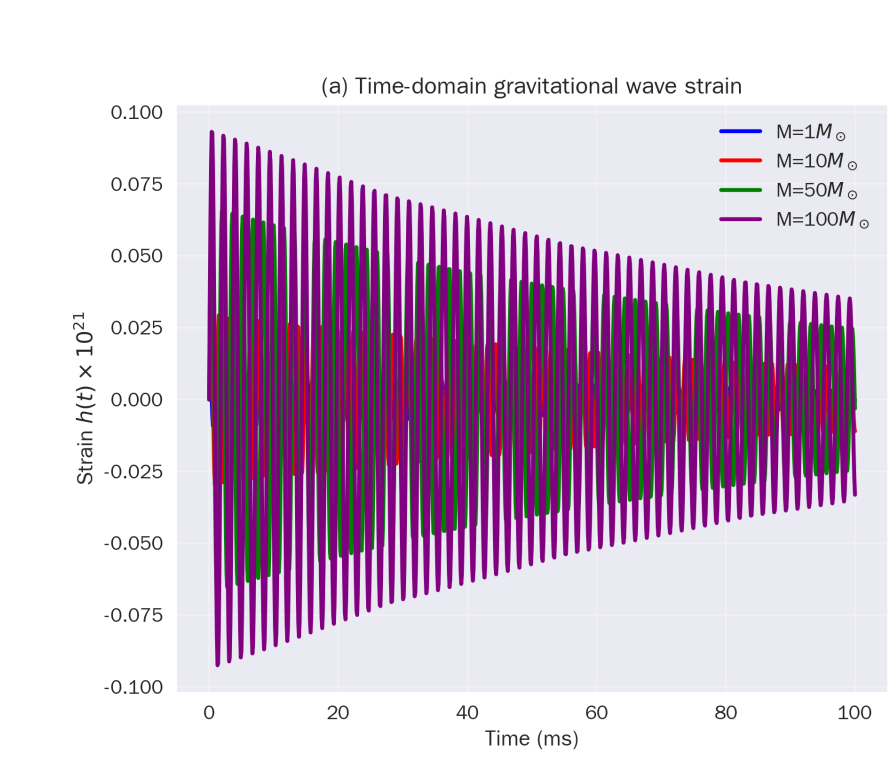
This approach yields gravitational wave strains of approximately 10⁻¹⁷ at 100 megaparsecs for primordial black holes with masses ranging from one to one hundred times the mass of the sun, and detailed calculations of dynamic Casimir effects and coherent field amplification in time-dependent geometry model the electromagnetic counterparts, revealing a strong environmental dependence on the density of the surrounding medium. The research demonstrates a clear mass dependence of both frequency and amplitude in the gravitational wave signal, and calculates the probability of a primordial black hole undergoing a quantum bounce rather than classical collapse. A comprehensive parameter space analysis reveals that a combined signal-to-noise ratio of at least 5 requires a primordial black hole mass greater than 30 solar masses, a distance less than 100 megaparsecs, and an environmental density exceeding 10⁻³ cubic centimeters. This work resolves fundamental theoretical challenges by demonstrating that quantum geometry provides the seeding mechanism for asymmetric perturbations, paving the way for future observations with next-generation observatories.
Asymmetric Bounce Generates Gravitational Wave Signals
This work presents a comprehensive theoretical framework extending a loop model to incorporate asymmetries in gravitational collapse, resolving a tension between spherical symmetry assumptions and the requirements for gravitational wave emission. Scientists developed a consistent perturbation theory for non-spherical modes propagating on a quantum-corrected spherically symmetric background, demonstrating that geometric effects naturally seed asymmetric perturbations during the bounce phase, leading to observable gravitational wave bursts accompanied by distinctive electromagnetic counterparts. Calculations compute the coupling between bounce dynamics and perturbative modes, yielding gravitational wave strains at 100 megaparsecs for primordial black holes with specific masses. The team analyzed the electromagnetic emission mechanism through detailed calculations of dynamic Casimir effects and coherent field amplification in time-dependent quantum geometry, revealing the potential for multi-messenger observations.
A parameter sensitivity analysis demonstrates that detection prospects are critically dependent on primordial black hole abundance constraints. Experiments reveal that quantum geometric fluctuations naturally seed the perturbative modes, with the amplitude of asymmetric deviations scaling with mass and density. The bounce timescale is determined by the interplay between critical density and the local gravitational field. These results deliver testable predictions for quantum gravity theories while extending previous work beyond spherical symmetry assumptions, opening new avenues for probing the early universe and black hole physics.
Asymmetric Bounce Generates Detectable Gravitational Waves
This research presents a comprehensive theoretical framework for understanding multi-messenger signals, both gravitational waves and electromagnetic radiation, generated during the collapse of massive stars within a specific loop quantum gravity model. By extending previous work, the team successfully addressed the challenge of incorporating asymmetries into the traditionally symmetrical models of gravitational collapse, a crucial step towards realistic predictions. The analysis demonstrates that quantum effects naturally introduce perturbations during the bounce phase of stellar collapse, leading to the emission of detectable gravitational waves with frequencies ranging from one-thousandth to one-thousand Hertz.
🗞 Quantum-corrected gravitational collapse and multi-messenger signatures: Beyond spherical symmetry in loop quantum gravity
🧠 ArXiv: https://arxiv.org/abs/2511.05624