

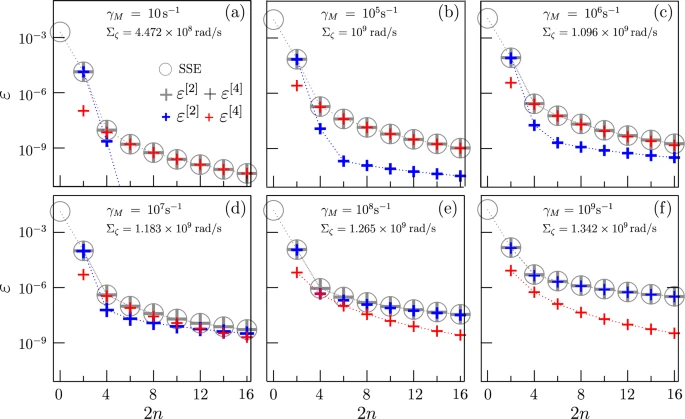
Researchers have made significant strides in harnessing the power of quantum control techniques, specifically dynamical decoupling (DD), to revolutionize small-scale networks. By exploiting the properties of selected pulse sequences, scientists can extract valuable information about noise-induced errors and non-Gaussian features contained in the fourth-order cumulant. This breakthrough has far-reaching implications for state-of-the-art small networks based on solid-state platforms, paving the way for further exploration of quantum control techniques in these systems.
Can Quantum Control Techniques Revolutionize Small-Scale Networks?
The quest for high-fidelity quantum operations has led researchers to explore the realm of quantum control techniques. In this article, scientists from various institutions have delved into the world of open-loop quantum control, specifically focusing on dynamical decoupling (DD) and its applications in small-scale networks.
The Power of Dynamical Decoupling
Dynamical decoupling is a form of open-loop quantum control that has been extensively validated through experiments using various platforms. This technique can be seen as a noise filtering process, mathematically expressed in terms of generalized filter functions (FFs). By exploiting the properties of selected pulse sequences, researchers have shown that it is possible to extract the second-order statistics spectrum and cross-spectrum, highlighting non-Gaussian features contained in the fourth-order cumulant.
The Role of Noise in Quantum Operations
Environmental noise sets the accuracy limits of quantum gates, making unreliable even moderate-size quantum circuits. Material-inherent noise sources still represent a problem, despite tremendous progress in the last two decades. Quantum control techniques aim to maintain noise-induced errors below a fault-tolerance threshold required for efficient implementation of quantum error correction.
The Magnus Expansion: A Key Tool
To evaluate gate error, researchers employed the Magnus expansion, introducing generalized filter functions that describe decoupling while processing. This allowed them to derive an approximate analytic expression as a hierarchy of nested integrals of noise cumulants. The error is separated into contributions of Gaussian and non-Gaussian noise, with corresponding generalized filter functions calculated up to the fourth order.
Applications in Small-Scale Networks
The results of this study have significant implications for state-of-the-art small networks based on solid-state platforms. By exploiting the properties of selected pulse sequences, researchers can extract the second-order statistics spectrum and cross-spectrum, highlighting non-Gaussian features contained in the fourth-order cumulant. This paves the way for further exploration of quantum control techniques in small-scale networks.
The Future of Quantum Control
The development of efficient quantum control techniques is crucial for the implementation of high-fidelity quantum operations. As researchers continue to push the boundaries of what is possible, it becomes increasingly clear that dynamical decoupling and other open-loop quantum control methods will play a vital role in the future of quantum technologies.
The Potential for Quantum Sensing
Dynamical control can be turned into a tool for quantum sensing (QS) and quantum noise spectroscopy. This opens up new avenues for exploring the properties of small-scale networks, potentially leading to breakthroughs in fields such as quantum computing and cryptography.
Conclusion
In conclusion, this study demonstrates the power of dynamical decoupling in small-scale networks. By employing the Magnus expansion and generalized filter functions, researchers have shown that it is possible to extract valuable information about noise-induced errors and non-Gaussian features contained in the fourth-order cumulant. As the field of quantum control continues to evolve, it will be essential to explore new techniques and applications, such as quantum sensing, to unlock the full potential of small-scale networks.
Publication Date: 2024-07-19
Authors: A. D’Arrigo, G. Piccitto, G. Falci, E. Paladino, et al.
Source: Scientific Reports
DOI: https://doi.org/10.1038/s41598-024-67503-x


