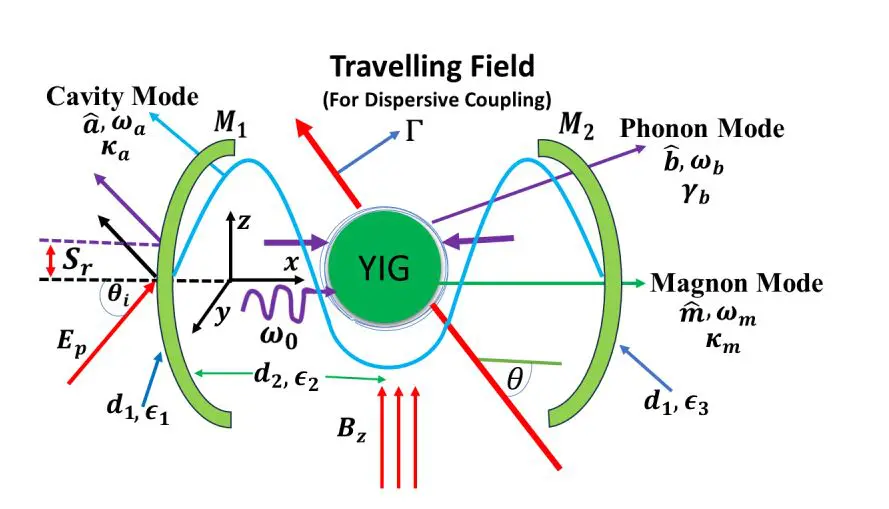
The precise manipulation of light is fundamental to many technologies, and researchers are continually seeking new ways to control its behaviour. Shah Fahad and Gao Xianlong, from the Department of Physics at Zhejiang Normal University, along with their colleagues, now demonstrate a method for controlling the Goos-Hänchen shift, a subtle sideways displacement of a reflected light beam, within a specially designed system combining microwave cavities and magnetic materials. This work advances the field of non-Hermitian magnomechanics and reveals that, by carefully tuning the interactions within this system, they can significantly enhance or suppress this lateral shift, exceeding the performance of traditional, standard optical setups. The ability to precisely control the Goos-Hänchen shift opens exciting possibilities for developing novel microwave components with applications in switching technology and precision measurement.
Light-Matter Coupling, Shifts and Resonances
This extensive collection of research explores the fascinating interplay between light and matter, specifically within the fields of cavity optomechanics, magnomechanics, and related optical phenomena like the Goos-Hänchen shift, Fano resonances, and non-Hermitian physics. The research focuses on understanding how light interacts with mechanical motion and magnetic excitations, leading to novel effects and potential applications. Central to this work is the study of strong coupling, where light and matter exchange energy efficiently. Investigations into non-Hermitian systems, which deviate from conventional symmetry rules, reveal unique phenomena like exceptional points, offering opportunities for enhanced sensing, lasing, and other technologies.
Fano resonances, characterized by sharp, asymmetric spectral features, are also explored for their relevance to sensing and nonlinear optics. A growing area of focus is cavity magnomechanics, which investigates the interaction between light and magnons, collective spin excitations in magnetic materials, with the potential to create new magnetic devices and quantum technologies. Throughout this body of work, a recurring theme is the development of highly sensitive sensors utilizing these phenomena for measuring parameters like temperature, strain, and magnetic fields. Researchers also investigate the quantum properties of these systems and the generation of nonlinear optical effects, alongside exploring topological photonic effects within these complex structures.
Goos-Hänchen Shift in Non-Hermitian Magnomechanical System
Scientists engineered a non-Hermitian cavity magnomechanical system to investigate and control the Goos-Hänchen shift, a phenomenon describing the lateral displacement of a reflected light beam. The study centers on a microwave cavity containing a yttrium-iron-garnet (YIG) sphere, where interactions between photons, magnons, and phonons are carefully orchestrated to achieve non-Hermitian dynamics. A magnetic field excites magnon modes within the YIG sphere, facilitating coupling to cavity photons and, through lattice deformation, to phonon modes. Crucially, researchers introduced non-Hermiticity by driving the magnon mode with a field, inducing gain within the system.
They meticulously balanced gain and loss conditions alongside finite magnomechanical coupling to create a third-order exceptional point, a unique condition where standard symmetry rules break down. The team then systematically analyzed the Goos-Hänchen shift in the reflected light, employing a mathematical method to calculate its behavior. Experiments demonstrate pronounced enhancement or suppression of the Goos-Hänchen shift at the exceptional point and across phase transitions, governed by the system’s non-Hermitian eigenvalue structure. Scientists further revealed that the length of the cavity serves as an additional control parameter for precise tuning of the lateral shift. This innovative approach establishes coherent control over the Goos-Hänchen shift, presenting a novel paradigm for tunable microwave devices and enhanced sensing capabilities.
Goos-Hänchen Shift Control in Non-Hermitian Systems
Scientists have demonstrated coherent control of the Goos-Hänchen shift within a non-Hermitian cavity magnomechanical system. The research centers on a hybrid system comprising a microwave cavity, a yttrium iron garnet (YIG) sphere, and a field inducing gain, allowing for investigation of both broken and unbroken PT-symmetric phases, as well as a third-order exceptional point. Experiments reveal that the shift is significantly influenced by the interplay of photon-magnon and magnon-phonon couplings within the system. The team discovered that under conditions of balanced gain and loss, coupled with finite effective magnomechanical coupling, an exceptional point emerges when the effective magnon-photon coupling strength reaches a critical value.
Through precise tuning of this coupling, scientists achieved coherent control over the lateral shift of the probing light. Measurements confirm that the shift exhibits pronounced enhancement or suppression as the system transitions across the PT-symmetric phases and through the exceptional point, directly linked to the system’s non-Hermitian eigenvalue structure. This work establishes a novel paradigm for tunable microwave devices and enhanced sensing capabilities, demonstrating that the shift can be precisely manipulated by controlling the system’s parameters, opening avenues for advanced applications in microwave technology and precision measurement.
Goos-Hänchen Shift Control in Non-Hermitian Systems
Scientists have demonstrated coherent control of the Goos-Hänchen shift within a non-Hermitian cavity magnomechanical system. By carefully manipulating gain and loss in a system combining a microwave cavity and a magnetic sphere, scientists achieved substantial enhancement of the shift compared to traditional systems. The team identified distinct operational phases, broken and unbroken PT symmetry, and a third-order exceptional point, each exhibiting unique behaviour of the shift, allowing for precise control over its magnitude. The investigation revealed that the effective coupling between the magnetic and microwave components plays a crucial role; its absence leads to a clear phase transition in the shift, while increasing it eliminates the transition and introduces strong absorption. Furthermore, the length of the cavity serves as an additional tuning parameter, enabling further refinement of the shift. These findings highlight the advantages of non-Hermitian systems for applications requiring substantial lateral shifts, such as quantum switching and high-precision microwave sensing.
🗞 -assisted control of Goos-Hänchen shift in cavity magnomechanics
🧠 ArXiv: https://arxiv.org/abs/2511.20262