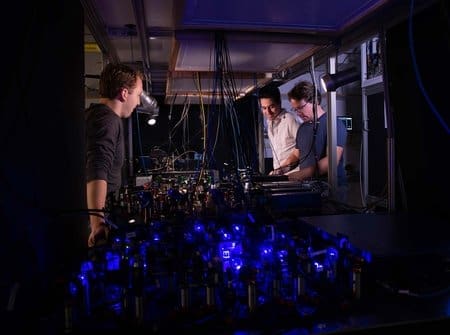
Researchers at Caltech, led by Professor Manuel Endres, have demonstrated a novel method for encoding and controlling quantum information using the motion of individual atoms held within optical tweezers – devices that use laser light to manipulate atoms. The team successfully cooled an array of neutral alkaline-earth atoms to near standstill, inducing controlled oscillations and achieving hyper-entanglement, where both the motion and internal electronic states of atom pairs are correlated. This experiment, detailed in Science, represents the first demonstration of hyper-entanglement in massive particles like atoms and establishes a new approach to enhance quantum information storage and manipulation, potentially advancing quantum computing and precision measurement technologies. The research was funded by multiple US federal agencies and international fellowships.
Precision Atomic Control Enables Hyper-Entanglement
Researchers demonstrate precise manipulation of atomic motion, extending beyond simple confinement to induce superposition where atoms simultaneously exhibit multiple oscillatory modes—a state essential for quantum information processing. This advancement utilises a novel cooling technique, termed ‘erasure cooling’, which surpasses conventional laser cooling methods by actively correcting atomic motion and establishing well-defined quantum states. By bringing atoms to a state of near quiescence prior to inducing controlled oscillations, researchers create an ideal environment for maintaining quantum coherence and performing complex quantum operations.
This innovative approach allows scientists to create correlated states of motion across micrometre distances, forming the basis for entanglement and enabling the exploration of multiple computational pathways simultaneously. The team achieves this by continuously measuring individual atomic velocities and applying targeted corrective operations, significantly reducing thermal excitation. Utilizing atoms as qubits – the quantum equivalent of classical bits – offers significant advantages in terms of coherence times and the ability to implement complex quantum gates, solidifying their potential as building blocks for future quantum technologies.
The implementation of ‘erasure cooling’ represents a departure from established laser cooling methodologies, achieving superior performance through active correction of atomic motion and establishing a new standard for precision control. This technique, conceptually aligned with Maxwell’s demon thought experiment, involves continuous measurement of individual atomic velocities followed by targeted corrective operations, resulting in a substantial reduction in thermal excitation.
More information
External Link: Click Here For More