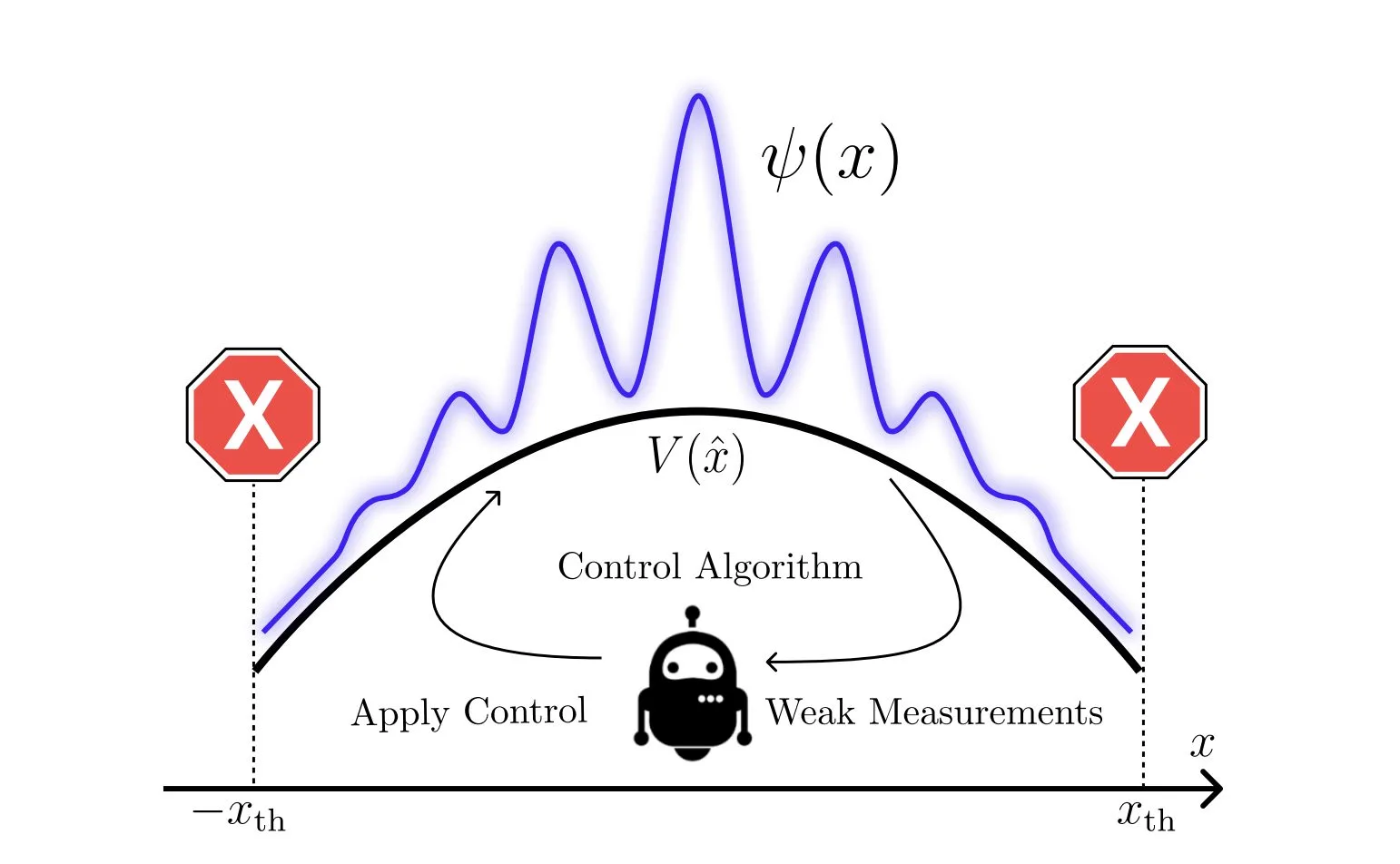
Quantum control, the manipulation of quantum systems to achieve desired outcomes, is vital for the development of quantum technologies. However, controlling these systems is complex due to unique quantum mechanics properties. Researchers propose using weak quantum measurements and model-free reinforcement learning agents for quantum control. They demonstrated the feasibility of this approach using the quantum cartpole problem, a benchmark for testing quantum control methods. The research contributes to the development of effective quantum control methods and suggests that machine learning techniques and improved quantum measurement techniques could be crucial for future advancements in quantum control.
What is Quantum Control and Why is it Important?
Quantum control is a field of science that focuses on manipulating quantum systems to achieve desired outcomes. This is a crucial aspect of quantum computing, quantum communication, and other quantum technologies. The ability to control quantum systems is essential for the development and application of these technologies. However, controlling quantum systems is a complex task due to the unique properties of quantum mechanics, such as superposition and entanglement.
The standard method for controlling classical stochastic systems and processes is feedback-based control. This method involves continuously adjusting the system inputs based on real-time feedback. However, this method faces challenges when applied to quantum systems due to measurement-induced backaction and partial observability. Measurement-induced backaction refers to the phenomenon where the act of measuring a quantum system can change its state. Partial observability refers to the fact that it is not always possible to measure all aspects of a quantum system at once.
How Can We Control Quantum Systems?
To overcome these challenges, researchers have proposed using weak quantum measurements and model-free reinforcement learning agents to perform quantum control. Weak quantum measurements are a type of quantum measurement that minimally disturbs the system, allowing for more accurate control. Model-free reinforcement learning agents are a type of artificial intelligence that can learn to control a system without a pre-existing model of the system’s dynamics.
The researchers compared control algorithms with and without state estimators to stabilize a quantum particle in an unstable state near a local potential energy maximum. They found that a tradeoff arises between state estimation and controllability. In scenarios where the classical analogue is highly nonlinear, the reinforcement learned controller has an advantage over the standard controller.
What is the Quantum Cartpole Problem?
The quantum cartpole problem is a benchmark problem for testing quantum control methods. It is based on the classical cartpole problem, which is a standard benchmark for reinforcement learning controllers. In the classical cartpole problem, a cart rolls on a flat one-dimensional track, and a force must be applied in either direction to keep a pole hinged to the middle of the cart upright. The quantum version of this problem involves controlling a quantum particle in an unstable state near a local potential energy maximum.
How Can We Solve the Quantum Cartpole Problem?
The researchers demonstrated the feasibility of using transfer learning to develop a quantum control agent trained via reinforcement learning on a classical surrogate of the quantum control problem. Transfer learning is a machine learning technique where a model trained on one task is re-purposed on a related task. This approach allows the quantum control agent to leverage the knowledge gained from solving the classical problem to solve the quantum problem.
The researchers also presented results showing how the reinforcement learning control strategy differs from the classical controller in nonlinear scenarios. This demonstrates the potential of reinforcement learning for controlling quantum systems in complex scenarios.
What are the Implications of This Research?
This research contributes to the ongoing efforts to develop effective methods for controlling quantum systems. The proposed approach of using weak quantum measurements and reinforcement learning could potentially be applied to a wide range of quantum control problems. This could accelerate the development and application of quantum technologies.
Moreover, the quantum cartpole problem provides a useful benchmark for testing and comparing different quantum control methods. This could facilitate the development of more effective and efficient quantum control algorithms.
What is the Future of Quantum Control?
The field of quantum control is still in its early stages, and there is much more to learn and discover. As our understanding of quantum mechanics continues to deepen, and as quantum technologies continue to advance, the importance of quantum control will only increase.
One promising direction for future research is the further development and application of machine learning techniques for quantum control. As demonstrated in this research, reinforcement learning and transfer learning can be effective tools for controlling quantum systems. Other machine learning techniques, such as deep learning and unsupervised learning, could also potentially be applied to quantum control.
Another important area for future research is the development of more accurate and efficient quantum measurement techniques. As this research shows, the ability to accurately measure quantum systems is crucial for effective quantum control. Improvements in quantum measurement techniques could therefore significantly enhance our ability to control quantum systems.
Publication Date: 2024-05-07
Authors: Kai Meinerz, Simon Trebst, Mark S. Rudner, Evert van Nieuwenburg, et al.
Source: SciPost physics core
DOI: https://doi.org/10.21468/scipostphyscore.7.2.026