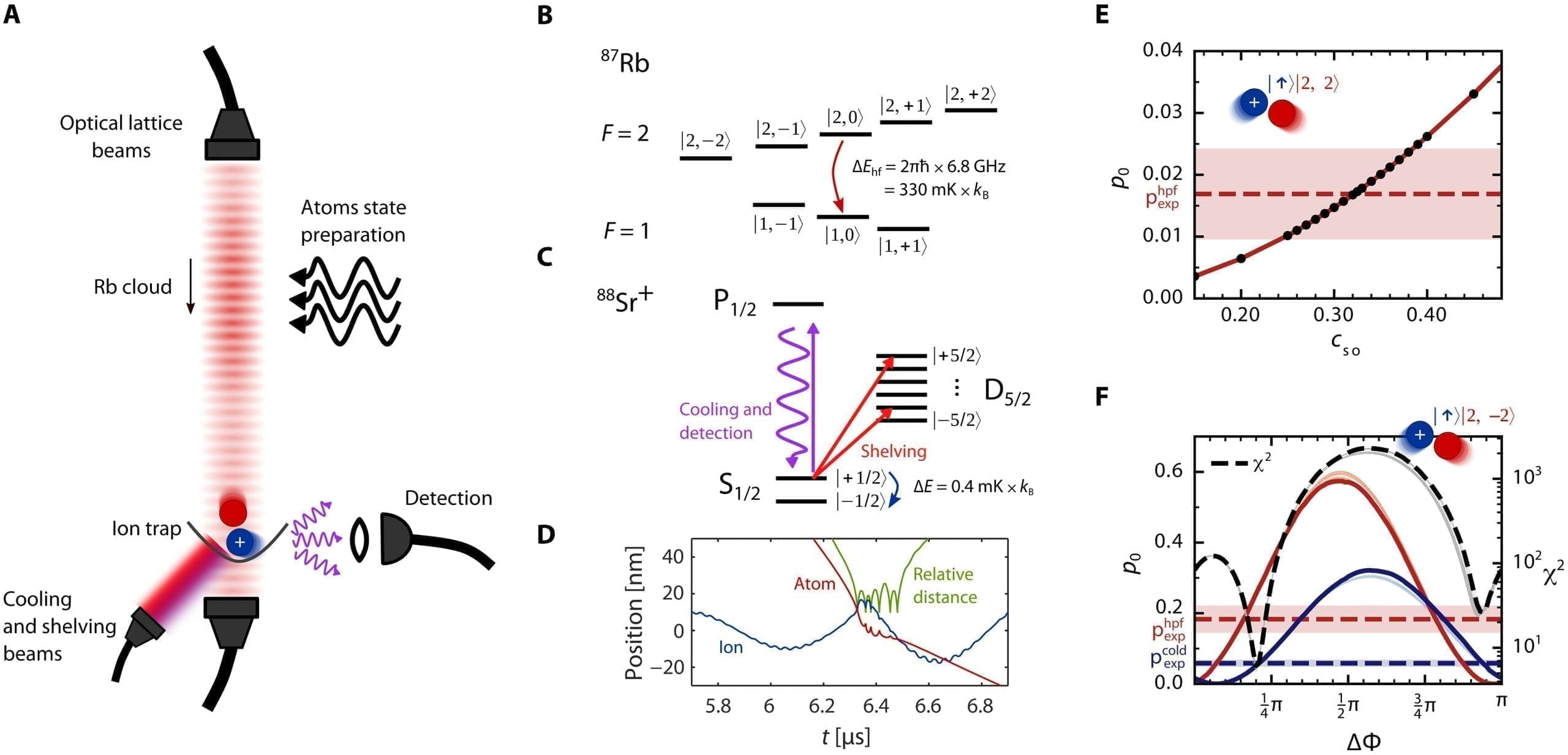
Researchers from the University of Warsaw and the Weizmann Institute have discovered that ion-atom collisions can be controlled at higher temperatures using rubidium atoms and strontium cations. This finding, published in Science Advances, could simplify the development of quantum technologies by reducing reliance on extreme cooling methods.
Recent research by Walewski and colleagues published in Science Advances has demonstrated a significant advancement in quantum control by successfully managing ion-atom collisions at higher temperatures. Traditionally, quantum experiments require ultralow temperatures to maintain quantum coherence, as thermal noise can disrupt the delicate states essential for technologies like quantum computing. This study challenges that paradigm by showing that quantum principles can still govern interactions even with increased thermal motion.
The researchers employed advanced techniques such as improved magnetic traps and laser cooling methods. Magnetic traps were likely enhanced to better contain particles despite higher thermal motion, possibly through dynamic adjustments or more robust designs. Laser cooling was optimized, potentially using more powerful lasers or different wavelengths to effectively slow down atoms even in warmer conditions.
The team may have implemented feedback mechanisms or real-time monitoring systems to counteract the disruptive effects of thermal noise. These could adjust parameters dynamically to maintain coherence, extending the lifespan of quantum states despite higher temperatures.
This breakthrough has profound implications for quantum technologies. Reducing reliance on extreme cooling could make quantum computing and precision metrology more practical and scalable. Potential applications include robust quantum sensors or computers that function without stringent temperature requirements, opening new avenues for real-world deployment across various industries.
While the study is promising, questions remain about temperature thresholds beyond which coherence cannot be maintained. The efficiency and performance of quantum systems at higher temperatures also need to be evaluated for trade-offs in speed or accuracy.
The innovative experimental setup likely involved novel trap designs or cooling techniques, though specifics were not detailed. Theoretical models used to predict collision behavior at higher temperatures may have required new adaptations or developments to align with observed results.
Looking ahead, researchers aim to explore even higher temperature thresholds and scale up methods for specific applications. Potential targets include quantum computing enhancements or advanced sensors for navigation and medical imaging. The success of these endeavors could significantly accelerate the implementation of practical quantum technologies.
This research represents a promising step toward making quantum technologies more accessible, though further exploration into method specifics, application scalability, and theoretical underpinnings is essential to realize its potential fully.
More information
External Link: Click Here For More