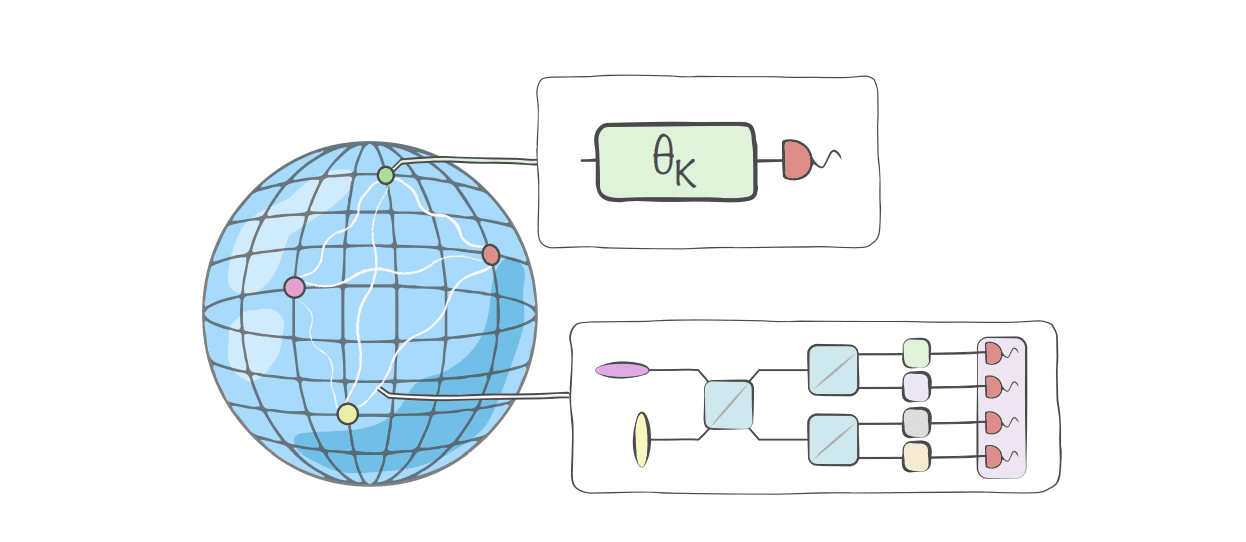
Protecting sensitive local data while collaboratively measuring a global parameter presents a significant challenge, particularly within the emerging field of quantum sensing. A team led by A. de Oliveira Junior from the Technical University of Denmark and Anton L. Andersen from Sorbonne Université now demonstrates a solution using a network of interconnected quantum sensors. Their research introduces a protocol for distributed sensing that achieves high-precision estimation of an average phase, scaling with the number of photons used, while simultaneously protecting the individual phase values encoded at each sensor location. Although perfect privacy remains elusive in practical scenarios, the team reveals that increasing the quantum entanglement within the network brings the system closer to complete data protection, and they thoroughly investigate how imperfections like signal loss impact both sensing accuracy and privacy levels.
Privacy Limits in Quantum Distributed Sensing
Researchers investigate the fundamental limits of privacy in distributed quantum sensing, a technique where multiple, spatially separated parties collaborate to estimate a common, unknown parameter using quantum resources like correlated light. This collaboration inevitably reveals some information about each party’s individual measurements, potentially compromising their privacy. This work addresses unavoidable information leakage during distributed sensing and its impact on estimation precision. The team developed a theoretical framework, employing tools from quantum information theory and statistical inference, to quantify the trade-off between sensing precision and privacy.
This framework establishes a fundamental lower bound on information leakage, demonstrating that any distributed sensing protocol must reveal at least a certain amount of information about individual measurements. Specifically, the amount of leaked information scales linearly with the number of parties involved. To address this, the researchers propose a privacy-preserving protocol based on differential privacy, a rigorous mathematical framework for controlling information leakage. This protocol carefully adds calibrated noise to individual measurements, masking the contribution of any single party while still enabling accurate parameter estimation.
Analytical and numerical evaluations demonstrate that this protocol achieves a near-optimal balance between sensing precision and privacy, minimizing information leakage while maintaining high accuracy, and outperforms existing schemes. The research addresses whether a distributed network of quantum sensors can estimate a global parameter while simultaneously protecting locally encoded values. The study considers a network where multiple quantum sensors collaborate, demonstrating a pathway for secure and accurate parameter estimation across a distributed system. This approach preserves the integrity of local information during global estimation, offering advantages over traditional methods.
Quantum Information and Privacy Quantification
This research presents a rigorous mathematical derivation of key concepts in quantum parameter estimation and privacy. The work focuses on the quantum Fisher information (QFI), which quantifies how much information a quantum state carries about an unknown parameter, and a corresponding privacy measure that quantifies how well a quantum state protects sensitive information. The goal is to provide easily calculable expressions for both the QFI and the privacy measure, simplifying their analysis in practical scenarios. The QFI measures the sensitivity of a probability distribution to changes in a parameter; a higher QFI indicates more precise estimation is possible.
The privacy measure, defined as a ratio involving the QFI matrix, indicates the level of protection for sensitive information. The derivation uses mathematical tools like Wick’s theorem to arrive at closed-form expressions for both quantities. These results have significant implications for quantum parameter estimation, enabling optimization of quantum experiments for maximum precision, and contribute to quantum cryptography and privacy, providing a tool for evaluating the security of quantum communication protocols. Furthermore, the work has applications in quantum machine learning and quantum sensing, where precise parameter estimation is crucial. In essence, the research provides valuable tools for designing and analysing quantum systems for a variety of applications.
Global Estimation With Protected Local Data
This research demonstrates a new protocol for distributed sensing using continuous variable systems, achieving high precision in estimating a global parameter while protecting locally encoded information. The team rigorously characterised privacy within such networks, establishing a link between directions in the quantum Fisher information matrix that are unobservable and the privacy of individual components. Analysis of two-mode squeezed states distributed across a network reveals that accurate global estimation and component-level privacy can be simultaneously achieved, although complete privacy remains unattainable with finite squeezing. The investigation further explored the impact of practical imperfections and resource enhancements, revealing how displacements improve estimation accuracy at the cost of privacy, and how optical loss reduces sensitivity without necessarily compromising privacy. Importantly, the researchers benchmarked their protocol against alternative Gaussian states, confirming the superior performance of the two-mode squeezed state for private distributed sensing. They propose investigating methods to formally identify optimal states for constrained sensing tasks, potentially revealing new resources that offer improved performance in balancing precision and information leakage.
👉 More information
🗞 Privacy in continuous-variable distributed quantum sensing
🧠 ArXiv: https://arxiv.org/abs/2509.12338