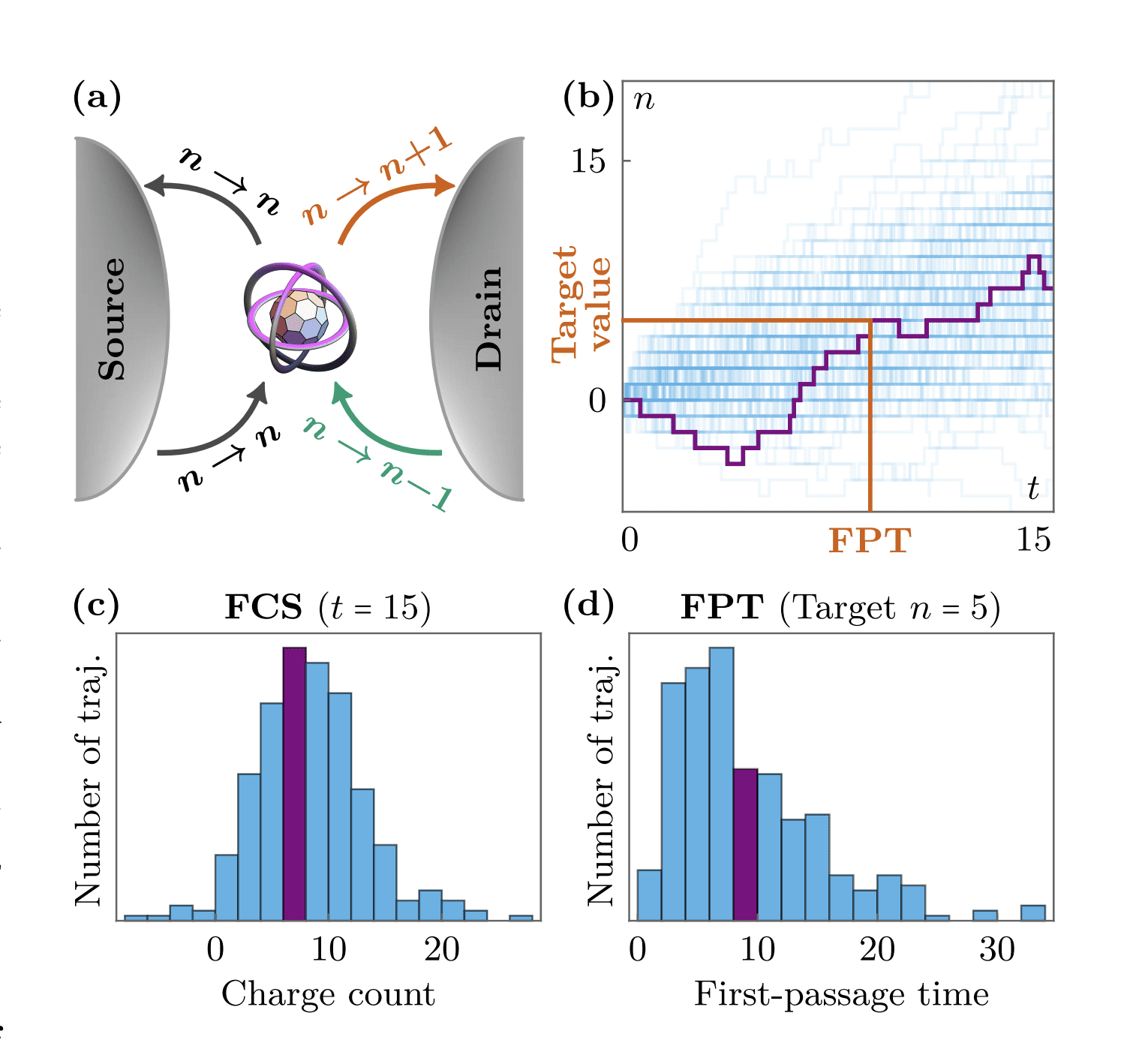
Understanding fluctuations is crucial for advancing quantum technologies, and researchers are now offering a comprehensive framework for characterising these fluctuations in quantum systems. Paul Menczel from RIKEN Center for Quantum Computing, Christian Flindt from Aalto University, and Fredrik Brange, along with colleagues, develop a powerful approach using full counting statistics and first-passage times to explore how quantum systems evolve and respond to change. Their work establishes clear connections between these two methods, revealing how long-term behaviour relates to the likelihood of specific events, and importantly, identifies conditions where standard expectations break down in complex systems. This research provides a complete picture of fluctuations in quantum systems, with direct implications for experiments in areas like quantum optics, circuits, and the development of nanoscale heat engines.
The work focuses on open quantum systems governed by predictable dynamics, and the team derives general relationships connecting these two approaches at all times. These relationships clarify how steady states, reached after extended periods, relate to those reached after a large number of quantum jumps. Furthermore, the team formulates a fluctuation theorem governing the probability of rare fluctuations in the first-passage time distribution.
Open Quantum Systems and Predictable Dynamics
This is a comprehensive list of references detailing research into quantum physics, particularly focusing on open quantum systems, predictable dynamics, quantum jumps, and related topics like exceptional points and quantum thermodynamics. Key themes include the dynamics of quantum systems interacting with their environment, the importance of well-defined environments for accurate predictions, and the observation of discrete changes in a quantum system’s state. Advanced topics covered include singularities in quantum systems leading to unusual behaviour, the application of thermodynamic principles to quantum systems, and the use of Gaussian states for quantum information processing. The bibliography also details experimental techniques such as cavity QED, superconducting qubits, quantum dots, trapped ions, and single-photon detection, alongside computational tools like the QuTiP framework and numerical methods.
Fluctuations, First Passage, and Thermodynamic Uncertainty Relations
Researchers have established a comprehensive framework connecting full counting statistics and first-passage times, revealing a fundamental relationship between how quantities accumulate and the time it takes to reach specific values. The team rigorously derived general relationships linking these approaches at all times, clarifying how long-term steady states relate to those reached after a large number of quantum jumps. This work extends the connection between these methods to scenarios with two-way currents, where the counted quantity can both increase and decrease. The findings demonstrate that thermodynamic uncertainty relations for full counting statistics can be directly translated into equivalent uncertainty relations for first-passage time distributions, offering a new perspective on understanding fluctuations in quantum systems. Experiments reveal that these relationships hold true even in systems exhibiting intermediate states, offering insights into complex quantum behaviours. The researchers establish a general connection between these two approaches, clarifying how long-term behaviour relates to the timing of specific events, and demonstrate this connection across various quantum systems. Importantly, the study reveals that deviations from expected relationships can occur in systems exhibiting intermediate states, offering a potential method for detecting these states. Through illustrative examples, including a two-state emitter, a driven system, and a specific quantum model, the researchers demonstrate the practical implications of their findings for experiments in quantum optics, circuits, and nanoscale heat engines. The authors acknowledge that their results are most applicable to systems governed by predictable dynamics and that further investigation may be required for systems with more complex dynamics.
👉 More information
🗞 Full counting statistics and first-passage times in quantum Markovian processes: Ensemble relations, metastability, and fluctuation theorems
🧠 ArXiv: https://arxiv.org/abs/2508.18614