The quest for fault-tolerant quantum computing has led researchers to explore innovative solutions to overcome errors caused by hardware imperfections or environmental noise. A team from ORCA Computing has proposed a novel approach that demonstrates high photon loss thresholds in linear-optical constructions, using Greenberger-Horne-Zeilinger (GHZ) state measurements. This breakthrough could pave the way for the development of practical quantum computers that can withstand the challenges posed by photon loss and other sources of error.
Can Quantum Computing Survive Photon Loss?
The quest for fault-tolerant quantum computing has led researchers to explore innovative solutions, including the use of Greenberger-Horne-Zeilinger (GHZ) state measurements. A team of scientists from ORCA Computing has proposed a novel approach that demonstrates high photon loss thresholds in linear-optical constructions.
In traditional quantum computing, errors can occur due to hardware imperfections or environmental noise. Fault-tolerant architectures aim to correct these errors during the execution of a quantum computer program. One such approach is measurement-based quantum computing (MBQC), which relies on destructive measurements performed on previously generated entangled states. MBQC has been shown to be suitable for hardware with probabilistic entangling operations and destructive measurements, such as discrete variable photonic qubits.
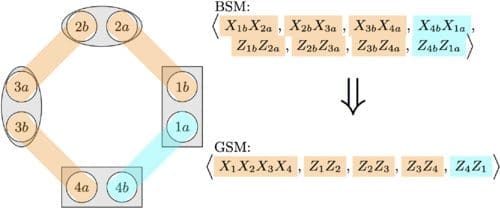
The ORCA Computing team’s proposal involves performing projective measurements in the GHZ basis on constantsized entangled resource states. This approach is designed to suppress errors induced by photon loss and the probabilistic nature of linear optics. Simulations demonstrate high single-photon loss thresholds compared to state-of-the-art linear-optical architectures realized with encoded two-qubit fusion measurements performed on constantsized resource states.
What’s Driving the Need for Fault-Tolerant Quantum Computing?
The development of fault-tolerant quantum computing is crucial for the practical implementation of quantum computers. Hardware errors can occur due to various factors, including imperfections in the underlying hardware or environmental noise. In traditional circuit-based error correction, non-destructive ancilla-assisted measurements are used to detect errors. However, this approach has limitations and may not be suitable for all types of hardware.
MBQC offers an alternative approach to fault-tolerant quantum computing. By performing destructive measurements on previously generated entangled states, MBQC can construct error syndromes that allow for the correction of errors. This approach is well-established for hardware with probabilistic entangling operations and destructive measurements, such as discrete variable photonic qubits.
The Role of Photonic Quantum Computing in Fault-Tolerant Architectures
Photonic quantum computing has emerged as a promising area of research, with many architectures achieving fault tolerance through the preparation of large entangled resource states followed by single-qubit measurements. One such architecture is fusion-based quantum computation (FBQC), which performs destructive two-qubit projective measurements in the Bell-state basis on constantsized resource states.
Recent advancements in FBQC have led to the development of surface codes with high thresholds for photon loss and fusion failures. These architectures demonstrate the potential for photonic quantum computing to achieve fault tolerance, paving the way for the development of practical quantum computers.
The Potential of GHZ State Measurements in Fault-Tolerant Quantum Computing
The ORCA Computing team’s proposal involves performing projective measurements in the GHZ basis on constantsized entangled resource states. This approach is designed to suppress errors induced by photon loss and the probabilistic nature of linear optics. Simulations demonstrate high single-photon loss thresholds compared to state-of-the-art linear-optical architectures realized with encoded two-qubit fusion measurements performed on constantsized resource states.
The use of GHZ state measurements in fault-tolerant quantum computing offers several advantages, including the ability to suppress errors and improve the overall reliability of the system. This approach has the potential to enable the development of practical quantum computers that can withstand the challenges posed by photon loss and other sources of error.
The Future of Fault-Tolerant Quantum Computing
The development of fault-tolerant quantum computing is an active area of research, with many researchers exploring innovative solutions to achieve this goal. The ORCA Computing team’s proposal involving GHZ state measurements offers a promising approach that can help overcome the challenges posed by photon loss and other sources of error.
As researchers continue to push the boundaries of what is possible in fault-tolerant quantum computing, it is likely that we will see the development of more advanced architectures that can withstand the demands of practical quantum computing. The potential for photonic quantum computing to achieve fault tolerance is significant, and further research in this area has the potential to lead to major breakthroughs in our understanding of quantum mechanics and the development of practical quantum computers.
Publication details: “High-Photon-Loss Threshold Quantum Computing Using GHZ-State Measurements”
Publication Date: 2024-08-01
Authors: Brendan Pankovich, Angus Kan, Kwok Ho Wan, Maike Ostmann, et al.
Source: Physical Review Letters
DOI: https://doi.org/10.1103/physrevlett.133.050604