

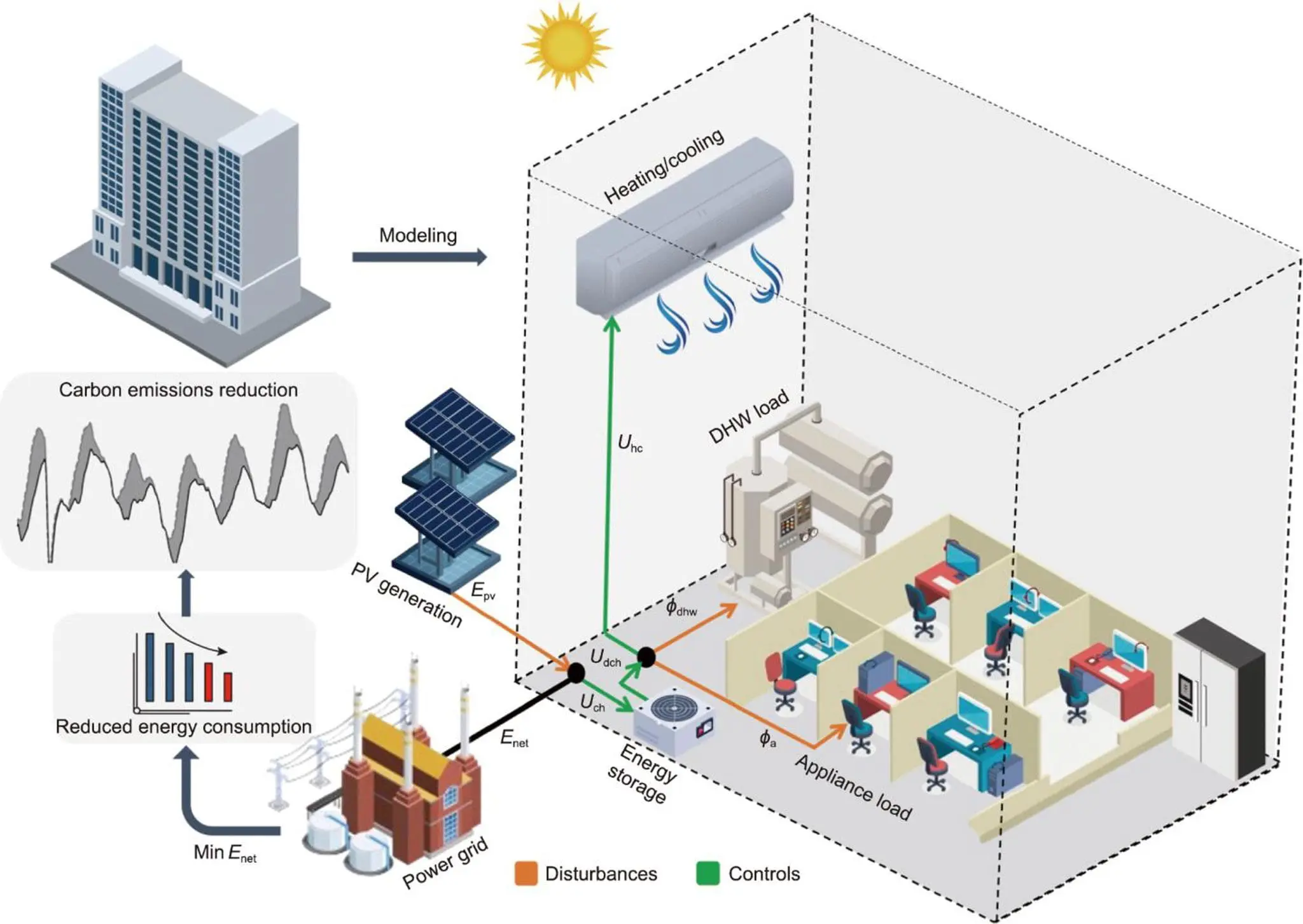
A study published in Engineering on February 13, 2025, by Akshay Ajagekar and Fengqi You from Cornell University presents an adaptive quantum approximate optimization-based model predictive control (MPC) strategy for building energy management. This approach integrates quantum computing with renewable energy systems to improve efficiency and reduce emissions. The researchers tested their method on two buildings at Cornell, achieving a 6.8% increase in energy efficiency and a 41.2% annual reduction in carbon emissions compared to traditional MPC methods. While the strategy demonstrates adaptability to environmental changes, it also highlights limitations related to system complexity and uncertainty handling.
The study by Akshay Ajagekar and Fengqi You from Cornell University introduces a novel approach that integrates quantum computing with model predictive control (MPC) to enhance energy efficiency in buildings. This strategy aims to address the significant role of buildings as major energy consumers and contributors to greenhouse gas emissions.
At the core of their research is an adaptive quantum approximate optimization algorithm (QAOA), which employs a learning-based parameter transfer scheme. By utilizing Bayesian optimization and Gaussian processes, the researchers predict initial quantum circuit parameters, thereby reducing computational demands and enabling adaptability to changing conditions.
The results demonstrate notable improvements in energy efficiency, with a 6
The results demonstrate notable improvements in energy efficiency, with a 6.8% enhancement over deterministic MPC methods and an annual reduction of 41.2% in carbon emissions. This underscores the effectiveness of their approach compared to traditional and alternative quantum strategies.
Additionally, the strategy exhibits strong adaptability by adjusting heating and cooling loads in response to temperature fluctuations, ensuring indoor comfort while optimizing energy use. This capability highlights its potential for real-world applications where environmental conditions vary dynamically.
In terms of computational efficiency, the learning-based QAOA initially requires more iterations but rapidly improves, outperforming quantum annealing as the system evolves. This indicates a promising trajectory for practical implementation despite initial challenges.
The researchers tested their strategy on two buildings at Cornell University, comparing it against deterministic MPC and quantum annealing. Their results demonstrated a 6.8% improvement in energy efficiency compared to deterministic MPC and a 41.2% annual reduction in carbon emissions. This comparison highlights the effectiveness of their approach against traditional and alternative quantum strategies.
The study identifies several limitations in its current implementation. The building energy model used is relatively simple, which may not fully capture the complexities of real-world systems. This simplicity could limit the strategy’s scalability when applied to more intricate or larger-scale buildings. Additionally, the absence of uncertainty quantification in the model could affect its reliability under varying and unpredictable conditions.
Looking ahead, the researchers propose several directions for future work
Looking ahead, the researchers propose several directions for future work. They aim to integrate real-time carbon intensity metrics into their framework to better align energy use with low-carbon power sources. Expanding testing across diverse building types and locations is another priority, as this would provide a more comprehensive understanding of the strategy’s applicability. Addressing complex control scenarios involving multiple objectives or constraints is also identified as a key area for development. Finally, refining quantum algorithms to enhance performance and practicality remains an important focus for improving the overall system.
External Link: Click Here For More


