

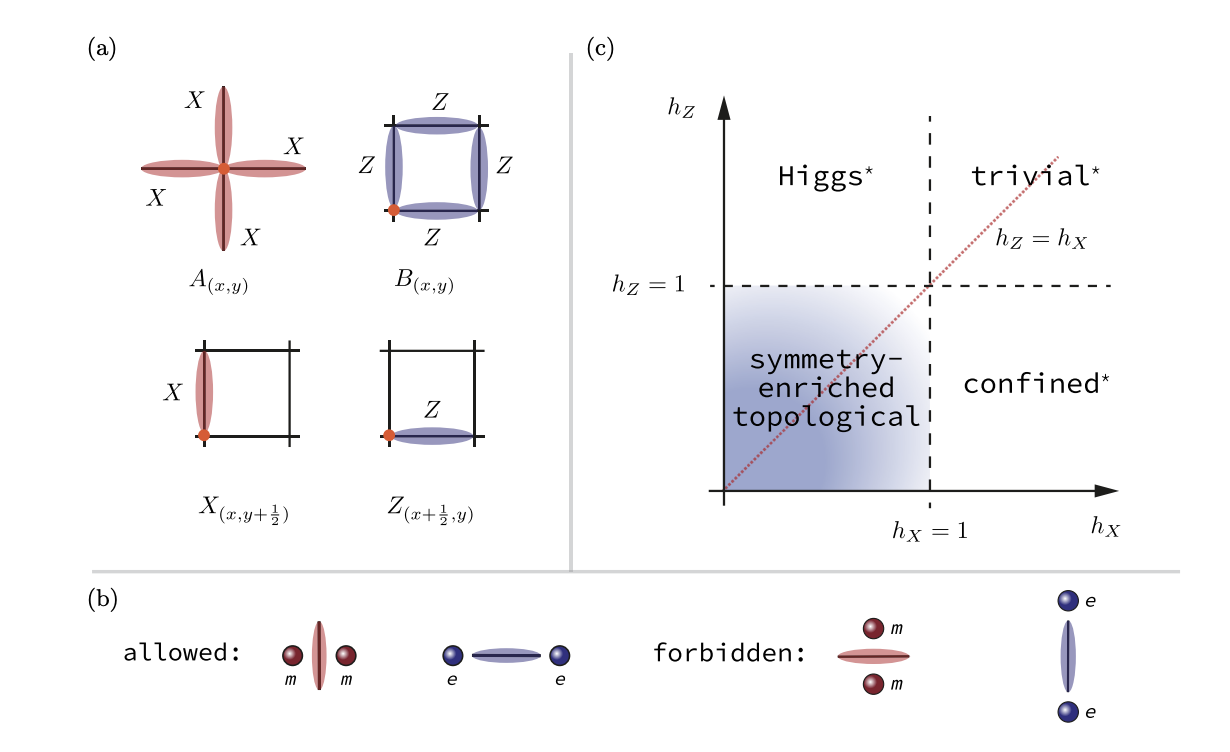
The quest for a practical quantum computer took a leap forward with the discovery of novel topological phases of matter uniquely suited for measurement-based quantum computation (MBQC), a promising architecture where calculations are performed through strategic measurements on an entangled quantum state. Researchers have identified new materials exhibiting “symmetry-enriched” topological order, expanding beyond previously known limitations and opening doors to more robust and powerful quantum processing. This breakthrough, published in PRX Quantum, demonstrates that these phases possess the necessary properties to serve as universal computational resources, potentially simplifying the creation of stable and scalable quantum computers by leveraging inherent material properties for computation.
Symmetry-Enriched Topological Phases
Recent research has unveiled a new framework for understanding measurement-based quantum computation (MBQC) through the lens of “symmetry-enriched topological phases,” expanding beyond previously studied short-range entangled systems. These phases, exhibiting both topological order and specific symmetries, offer promising resources for MBQC due to the protective nature of those symmetries on their computational power. Researchers have demonstrated this framework with examples like the toric code in an anisotropic magnetic field and, more significantly, a novel model possessing universal capabilities for MBQC. This advancement is crucial because a complete classification of resource states for MBQC remains elusive, and understanding the connection between physical properties—like topological order—and computational power is a key challenge. By analyzing phases enriched with subsystem symmetries, scientists are broadening the range of physical models considered viable for quantum computation and gaining insight into the fundamental nature of MBQC resource states.
MBQC Resource State Analysis
Recent research has introduced a new framework for analyzing resource states used in measurement-based quantum computation (MBQC), expanding beyond limitations previously confined to short-range entangled phases in one dimension. This work, detailed in PRX Quantum, demonstrates that certain topological phases of matter can support uniform power for MBQC, leveraging subsystem symmetries to protect computational ability. Specifically, the researchers analyzed the toric code model in an anisotropic magnetic field, finding it a non-computationally universal application of their framework, and then presented a novel model exhibiting ground states that are universal resources for MBQC. Importantly, this approach moves beyond existing classifications of MBQC resource states—like cluster or AKLT states—by connecting computational power to the underlying “physical order” of condensed matter systems, potentially offering a pathway toward a more complete understanding of how entanglement enables quantum computation.
Framework for Computational Properties
A new framework for analyzing the computational properties of quantum phases of matter is presented, expanding beyond limitations previously restricted to short-range entangled phases in one dimension. This advancement allows researchers to explore a wider range of physical models for potential computational applications, specifically within the realm of measurement-based quantum computation (MBQC). The researchers demonstrate this framework’s applicability using the toric code in an anisotropic magnetic field, though they note this yields a non-universal computational resource. More significantly, they introduce a novel model exhibiting topological order, whose ground states are universal resources for MBQC, protected by subsystem symmetries. This connection between topological phases and MBQC resource states represents a crucial step toward a more complete classification of these resources and a deeper understanding of the underlying principles governing their computational power.


