The increasing complexity of quantum algorithms demands a shift from single quantum processors to interconnected systems resembling modern data centres, but building and testing these quantum data centres presents a formidable challenge. Seyed Navid Elyasi, Seyed Morteza Ahmadian, Paolo Monti, and colleagues at Chalmers University of Technology, along with Jun Li and Rui Lin, address this problem by introducing a framework that emulates a full quantum data centre using a single quantum processor. This innovative approach partitions a processor’s connections to simulate multiple interconnected quantum processing units, and crucially, incorporates a realistic model of the noise that arises from communication between these units. By successfully implementing complex algorithms like Grover’s search and the Quantum Fourier Transform within this emulation, the researchers demonstrate the feasibility of distributed quantum computation and provide a valuable tool for validating future quantum data centre designs without the need for expensive, specialised hardware. The framework’s accuracy is further confirmed by its alignment with experimental results from interconnected ion-trap quantum processors, paving the way for more complex and scalable quantum computing architectures.
Grover’s Algorithm Runs Over Optical Fiber
This research details a significant advancement in distributed quantum computing, successfully implementing a quantum computation across a live optical network. This bridges the gap between theoretical proposals and practical realization, paving the way for more powerful quantum computers. The core achievement involves executing a simplified version of Grover’s search algorithm by distributing the computation across two quantum processors connected by a 40km optical fiber link. The system utilizes a hybrid approach, combining quantum processors with classical control and communication infrastructure, essential for coordinating distributed quantum computation.
A key challenge addressed is the distribution of entanglement, a fundamental quantum resource, across the optical link. Researchers employed techniques to generate and maintain entanglement despite the losses and noise inherent in long-distance fiber optic communication. To combat these effects, the team implemented a collision model, borrowed from open quantum systems theory, to simulate noise and mitigate errors during the computation. This innovative approach offers a novel method for error mitigation in distributed quantum systems. The experiment was conducted over a live optical network, demonstrating the feasibility of integrating quantum computing with existing communication infrastructure. Implementing Grover’s algorithm served as a benchmark for evaluating the performance of the distributed system. This work demonstrates a pathway towards building larger, more powerful quantum computers by networking smaller quantum processing units and represents a crucial step towards realizing a quantum internet, where quantum information can be securely transmitted and processed across long distances.
Emulating Distributed Quantum Computing with Virtual QPUs
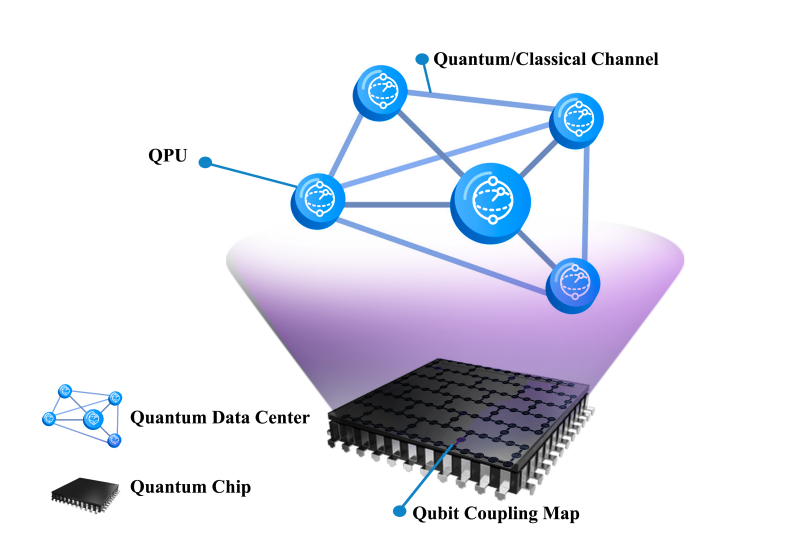
Researchers developed a novel emulation framework to investigate Quantum Data Centers (QDCs) and distributed quantum computing. This addresses the limitations of single-chip quantum processors and the challenges of interconnecting multiple quantum processing units (QPUs). The team engineered a system that emulates a network of interconnected QPUs using a single quantum processor, partitioning its existing qubit coupling map into multiple logically distinct virtual QPUs. This allows scientists to study distributed algorithms without the need for specialized interconnect hardware or complex physical setups.
The method involves simulating quantum communication channels between these virtual QPUs, effectively mimicking the behavior of noisy quantum links found in real-world QDC architectures. To accurately represent communication noise, scientists implemented a quantum collision model, quantifying the impact of interconnects on quantum information transfer. This model accounts for the degradation of quantum states during transmission, providing a realistic representation of communication fidelity. Furthermore, the emulation results of Grover’s algorithm align with experimental implementations achieved between two ion-trapped QPUs connected by optical fiber, confirming the accuracy and feasibility of the framework. By providing a versatile and accessible testbed, this emulation framework enables researchers to benchmark and validate distributed quantum algorithms on physical quantum devices, bridging the gap between theoretical simulations and practical implementations.
Emulating Quantum Data Centers with Realistic Noise
Researchers have developed a framework to emulate distributed quantum computing systems, addressing a key challenge in scaling quantum processors beyond the limitations of single chips. The team successfully partitioned a quantum processing unit (QPU) into multiple logical QPUs, creating a simulated data center environment for quantum information processing. This emulation allows investigation of distributed quantum algorithms without requiring specialized hardware, offering a versatile tool for exploring quantum data center (QDC) behavior. The core of this work lies in a novel noise model, termed the Collisional Model (CM), which accurately simulates the impact of communication-induced noise on entangled qubits connecting different QPUs.
By discretizing the communication environment, such as optical fibers, into sequential segments, the CM captures the degradation of entanglement fidelity over distance. This model was integrated into the emulation framework, demonstrating the realistic impact of noise on remote gate operations, essential for distributed algorithms. Experiments revealed successful execution of remote gates under these noisy conditions, validating the accuracy of the simulation. Notably, the emulation results of Grover’s algorithm align with experimental data obtained from interconnected ion-trapped QPUs using optical fiber, confirming the framework’s accuracy and predictive power. This work provides a practical method for validating distributed protocols and offers a crucial step towards realizing scalable, modular quantum computers.
Emulating Distributed Quantum Data Centers Realistically
This work introduces a framework for emulating Quantum Data Centers (QDCs) using existing digital quantum computing hardware. By logically partitioning a single processor into multiple virtual quantum processing units (QPUs), and incorporating a noise model based on collision dynamics, the researchers created a platform to explore distributed quantum computation under realistic conditions. The framework successfully emulates essential components of distributed architectures, including the generation of entangled resources, without requiring specialized interconnect hardware. The authors acknowledge that the emulation, while demonstrating feasibility, does not fully capture all complexities of a real QDC, and further refinement of the noise model is needed. Future work will focus on expanding the framework to investigate more complex quantum algorithms and architectural designs, ultimately supporting the development and benchmarking of scalable QDC architectures.
🗞 A Framework for Quantum Data Center Emulation Using Digital Quantum Computers
🧠 ArXiv: https://arxiv.org/abs/2509.04029