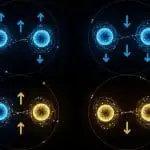
The shift from classical supercomputers to quantum computers is justified, according to Prof Artur Ekert from Oxford University and the National University of Singapore. He explains that classical and quantum computers are fundamentally different, with the latter offering new ways to process information due to our improved understanding of quantum mechanics. The concept of a bit has also evolved in quantum computing, with quantum bits or qubits able to exist in multiple states simultaneously, allowing for higher volumes of information processing. Prof Ekert’s research has been instrumental in advocating for this shift towards quantum computing.
Is the Shift from Classical Supercomputers to Quantum Computers Justified?
The world of computing has seen a significant shift in focus from conventional supercomputers to quantum computers in recent years. This shift has raised questions about whether the emphasis on quantum physics is warranted or if it is predominantly a PR strategy. According to Prof Artur Ekert from the Mathematical Institute at Oxford University and the National University of Singapore, the shift is justified. He explains that classical supercomputers and quantum computers are fundamentally different entities.
Classical computation theory, as developed by pioneers like Alan Turing, does not usually refer to physics. It is often falsely assumed that its foundations are self-evident and purely abstract. However, Prof Ekert argues that this is not the case. The concepts of information and computation can only be properly formulated in the context of a physical theory. Information is always stored, transmitted, and processed by physical means, and there is no computation that isn’t a physical process.
The shift towards quantum computing is also driven by our better understanding of the laws of nature that govern the microworld of quantum mechanics. The discovery of new phenomena in physics naturally opens up new possibilities for processing information. Until the early twentieth century, classical physics underpinned the computational machines that were developed. However, with the advent of quantum mechanics, new inherently quantum phenomena were discovered. These newly mastered phenomena can now be utilized to process information in new, unconventional ways.
Has the Concept of a Bit Changed in Quantum Computing?
In the realm of quantum computing, the traditional concept of a bit has undergone a transformation. From a physicist’s perspective, traditionally, a bit is any physical system that can be placed in one of two states, conventionally labeled zero or one. Regardless of the technology used, it always involves a physical process that allows the bit’s value to be toggled.
However, in the context of quantum computing, this traditional concept of a bit is expanded. Quantum bits, or qubits, can exist in multiple states at once, thanks to a property known as superposition. This allows quantum computers to process a higher volume of information compared to classical computers.
Furthermore, qubits can also be entangled, a unique quantum phenomenon where the state of one qubit becomes directly related to the state of another, no matter the distance between them. This property is expected to play a crucial role in future quantum communication and cryptography technologies.
Who is Prof Artur Ekert and What is His Role in Quantum Computing?
Prof Artur Ekert is a Polish-British theoretical physicist, a graduate of the Jagiellonian University and Oxford University. He is a Professor of quantum physics at the Mathematical Institute of Oxford University and the Lee Kong Chian Centennial Professor at the National University of Singapore. His research interests focus on information processing in quantum mechanics.
Prof Ekert has made significant contributions to the field of quantum computing. His work has helped to advance our understanding of quantum mechanics and its potential applications in information processing. He has been instrumental in explaining the fundamental differences between classical and quantum computing and advocating for the shift towards quantum computing.
His research has also shed light on the potential of quantum phenomena to process information in new and unconventional ways. This has opened up new possibilities for the development of quantum computers and has contributed to the ongoing shift in focus from classical supercomputers to quantum computers.
Publication details: “The Quest for Qubits”
Publication Date: 2024-05-21
Authors: Artur Ekert
Source: Academia
DOI: https://doi.org/10.24425/academiapas.2024.150226