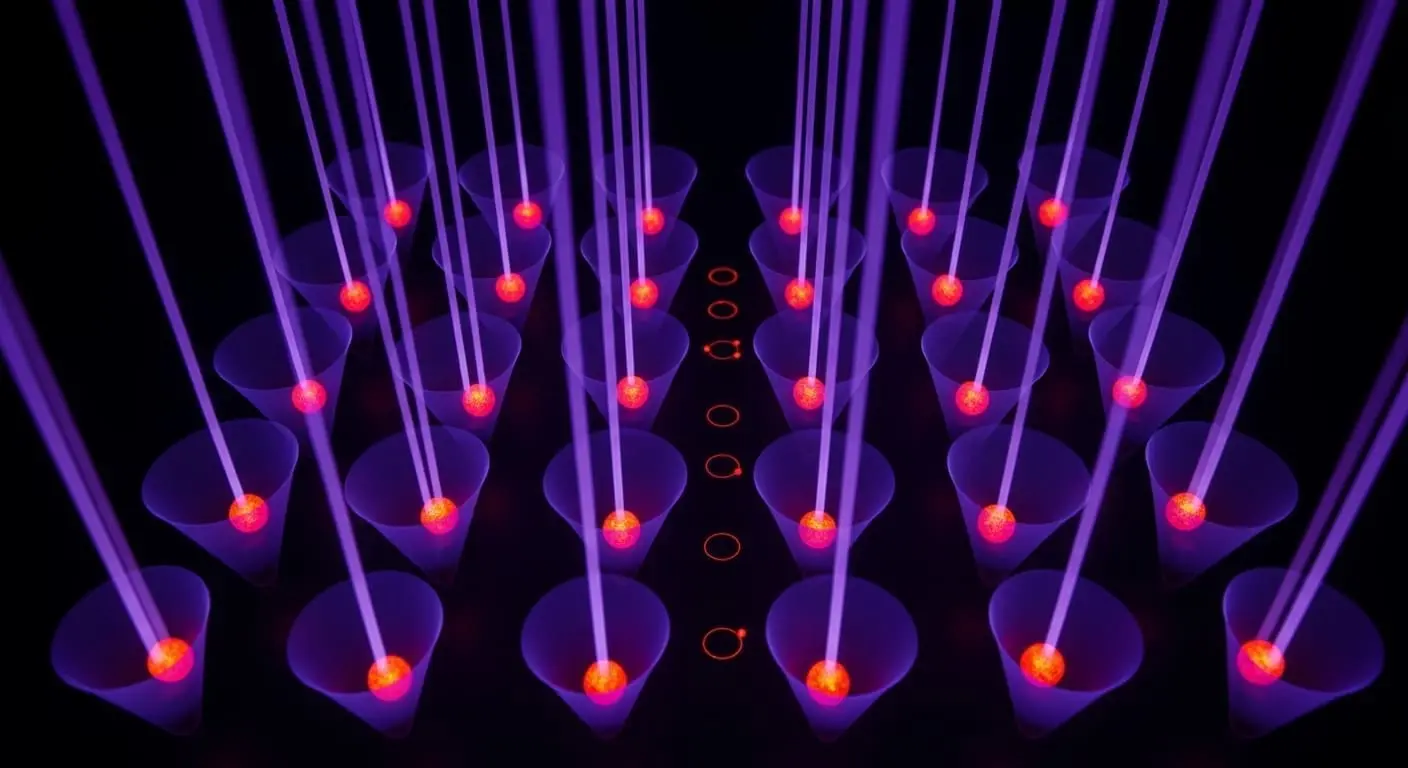
A new phase-stable approach to dynamically updating holograms used to control Rydberg atom arrays has been presented by Erdong Huang and colleagues at The Hong Kong University. The method uses a weighted-projective Gerchberg, Saxton algorithm and suppresses destructive interference and trap loss during hologram refreshes, a common issue hindering scalability. Numerical simulations involving arrays exceeding $10^$3 traps and complex 2D/3D manipulations demonstrate strong performance and accelerated hologram generation. Establishing inter-frame phase continuity is a key principle for advancing dynamic holographic control.
Weighted-projective Gerchberg-Saxton accelerates large neutral atom array reconfiguration through
Numerical simulations now reveal a greater than 50% reduction in hologram update times when using the weighted-projective Gerchberg, Saxton (WPGS) algorithm compared to conventional methods. This acceleration unlocks dynamic reconfiguration of neutral atom arrays exceeding $10^$3 traps, a threshold previously limited by transient instability and trap loss during spatial-light-modulator refresh. The WPGS algorithm enforces inter-frame trap-phase continuity, a key principle ensuring smooth transitions between hologram updates and suppressing destructive interference. The significance of this improvement lies in the potential to create more complex and rapidly changing quantum simulations and computations, as the speed of reconfiguration directly impacts the achievable complexity of quantum algorithms.
Simulations utilising 2D and 3D configurations, including complex multilayer assemblies and interlayer transport, demonstrated strong transient intensities, particularly within arrays containing over $10^$3 traps. The Gerchberg-Saxton (GS) algorithm, a foundational iterative method for phase retrieval, typically suffers from phase discontinuities when updating holograms, leading to unwanted light scattering and atom loss. The WPGS algorithm addresses this by incorporating a weighting function that prioritises maintaining phase consistency between successive iterations. This weighting scheme effectively ‘smooths’ the phase transitions, minimising disruptive interference. Analysis of the phase-difference distribution between consecutive holograms provides a diagnostic tool to assess the stability of these transient states, revealing a clear correlation between phase continuity and durability. Specifically, a lower standard deviation in the phase difference indicates a more stable transition and reduced risk of trap loss. While this advance demonstrates a major improvement in scalability and speed, it does not yet account for imperfections inherent in real-world spatial light modulators or the complexities of atom loading, leaving a substantial gap before practical implementation in a quantum computer. These real-world limitations include pixelation effects, limited dynamic range, and non-uniformity in the spatial light modulator’s response, all of which can introduce additional phase errors.
Scalable neutral-atom array reconfiguration for quantum computing applications relies on phase stability, alongside weighted intensity equalization. A phase-stable approach to hologram updates, the weighted-projective Gerchberg, Saxton (WPGS) algorithm, suppresses refresh-induced degradation during large-scale Rydberg atom-array reconfiguration. Maintaining weighted intensity equalization alongside inter-frame trap-phase continuity improves transient intensities, and the phase-difference distribution between holograms serves as a diagnostic of transient durability. Reducing the number of iterations needed to generate each hologram accelerates the process, and simulations of 2D and 3D reconfiguration with over $10^$3 traps demonstrate faster updates than conventional methods, establishing inter-frame phase continuity as a practical design principle for dynamic holographic control. The Rydberg atom arrays are created by trapping individual atoms with highly focused laser beams, and the WPGS algorithm ensures that these beams remain stable during reconfiguration. The weighting function within the WPGS algorithm is crucial; it assigns higher importance to maintaining the phase of the hologram in regions where the laser beams are most critical for trapping the atoms, further enhancing stability. Furthermore, the algorithm’s efficiency stems from its ability to converge on a stable solution with fewer iterations than traditional methods, reducing computational overhead and enabling faster reconfiguration cycles.
Enhanced atom array stability facilitates scalable quantum computation
Researchers at The Hong Kong University have engineered a significant improvement in controlling arrays of neutral atoms, essential building blocks for future quantum computers. This new algorithm tackles a persistent problem: maintaining stable optical tweezers while dynamically rearranging these atom arrays. Achieving stable control over neutral atoms is fundamentally challenging, yet this demonstrably improves stability during dynamic rearrangement, a vital step towards building larger quantum processors. The ability to precisely control and manipulate these atoms is paramount, as their quantum states represent the qubits used to perform calculations.
Maintaining the integrity of large neutral atom arrays is vital for advancing quantum computing; these arrays, collections of atoms held in place by laser beams, require precise manipulation for complex calculations. The method refines how holograms, the blueprints for these laser beam arrangements, are updated during reconfiguration. By ensuring a smooth transition between hologram states and enforcing continuity of the light’s phase, a property describing the wave-like behaviour of light, the algorithm prevents disruptions that previously caused atoms to escape their designated positions. The phase of light dictates how the electromagnetic waves interfere with each other, and discontinuities in phase can lead to destructive interference, weakening the trapping potential and causing atoms to be lost from the array. The conventional GS algorithm often struggles to maintain this phase continuity, particularly when dealing with complex array geometries or rapid reconfiguration speeds. The WPGS algorithm, by prioritising phase stability, significantly reduces these disruptions, leading to more robust and reliable atom arrays. This is particularly important for implementing complex quantum algorithms that require frequent and precise manipulation of the atoms.
The implications of this work extend beyond simply increasing the size of atom arrays. The ability to dynamically reconfigure arrays with high speed and stability opens up new possibilities for exploring novel quantum algorithms and architectures. For example, it could enable the creation of dynamically reconfigurable quantum simulators, where the arrangement of atoms is tailored to mimic the behaviour of complex physical systems. Furthermore, the improved stability of the atom arrays could lead to longer coherence times, which are crucial for performing complex quantum computations. Coherence refers to the ability of a qubit to maintain its quantum state, and longer coherence times allow for more operations to be performed before the qubit loses its information. The researchers are now focusing on implementing the WPGS algorithm on a real spatial light modulator and integrating it with a fully functional neutral atom quantum computing platform, paving the way for practical applications in the field of quantum information science.
The researchers developed a new algorithm, weighted-projective Gerchberg, Saxton, which improves the stability of large-scale Rydberg atom arrays during reconfiguration. By maintaining continuity in the phase of the light used to trap over 1000 atoms, the method suppresses disruptions that previously caused atoms to be lost from the array. This ensures more reliable control and faster updates compared to conventional hologram generation techniques. The team is now working to implement this algorithm on physical hardware to further advance neutral atom quantum computing platforms.
👉 More information
🗞 Phase-Stable Hologram Updates for Large-Scale Neutral-Atom Array Reconfiguration
🧠 ArXiv: https://arxiv.org/abs/2604.04600